The tarjeta sanitaria is the single document that turns your legal right to Spanish healthcare into something you can actually use. Without it you have a right on paper; with it you have a named family doctor, a health centre, an electronic prescription record, and access to specialists. Almost everything written about it in English makes the process sound like a bureaucratic ordeal. It is not. Having done it, the honest answer is that the paperwork takes about five minutes and the only real variable is how long the queue is on the day you turn up.
This guide covers who has the right, what to bring, what actually happens at the desk, and a change to the law from March 2026 that has barely been reported outside Spain.
What the card is, and what it is not
It is not an insurance policy and it is not proof that you have paid for anything. It is your personal identifier inside the Sistema Nacional de Salud: the number that links you to your clinical history, your assigned health centre, your prescriptions and your appointments.
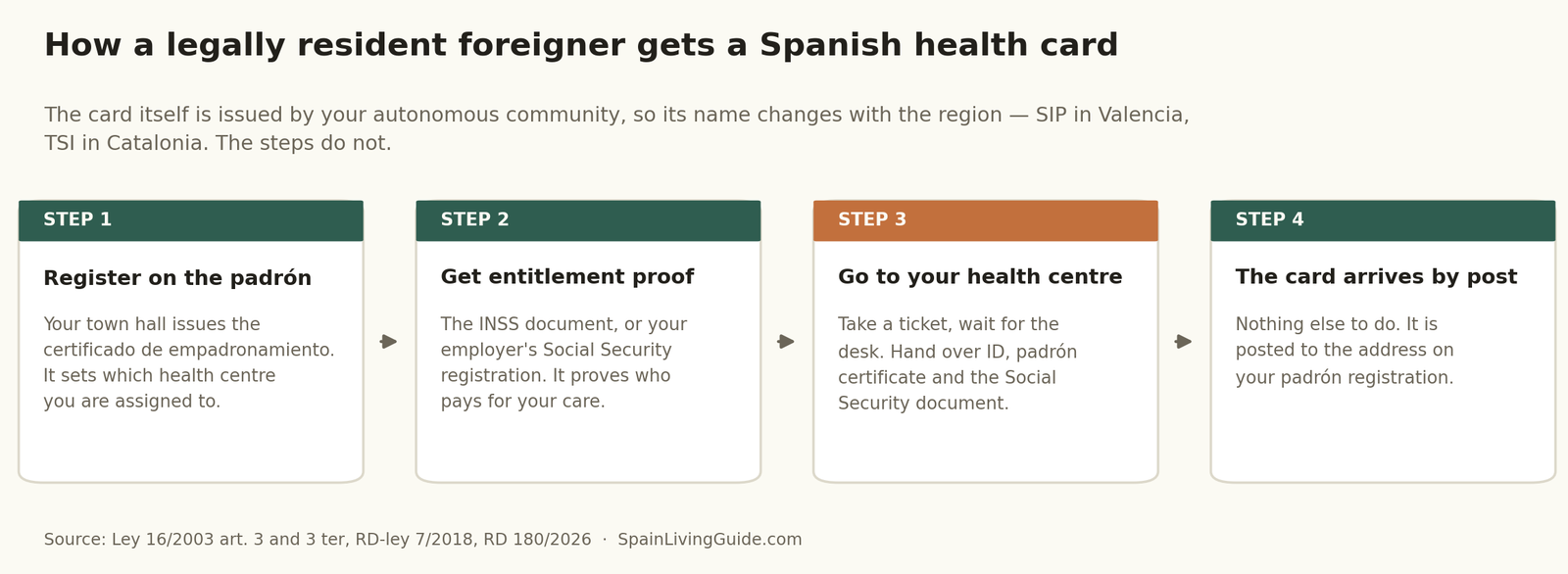
Healthcare in Spain is run by the seventeen autonomous communities, so the card is issued regionally and its name changes accordingly. In the Comunitat Valenciana it is the SIP. In Catalonia it is the TSI. Elsewhere it is simply the tarjeta sanitaria individual. The card travels with you across Spain for urgent care, but your assigned doctor and health centre belong to the region where you are registered, and moving region means registering again.
Who has the right to public healthcare
Spain restored residence-based universal access in 2018, after several years in which entitlement was tied to Social Security contributions. The governing framework is Law 16/2003 on the cohesion and quality of the National Health System, as amended, which grounds the right in habitual residence in Spain rather than in nationality or employment status.
In practice you will reach the system by one of these routes.
| Your situation | How entitlement arises |
|---|---|
| Employed in Spain | Through your employer’s Social Security registration. Cover starts from the date of registration, with no qualifying period. |
| Self-employed (autónomo) | Through your own registration and contributions in the RETA regime. |
| Spouse, partner or child of an insured person | As a beneficiary of the insured person, registered separately. |
| Pensioner from another EU or EEA state, or the UK | Through the S1 form, which makes your home country’s system pay for your care in Spain. |
| Legally resident but not working and not covered | Through the Convenio Especial, a paid monthly subscription to the public system, or through private insurance. |
| Resident in Spain without legal residence status | Through the procedure now regulated by Royal Decree 180/2026, covered below. |
If you hold a residence permit that does not allow you to work, you are in the fifth row, and this matters more than people expect when they plan a move. Our guide to the Non-Lucrative Visa explains why compliant private insurance is a condition of that permit in the first place, and our comparison of public healthcare versus private insurance and the Convenio Especial sets out what the paid route into the public system actually costs. Pensioners arriving from abroad should read our guide to totalization of contributions across several countries, which explains the S1 mechanism in context.
What to take with you
- Your identity document. NIE or TIE for foreign residents, passport as a backup. Take the physical card, not a photocopy.
- Your certificado de empadronamiento. This is what determines which health centre you are assigned to, so it must show your current address. If you have not registered on the padrón yet, that is your first stop — see our guide to NIE, TIE and empadronamiento.
- Your Social Security entitlement document. Either the document issued by the INSS confirming your right to healthcare, or evidence of your registration through an employer. This is the piece people most often arrive without.
- Your S1 form instead of the above, if you are a pensioner whose home country pays.
Take originals and a photocopy of each. Nobody will refuse the originals, but having copies occasionally saves a second trip.
What actually happened when I registered
I want to describe this plainly, because the gap between how the process reads online and how it feels in the room is the whole point of this section.
You walk into your health centre. There is a ticket machine, the same as at the bank or the town hall: you take a number and you sit down. When your number appears you go to the administrative desk — not to a doctor, not to a separate office, just the front desk of the same building where you will later be treated. You hand over three things: your DNI or NIE, your certificado de empadronamiento, and the Social Security document. The person behind the desk types your details in, checks the documents, and that is the transaction.
The whole thing takes about five minutes once you are actually at the window. There is no interview, no appointment to book in advance, nothing to sign in triplicate. Some days later the card arrives in your letterbox at the address on your padrón registration. You do not go back to collect it and nobody calls you.
The honest caveat is that the time this takes depends almost entirely on the queue on the day you go, not on the procedure. A busy urban health centre on a Monday morning is a different experience from the same centre at eleven on a Thursday. That is the only real variable, and it is worth planning around rather than worrying about the paperwork itself.
Below is my own Valencian SIP card, with the identifying fields obscured. It is worth seeing the real thing rather than a stock photo, because the layout tells you where to find the number you will need for everything else.
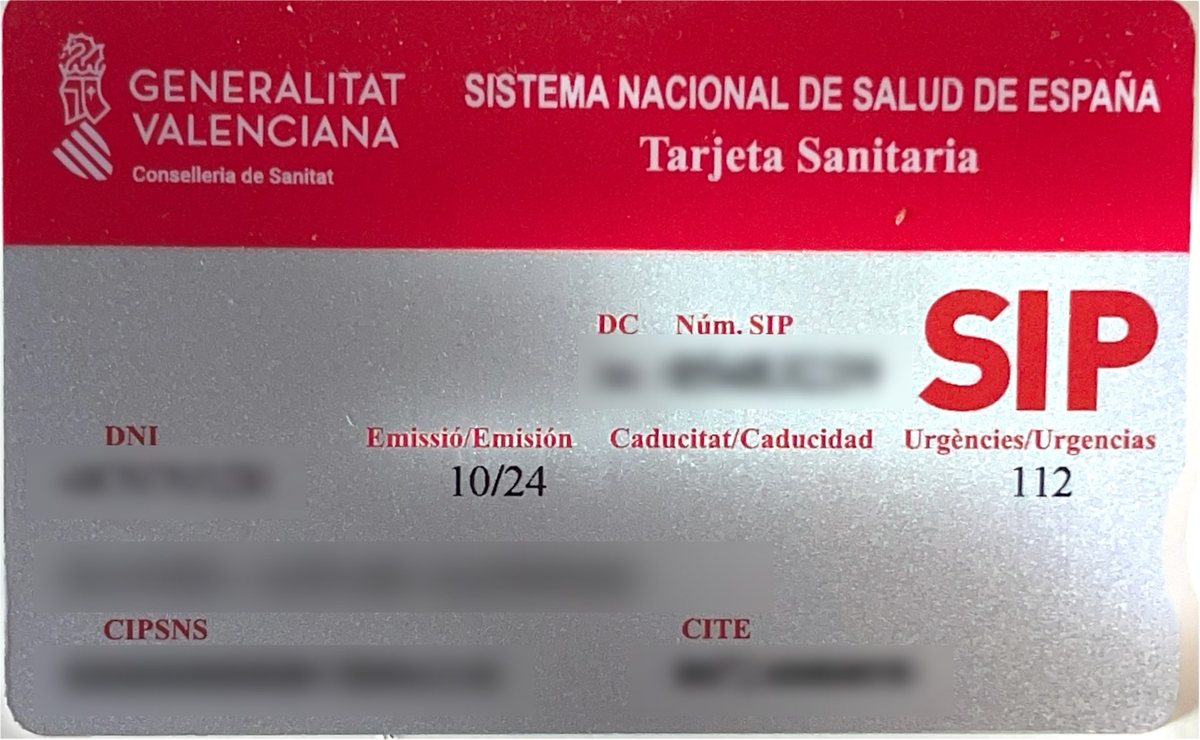
Note what is printed on it: the SIP number with its check digit, your DNI or NIE, the issue date, the CIPSNS code that identifies you across all of Spain rather than just your region, and — printed in the top right corner, which tells you something about Spanish priorities — the emergency number, 112.
Using the card: booking your first appointment
Once the card arrives you can book primary care appointments online, by phone, or at the same desk. The online route is the one most newcomers never find, and it is the one that saves the most time.
In the Comunitat Valenciana the booking assistant asks only for your SIP number and your date of birth — no certificate, no password, no registered account. This is the screen, and the small card diagrams on it exist precisely because so many people cannot find their own number:
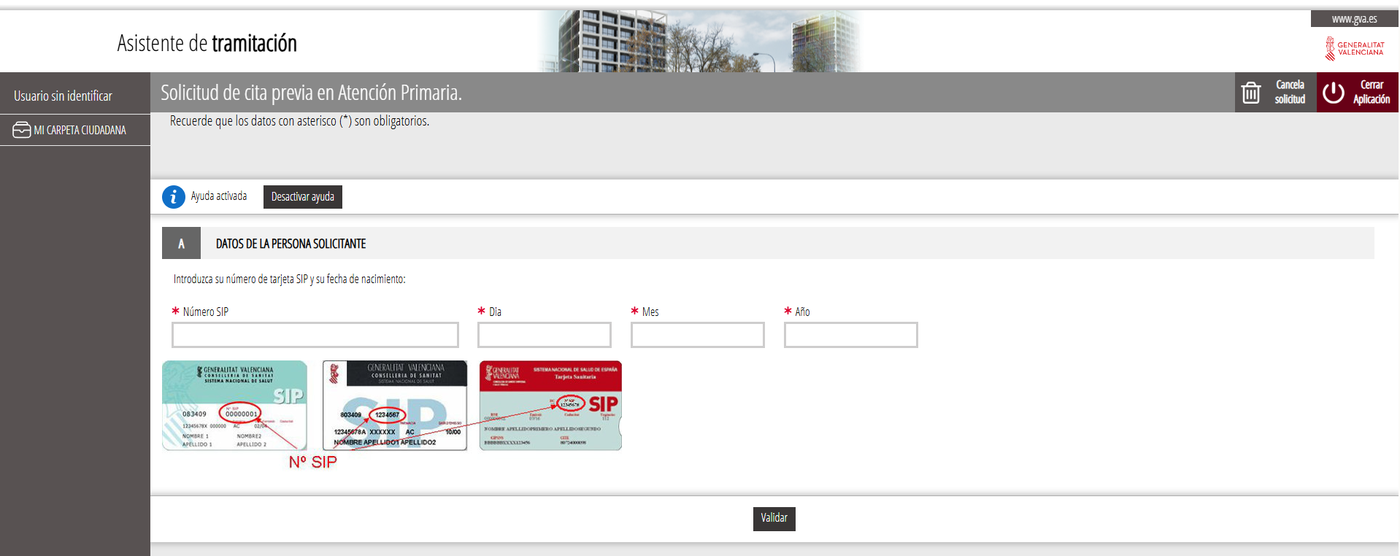
Every region runs its own equivalent under a different name and at a different address, but the pattern is the same: card number plus date of birth, and you are in. It is worth finding your region’s page and bookmarking it on the day your card arrives, rather than at the moment you actually need a doctor.
What changed in March 2026
Royal Decree 180/2026, approved on 11 March 2026, sets out a single nationwide procedure for recognising the right to publicly funded healthcare for foreign nationals in Spain who do not hold legal residence. Until then each autonomous community applied its own criteria, which produced refusals of care and improper charging in some territories and not in others. This is recent enough that most English-language guides have not caught up with it.
Three features of the new procedure are worth knowing even if you are here legally, because they show how the system now reasons about residence.
- The padrón is preferred but not indispensable. Where someone cannot produce a padrón certificate, the decree accepts alternative evidence of habitual residence: school enrolment certificates, social services reports, utility bills for electricity, gas, water, telephone or internet in the applicant’s name, and consular registration documents.
- Care starts immediately. On filing the application the person receives a provisional document that already gives access to healthcare, rather than waiting for a decision.
- Silence works in the applicant’s favour. If three months pass without a decision, the application is deemed granted and the card or entitlement document is issued.
The decree also assigns a common national identification code to people not registered as residents, so that clinical records follow the patient rather than the region, and it extends cover to Spaniards of origin living abroad during temporary stays in Spain.
What the card gets you
- A named family doctor or paediatrician at your assigned health centre, with unlimited consultations at no charge.
- Specialist care by referral, hospital treatment, surgery, maternity care and diagnostics, all without payment at the point of use.
- Emergency care at any hospital, anywhere in Spain, regardless of where you are registered.
- Prescriptions through the electronic system at the subsidised rate, which for most working-age residents is a percentage co-payment and for pensioners is considerably lower. Our guide to prescriptions and medications in Spain explains how transferring an existing prescription works.
- The European Health Insurance Card, issued on the basis of your Spanish entitlement, for travel elsewhere in the EU.
What it does not get you is adult dental care beyond extractions and emergencies, routine optical care, most psychology, and any choice of specialist or hospital. Those gaps are the reason a large share of Spanish residents also hold private cover, and they are the practical argument for holding both. Our comparison of health insurance requirements and what policies actually include is a useful reference if you are weighing that up.
What tends to go wrong
- Arriving without the Social Security document. Identity and padrón are the two people remember. The entitlement document is the one that sends you home.
- A padrón certificate with the wrong address. Your health centre is assigned from it, and so is the address the card is posted to. If you have moved, update the padrón first.
- Assuming the card will be handed over on the spot. It arrives by post. Ask at the desk whether you can be attended in the meantime — you generally can, since your registration exists in the system from the moment it is entered.
- Not registering children separately. Each family member needs their own card, including babies.
- Letting the card expire. There is an expiry date printed on it and renewal is not always automatic.
Frequently asked questions
Can I see a doctor before the card arrives?
In most cases yes, because your registration exists in the system as soon as the desk enters it, and the health centre can look you up. Ask at the desk when you register so you know where you stand. Emergency care is never conditional on holding the card.
Does the card work in another region?
For urgent and emergency care, yes, anywhere in Spain. For routine care with an assigned doctor, no — that belongs to the region where you are registered. If you move permanently, register again in the new region.
Do I need to speak Spanish at the health centre?
The registration itself is a document handover and needs very little language. Consultations are another matter, and English-speaking doctors are common in some coastal areas and rare elsewhere. It is worth asking at the desk whether any doctor at the centre speaks English before your doctor is assigned.
What if I am not entitled through work, family or a pension?
The Convenio Especial lets legally resident people without other entitlement subscribe to the public system for a monthly fee, subject to a minimum period of prior padrón registration that varies by region. It does not cover prescriptions at the subsidised rate, which is the detail most people miss.
Is the tarjeta sanitaria the same as the European Health Insurance Card?
No. The tarjeta sanitaria covers you in Spain; the EHIC covers necessary care during temporary stays in other EU and EEA countries. You request the EHIC separately, on the basis of the entitlement your Spanish card represents.
This article is general information, not medical or legal advice, and it describes administrative procedure rather than clinical care. Healthcare in Spain is administered regionally and requirements differ between autonomous communities, so confirm the detail with your own health service. The first-hand account and the card shown are the author’s own, in the Comunitat Valenciana, with identifying data obscured. Legal references were verified in August 2026 against Royal Decree 180/2026 of 11 March and the Ministry of Health’s announcement of the reform.
Leave a Reply