
Signing the deed on a Spanish home feels like the finish line, but it is really the starting line of a recurring set of obligations that catch many foreign owners off guard. The taxes you pay to buy a property, ITP or IVA and AJD, are one-off. The taxes you pay to own one arrive every single year, whether you rent the place out, live in it, or leave it empty, and one of them applies even to non-residents who never set foot in the property. This guide covers the full “after you buy” picture for 2026: the annual IBI, the surprising IRNR imputed-income tax for non-residents, the tasa de basura, and the plusvalía municipal that lands when you eventually sell, so nothing on the tax calendar takes you by surprise.
IBI: The Annual Property Tax Everyone Pays
The Impuesto sobre Bienes Inmuebles (IBI) is the Spanish equivalent of a council or property tax, and it is the one annual charge that every owner pays, resident or not. It is a municipal tax, collected by your town hall (or a regional collection body such as SUMA in Alicante, ATIB in the Balearics, or the provincial patronato in Málaga), and it funds local services.

IBI is calculated on your property’s valor catastral (cadastral value), an administrative value set by the Catastro that is typically well below market value. Each municipality then applies its own rate to that value, generally somewhere between 0.4% and 1.3% for urban property. Because the rate is set locally, two near-identical homes a few kilometres apart, but in different municipalities, can carry noticeably different IBI bills. The legal framework for IBI and the other local taxes in this guide is the consolidated Local Finances Law (Real Decreto Legislativo 2/2004).
Two practical points matter most. First, liability falls on whoever owns the property on 1 January of each year, so if you buy in March, the seller is technically the taxpayer for that year, though the Supreme Court allows buyer and seller to agree to apportion it by days (and in practice this is often negotiated at the point of sale). Second, payment dates vary by municipality, and most town halls only issue the bill once, so the single most reliable way to avoid a missed-payment surcharge is to set up a direct debit (domiciliación) from a Spanish bank account. Many municipalities also offer bonificaciones, discounts for direct debit, large families, or energy-efficient properties, that are easy to miss if you never check.
IRNR: The Tax That Surprises Non-Resident Owners
This is the obligation that catches out more foreign owners than any other, because it is genuinely counter-intuitive. If you own a Spanish property but are not a Spanish tax resident, you must file an annual Impuesto sobre la Renta de No Residentes (IRNR) return, and pay tax, even if the property sits empty and earns you nothing. Spain treats the mere availability of a second home as a taxable benefit, and levies tax on a notional “imputed income” (renta inmobiliaria imputada).
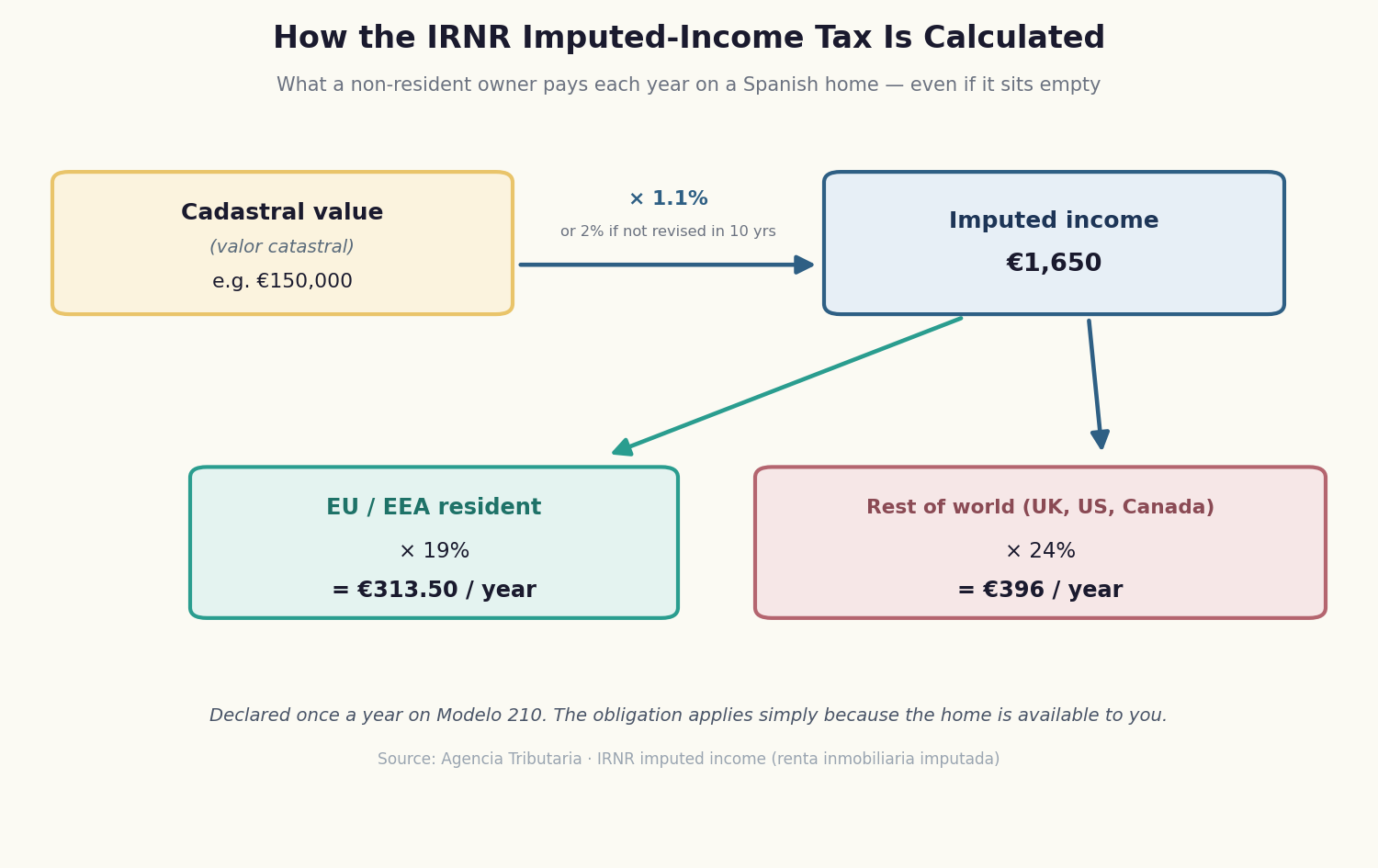
The calculation is mechanical. You take a percentage of the cadastral value, 1.1% if the value has been revised within the last ten years, or 2% if it has not, and that figure is your imputed income for the year. You then apply the non-resident tax rate to it: 19% for residents of the EU, Iceland, Norway, and Liechtenstein, or 24% for residents elsewhere (including, since Brexit, the United Kingdom, as well as the US and Canada). It is declared on Modelo 210, filed once a year, with the annual imputed-income return due by 31 December of the following year.
A worked example makes the scale clear. On a property with a cadastral value of €150,000 whose value was revised in the last decade, the imputed income is 1.1% × €150,000 = €1,650. A UK resident owner (24%) would owe €1,650 × 24% = €396 for the year; an EU-resident owner (19%) would owe €313.50. The amounts are modest, but the filing obligation is real, and Spain’s tax authority increasingly cross-checks ownership data, so simply not filing is not a safe option.
If you rent the property out instead of leaving it available, the imputed-income rules give way to actual rental taxation: EU/EEA residents pay 19% on net rental profit (after deductible expenses), while non-EU residents pay 24% on gross rent with no expense deductions, one of the starker post-Brexit disadvantages for British landlords. And if you are a Spanish tax resident, none of this IRNR machinery applies to you: your main home is exempt from imputed income, and any second home’s imputed income or rental income goes into your ordinary IRPF return instead.
The Tasa de Basura and Other Local Charges
Separate from IBI, most municipalities levy a tasa de recogida de residuos (waste-collection fee), and this deserves specific mention because it has become near-universal. Under Spain’s 2022 waste law transposing EU rules, municipalities are required to fund waste collection through a specific, non-deficit fee, which means many town halls that previously bundled the cost into IBI, or did not charge separately at all, have introduced or increased a standalone rubbish tax. The amount is usually modest (often a few tens to a couple of hundred euros a year) and varies widely by municipality.
Depending on where you live, you may also see charges for water and sewerage (often billed with your water supply), a vado licence if you have a private garage entrance, and community fees (gastos de comunidad) if the property is in a building or urbanisation with shared areas, though community fees are a private charge set by the owners’ association, not a tax. None of these are optional once they apply, so budget for them alongside IBI.
Wealth Tax: Only for Higher-Value Estates
Owning a Spanish property can also bring you within scope of Spain’s annual Impuesto sobre el Patrimonio (Wealth Tax), though only above significant thresholds. Non-residents are assessed only on their Spanish-situated assets (including the property), while residents are assessed on worldwide net wealth. There is generally a substantial exempt minimum (commonly €700,000, plus an additional allowance for a main residence), and the rules, rates, and regional bonifications vary enormously by autonomous community, with a separate state-level “solidarity” tax (ITSGF) targeting the largest estates. For most owners of a standard holiday home this will not bite, but higher-value buyers should plan for it deliberately; our guide to Spain’s Wealth Tax covers the thresholds and regional differences in detail.
Plusvalía Municipal: The Tax That Lands When You Sell
The plusvalía municipal, formally the Impuesto sobre el Incremento de Valor de los Terrenos de Naturaleza Urbana (IIVTNU), is a municipal tax on the increase in value of the land (not the building) between the date you acquired the property and the date you sell, inherit, or gift it. It is normally paid by the seller in a sale (or by the recipient in an inheritance or gift), and it is separate from, and additional to, the capital-gains tax on the profit itself.
This tax was overhauled after Spain’s Constitutional Court struck down its old calculation method in a landmark October 2021 ruling. The reform, enacted by Royal Decree-Law 26/2021, introduced two crucial changes that work in the taxpayer’s favour:
- No gain, no tax. If you sell for the same as or less than you paid (i.e. there is no real increase in land value), the transaction is not subject to the tax at all. You must still declare it and prove the absence of gain using the acquisition and transmission deeds, but you will not pay.
- Two calculation methods, and you choose the lower. You can calculate the taxable base either objectively (applying a coefficient set by the government to the land’s cadastral value, based on how many years you owned it) or on the real gain (the actual increase in the land’s value between purchase and sale). You are entitled to whichever produces the lower bill.
Two further points are worth flagging. The objective-method coefficients are revised annually through the national budget legislation, so the figure that applies to you depends on the table in force for the year of the transfer and on your municipality’s own rate; check both rather than relying on a coefficient quoted in any older guide. And the tax now also captures gains made in under a year of ownership, which the old system missed. The filing deadline is generally 30 working days from the sale (six months, extendable to a year, for inheritances), and it is declared to the town hall, not the Agencia Tributaria.
Because plusvalía also applies to lifetime gifts and inheritances, it forms part of the real cost of passing property to family. Our guides to Spain’s gift tax and to estate planning and wills in Spain set out how it stacks with the gift or inheritance tax itself and, for gifts, with the donor’s capital gains charge.
Your Annual Ownership Tax Calendar at a Glance
| Tax / charge | Who pays | When | Paid to |
|---|---|---|---|
| IBI | Owner on 1 January | Annually (date varies by town hall) | Town hall / regional body |
| IRNR (imputed income) | Non-resident owners | Annually, by 31 Dec of following year | Agencia Tributaria (Modelo 210) |
| Tasa de basura | Owner / occupier | Annually or per billing cycle | Town hall |
| Wealth Tax | Owners above the threshold | Annually (with the renta campaign) | Agencia Tributaria (Modelo 714) |
| Plusvalía municipal | Seller / recipient | On sale, inheritance, or gift | Town hall |
Frequently Asked Questions
I’m a non-resident and my Spanish flat is empty. Do I really owe tax on it?
Yes. The IRNR imputed-income tax applies precisely because the property is available to you, regardless of whether you use it or earn anything from it. You file Modelo 210 once a year and pay tax on 1.1% or 2% of the cadastral value at your applicable rate. This is the single most commonly overlooked obligation among non-resident owners.
Who pays the IBI if I buy or sell part-way through the year?
Legally, the person who owned the property on 1 January is liable for that whole year’s IBI. In practice, buyers and sellers frequently agree to split it proportionally for the days each owned the property, and the Supreme Court has confirmed this apportionment is valid, but it must be agreed between the parties; the town hall will still pursue the 1-January owner if it goes unpaid.
If I sell my property at a loss, do I still pay plusvalía municipal?
No. Since the 2021 reform, a sale with no increase in land value is not subject to the tax. You must still declare the transaction and evidence the absence of gain with your purchase and sale deeds, but no tax is due. If a gain does exist, you can choose whichever of the two calculation methods gives the lower bill.
Does becoming a Spanish tax resident change any of this?
Substantially. IBI, the tasa de basura, and plusvalía apply the same way regardless of your residence status, but the IRNR imputed-income regime is replaced entirely: your main home carries no imputed income at all, and any second property or rental income flows into your ordinary IRPF return instead. Residents are also assessed for Wealth Tax on worldwide net wealth rather than only on Spanish assets.
How does this connect to the taxes I paid when buying?
The purchase taxes (ITP or IVA plus AJD) are entirely separate one-off costs paid at acquisition; the taxes in this guide are the recurring cost of ownership that follows. If you are still at the buying stage or want the full picture, our guide to property purchase taxes in Spain covers the upfront side of the equation.
Understanding these annual obligations before you buy is part of budgeting realistically for life in Spain. For the wider financial and practical picture, see our overview of how to move to Spain in 2026.
This article is for general informational purposes only and does not constitute legal, tax, or financial advice. Property tax rates, cadastral values, imputed-income percentages, plusvalía coefficients, and local charges change frequently and depend on your specific municipality, autonomous community, tax-residence status, and individual circumstances. Before relying on any figure here, confirm the current rules with your town hall and the Agencia Tributaria, and consult a qualified Spanish tax adviser (asesor fiscal) or gestor about your specific situation.
Leave a Reply