
The Non-Lucrative Visa is the quietest and most misunderstood route into Spain. It has no investment threshold, no job offer, no business plan and no language test. What it does have is a single, unforgiving trade-off that most guides bury in a footnote: it grants you the right to live in Spain on condition that you do not work, and in exchange for that right you almost certainly become a Spanish tax resident on worldwide income. People arrive focused on the visa and are ambushed a year later by the tax bill.
This guide covers the 2026 rules as they actually stand under the current immigration regulation, the exact amounts you must prove, the documents, the timeline, the renewal trap that catches people in year two, and the tax consequences nobody mentions at the consulate. Where a figure appears, it comes from the Ministry’s own published requirement sheets rather than from other guides.
What the Non-Lucrative Visa actually is
The formal name is autorización de residencia temporal no lucrativa. It authorises a non-EU national to live in Spain without carrying out any employment or professional activity, on the basis of their own resources. It is governed by Organic Law 4/2000 (articles 30 bis and 31) and by Royal Decree 1155/2024, the immigration regulation that replaced the 2011 rules and came into force on 20 May 2025. The non-lucrative provisions sit in articles 60 to 64.
Two structural points define everything else. First, you apply from your country of residence, at the Spanish consulate with jurisdiction over where you live — you cannot switch to it from inside Spain as a tourist. Second, the initial authorisation lasts one year, and its clock starts on the day you physically enter Spain, not on the day it was granted.
Who it suits, and who should look elsewhere
The NLV was designed for people who can support themselves without earning: retirees drawing a pension, people living off investment income or rent, and those with enough capital to fund several years without touching employment. It is also used, more awkwardly, by people in a career gap or by families where one partner has independent means.
It is the wrong route if you intend to keep working remotely for a foreign employer. That is a widespread and expensive misunderstanding. The prohibition covers professional activity in general, not merely employment with a Spanish company, and remote work performed from Spanish soil is work performed in Spain regardless of who pays you or where the client sits. Spain created a separate authorisation precisely for that profile, and applying for the wrong one wastes a year and a consular fee. If you are still earning, read our comparison of the Entrepreneur Visa and the Digital Nomad Visa before going any further, and our overview of the residency routes that remain after the Golden Visa closure.
How much money you actually need in 2026
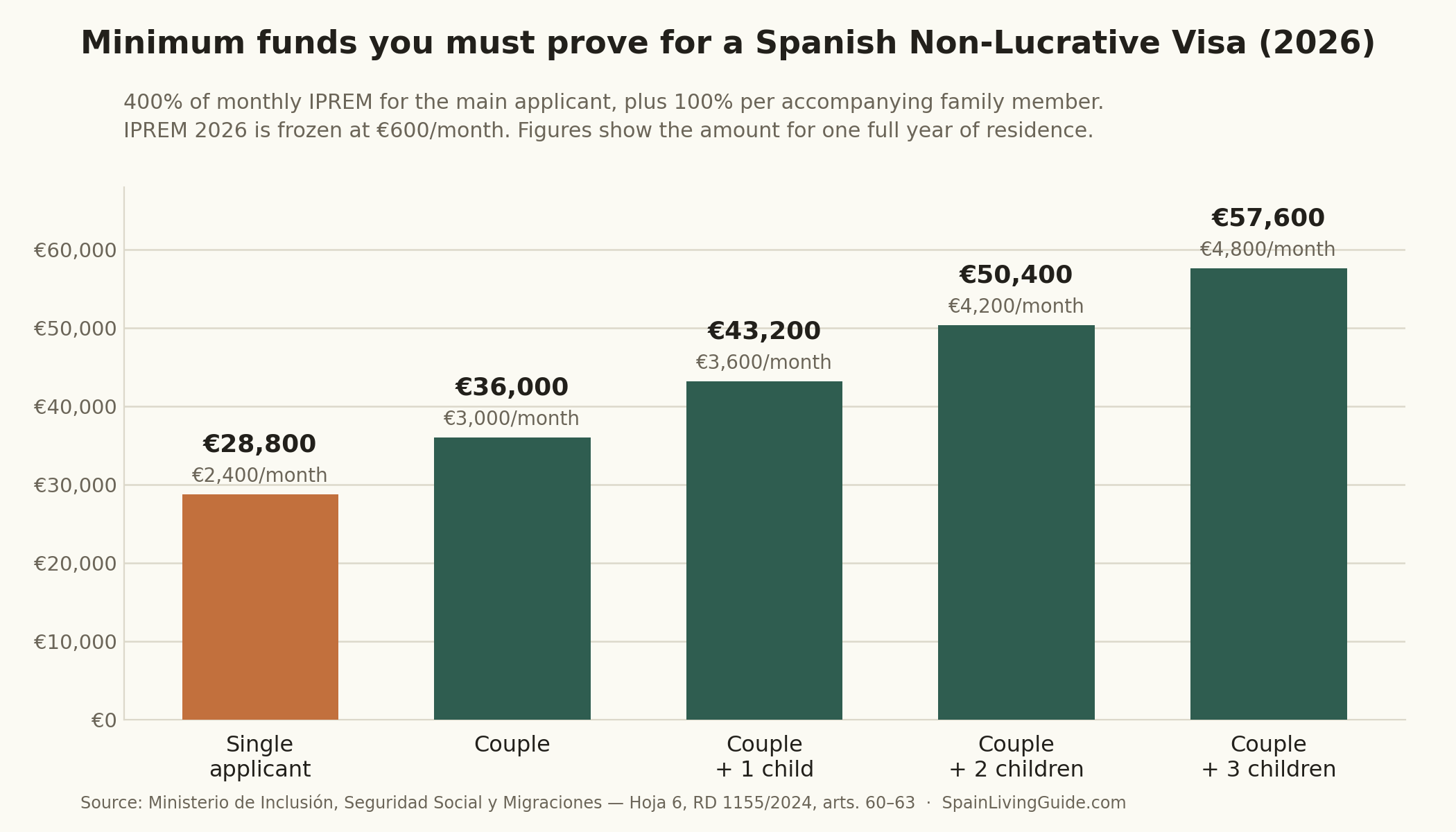
The requirement is expressed as a multiple of the IPREM, the public income index Spain uses as a reference in dozens of administrative thresholds. The Ministry states it monthly: 400% of the IPREM for the main applicant, and 100% of the IPREM for each accompanying family member, for the whole period of residence requested.
The IPREM is set by the annual Budget Act. Because the Budget has been rolled over rather than passed for several years running, the IPREM has been frozen since 2023 and remains at €600 per month in 2026. That gives a monthly requirement of €2,400 for the applicant and €600 per additional person.
| Household | Monthly requirement | For one year | Realistic amount to show |
|---|---|---|---|
| Single applicant | €2,400 | €28,800 | €34,000–36,000 |
| Couple | €3,000 | €36,000 | €43,000–45,000 |
| Couple + 1 child | €3,600 | €43,200 | €52,000–54,000 |
| Couple + 2 children | €4,200 | €50,400 | €60,000–63,000 |
| Couple + 3 children | €4,800 | €57,600 | €69,000–72,000 |
That fourth column deserves an explanation, because it is not in any regulation. The legal minimum is exactly that — a minimum, not a target. Consulates assess whether means are sufficient for the period requested, and they exercise judgement. An applicant sitting precisely on €28,800 with no cushion and no recurring income is demonstrably one bad month away from falling below the threshold. Applications at the bare minimum are refused more often than applications with a visible margin of twenty to twenty-five per cent, which is why practitioners routinely advise showing more than the letter of the rule requires.
Non-Lucrative Visa funds calculator — 2026
Work out the minimum you must prove, and what we suggest showing instead.
How this is calculated
The Ministry of Inclusion, Social Security and Migration states the requirement monthly: 400% of the IPREM for the main applicant and 100% of the IPREM for each accompanying family member, for the whole period of residence requested. The IPREM is set by the annual Budget Act; because the Budget has been rolled over since 2023, the 2026 monthly IPREM remains €600. So the monthly figure is (4 × €600) + (number of family members × €600), multiplied by the number of months.
The +20% line is not a legal requirement. It reflects the margin that consulates in practice tend to expect, since an applicant with no cushion is more likely to be assessed as lacking sufficient means. Consulates exercise judgement and some apply their own reference figures.
Rates verified August 2026 against the Ministry requirement sheet for the initial non-lucrative residence authorisation (RD 1155/2024, arts. 60–63). Estimate only — not legal advice. Exchange rate is whatever you enter; we do not fetch live rates.
What counts as proof of means
The regulation is deliberately open: means may be proven by any admissible form of evidence, including title deeds, certified cheques or credit cards accompanied by a bank certificate stating the available credit. In practice consulates want to see two things — that the money exists, and that it is genuinely yours and liquid.
- Bank certificates issued by the bank itself, on letterhead, stating balances and ideally the average balance over the preceding six or twelve months. A screenshot of your banking app is not a certificate.
- Statements covering six to twelve months, which is where the money’s history becomes visible. A lump sum that appeared three weeks before the application invites questions about whether it was borrowed for the occasion.
- Recurring income evidence: pension award letters, annuity statements, dividend records, signed rental contracts with matching bank credits. Recurring income is viewed far more favourably than a static balance, because it renews itself.
- Property and investment holdings, which support the picture but rarely carry an application alone, since they are not liquid.
If your means come from shares or holdings in companies based in Spain, you must additionally certify that you carry out no work in them and provide a sworn declaration to that effect. Note also that funds held jointly with someone not included in the application are typically counted at your share only. Moving money to Spain before you have residency and a Spanish account has its own friction — our guide to banking in Spain as a foreign resident covers the sequencing problem.

Health insurance: the second most common reason for refusal
You must hold public or private health insurance arranged with an insurer authorised to operate in Spain. That last phrase is the one that trips people up. A travel policy, an international expatriate plan underwritten outside Spain, or an employer scheme from your home country will generally not qualify, however comprehensive it looks, because the insurer is not authorised in the Spanish market.
Beyond authorisation, consulates expect cover comparable to what the Spanish public system provides: full cover, no co-payments, no waiting periods, no annual cap, and validity for the whole period of residence. Policies sold specifically as compliant with Spanish immigration requirements exist for exactly this reason. The same standards apply to the Digital Nomad Visa, and we set out the detail in our guide to zero-copay health insurance requirements. For what happens after you arrive and whether you can eventually access the public system, see public healthcare versus private insurance and the Convenio Especial.
Criminal record and medical certificates
You need a criminal record certificate from your country of origin and from every country you have resided in during the previous five years. Applicants who have moved around underestimate this badly: three countries in five years means three certificates, each legalised or apostilled, each sworn-translated into Spanish, and each subject to its own issuing timetable. Start these first, not last.
The medical certificate must confirm that you do not suffer from any disease that could have serious public health consequences under the 2005 International Health Regulations. It is a short document, but consulates often require specific wording and a recent date, so check your consulate’s own template before paying for one.
Every foreign public document must be legalised by the Spanish consulate with jurisdiction where it was issued, or apostilled under the 1961 Hague Convention, and translated by a sworn translator. Ordinary certified translation is not sufficient.
The process, step by step
| Stage | What happens | Timing |
|---|---|---|
| 1. Gather documents | Criminal records, apostilles, sworn translations, medical certificate, insurance, financial evidence | 6–12 weeks |
| 2. Consular appointment | Submit form EX-01 in person at the consulate for your area; pay the fee | Booking backlogs vary widely |
| 3. Decision | Maximum one month from receipt of the consular file. Silence means refusal | Up to 1 month |
| 4. Collect the visa | You must collect it in person within one month of notification, or it lapses | 1 month deadline |
| 5. Enter Spain | Within the visa’s validity, which never exceeds three months | Up to 3 months |
| 6. Apply for your TIE | In person at the police station for your area, within one month of entry | 1 month deadline |
Two details in that table are worth pausing on. Stage 3 is the reverse of what most people assume about Spanish administration: on an initial non-lucrative application, if the deadline passes with no answer, the application is deemed rejected, not approved. And stages 4, 5 and 6 are each hard deadlines with no discretion — missing the one-month collection window means the file is closed and you start again.
The TIE at stage 6 is the physical residence card, and it is a separate procedure from the visa. If the alphabet soup of NIE, TIE and padrón is unfamiliar, our guide to NIE, TIE and empadronamiento explains the correct order — and it matters, because you will generally need to register on the padrón at your town hall before your police appointment, which in turn requires a rental contract or deeds. Read our guide to renting a home in Spain as a foreigner before signing anything remotely.
What it costs
| Item | Typical cost per person |
|---|---|
| Consular visa fee (varies by nationality and reciprocity) | €80–€140 |
| Residence authorisation fee — Modelo 790 código 052, item 2.1.1 | Around €16 |
| Criminal record certificates and apostilles | €30–€120 per country |
| Sworn translations | €40–€80 per document |
| Medical certificate | €40–€100 |
| Compliant health insurance | €600–€1,800 per year, rising sharply with age |
| TIE card fee and photographs | Around €25 |
| Immigration lawyer or gestor (optional) | €800–€2,500 per family |
Renewal, and the 183-day condition that catches people
The first authorisation runs for one year. Renewal is applied for from inside Spain, electronically, during the two months before expiry — or within three months after expiry, although that carries the risk of a penalty procedure. Filing on time extends the validity of your existing authorisation until a decision is made, so you are not left in limbo.
A renewed authorisation is valid for two years, not one and not four, unless you qualify by then for long-term residence. Some guides in English still state four years; that figure belongs to a different authorisation type.
To renew you must continue to hold sufficient means and health insurance, have any children of compulsory school age enrolled in school, and — this is the condition that surprises people — have actually resided in Spain for more than 183 days during the calendar year. The NLV is not a flexible base for someone who wants to spend half the year elsewhere. Physical presence is a renewal requirement in its own right, evidenced through padrón records, utility bills, school enrolment and travel history.
On renewal the silence rule flips in your favour: if three months pass with no notification, the application is deemed approved, and you can request a certificate confirming it. A positive report on your integration efforts from your autonomous community may also be taken into account.
The tax consequence nobody mentions at the consulate
Read the last two sections together and the implication is unavoidable. Renewal requires more than 183 days of physical residence in the calendar year. More than 183 days in Spanish territory makes you a Spanish tax resident. Complying with your immigration obligation therefore triggers your tax obligation, by design. There is no version of the NLV in which you live in Spain properly and remain outside the Spanish tax system.
Spanish tax residence means declaring worldwide income, not just Spanish-source income. For a retired couple that typically means pensions, investment income, and gains on assets held anywhere in the world. Three consequences follow that are worth understanding before you commit:
- Income tax. Your pension and investment income enters the Spanish system, with rates set partly by the state and partly by your autonomous community. See IRPF for foreign residents.
- Wealth tax. Spain still taxes net wealth annually, with allowances and rates that differ dramatically by region — and a state-level solidarity tax that can override regional relief. See wealth tax and solidarity tax.
- Foreign asset reporting. Assets held abroad above certain thresholds must be declared, with severe consequences for non-compliance.
None of this means the numbers work out badly — for many people they do not — but it must be modelled before you apply, not after. Which country taxes what is governed by the relevant double taxation treaty, covered in our guide to the US–Spain and UK–Spain treaties. If you are retiring, our guides to transferring and protecting pensions and wealth and to totalization of contributions across several countries deal with the specifics.
Non-Lucrative Visa versus Digital Nomad Visa
| Non-Lucrative Visa | Digital Nomad Visa | |
|---|---|---|
| Can you work? | No professional activity of any kind | Yes, remotely for non-Spanish employers or clients |
| Financial basis | Passive means: 400% IPREM | Earned income, benchmarked to the minimum wage |
| Initial duration | 1 year | Up to 3 years depending on route |
| Where you apply | Consulate in your country of residence | Consulate or, in some cases, from within Spain |
| Minimum presence to renew | More than 183 days per calendar year | Presence rules differ |
| Tax treatment | Ordinary resident taxation on worldwide income | May access a reduced flat-rate regime |
The tax row is the one that changes decisions. Two people with identical circumstances can end up on very different effective rates depending on which authorisation they hold, which is why the choice deserves a spreadsheet rather than a gut feeling. Our article on how cross-border taxation works for digital nomads covers where Spain fits in that picture.
Why applications get refused
- Funds at exactly the minimum, with no margin and no recurring income.
- Money that appeared recently with no traceable origin in the statement history.
- Insurance from an insurer not authorised in Spain, or a policy with co-payments, waiting periods or an annual cap.
- Missing a criminal record certificate from a country you lived in during the last five years but no longer think of as relevant.
- Translations that are not sworn, or documents that were certified but not apostilled.
- Any indication that you intend to work, including a LinkedIn profile showing a current role, which consular officers do look at.
Where it leads
One year, then two, then two more takes you to five years of legal continuous residence, at which point long-term residence becomes available and the annual proof-of-means cycle ends. Time spent on the NLV also counts towards naturalisation, where the qualifying period depends on your nationality — ten years as a general rule, but only two for nationals of Ibero-American countries, Andorra, the Philippines, Equatorial Guinea, Portugal, and for Sephardic Jews of Spanish origin.
In the meantime there is a practical life to organise: exchanging your foreign driving licence, which has its own deadline from the date you register your residence, and getting ongoing prescriptions transferred to a Spanish pharmacy.
Frequently asked questions
Can I buy a property in Spain on a Non-Lucrative Visa?
Yes. Property ownership is unrelated to your immigration status, and foreigners may buy freely. Buying does not help your application and is not required, though owning a home you can live in strengthens the overall picture of settled means.
Can I rent out a property I own in Spain?
Passive rental income from a property you own is generally treated as investment return rather than professional activity, and rental income is one of the accepted ways to evidence means. Operating short-term lets as a business is a different matter and moves you towards professional activity.
Does the visa cover my spouse and children automatically?
Family members are included in the same application, but each requires an additional 100% of the IPREM per month and their own documentation. A registered partner may be included where the relationship is properly evidenced; requirements differ between consulates.
What happens if I am refused?
You may lodge an administrative appeal within the stated deadline, or reapply with a corrected file. In practice, where the refusal was for insufficient or poorly evidenced means, reapplying with better documentation is usually faster than appealing.
Can I switch to a work authorisation later?
Yes. After a period of legal residence it is possible to modify a non-lucrative authorisation into one permitting employment or self-employment, subject to the requirements of the target authorisation. This is a common path for people whose circumstances change.
This article is general information, not legal or tax advice. Immigration and tax rules change, consulates apply requirements differently, and individual circumstances vary. Figures were verified in August 2026 against the requirement sheets published by the Ministerio de Inclusión, Seguridad Social y Migraciones for the initial non-lucrative residence authorisation and its renewal, and against Royal Decree 1155/2024. Confirm current requirements with your consulate and take professional advice before acting.
Leave a Reply