Renting a home is often a foreigner’s very first major transaction in Spain, and it arrives at the worst possible moment: before you have a Spanish salary, a local guarantor, a credit history, or a full grasp of the language. That combination makes newcomers a favourite target for rental scams, and it leads many to accept terms that Spanish law would never actually allow. This guide explains how rental contracts and deposits work under Spanish law in 2026, what a landlord can and cannot demand, and how to spot the specific scams that most often catch foreigners, so you sign with confidence rather than crossed fingers.
The Starting Point: You Have the Same Rights as Anyone
The most important thing to understand is also the most reassuring: once you hold a valid rental contract, your rights as a tenant are identical to those of a Spanish national, regardless of your nationality or immigration status. Spain’s rental market is governed by the Ley de Arrendamientos Urbanos (LAU), and its protections apply to you in full. The real difficulty foreigners face is not the law, it is practical: persuading a landlord to choose you when you lack a Spanish payslip or history. That is a hurdle of perception, not of legal standing, and knowing your rights is what stops anyone from exploiting the gap.
It is also worth knowing that you can generally sign a rental contract with just a valid passport, before your NIE comes through, if the landlord agrees. In fact the relationship usually runs the other way: you often need the rental contract to complete your empadronamiento and then your NIE or TIE, as explained in our guide to the NIE, TIE, and empadronamiento. That is precisely why a contract that lets you register on the padrón matters so much (more on that below).
The Two Contract Types, and Why the Difference Matters
The LAU draws a crucial distinction that determines how much protection you get.
- Vivienda habitual (primary residence): the heavily protected regime for your main home. It carries minimum durations, compulsory renewals, and strict limits on deposits and rent increases. This is the contract you want.
- Uso distinto / temporada (seasonal or non-residential use): a far more flexible regime for short stays, holiday lets, and genuinely temporary needs, with far weaker tenant protection.
Here is the trap: some landlords offer an “11-month” or “seasonal” contract specifically to sidestep the protections of the primary-residence regime. If the property is genuinely your main home, Spanish courts can reclassify such a contract as a vivienda habitual tenancy and grant you the full LAU rights, but you may have to assert that, so it is far better to insist on the correct contract type from the outset. What decides the category is the real purpose of the rental, not merely the length written on the page.
How Long Your Contract Really Lasts
For a primary-residence contract, the LAU gives the tenant the right to stay well beyond what a short contract term might suggest. Even if the contract says one year, you generally have the right to renew annually up to a minimum of five years when the landlord is an individual, or seven years when the landlord is a company (a persona jurídica). The landlord cannot refuse these renewals except in specific, narrow circumstances, such as genuinely needing the property for their own use under the conditions the law sets. If neither party gives notice at the end of that period, a further tacit extension of several years can apply. As the tenant, you can leave after the first six months, giving at least 30 days’ written notice.
Deposits: What a Landlord Can Legally Ask For
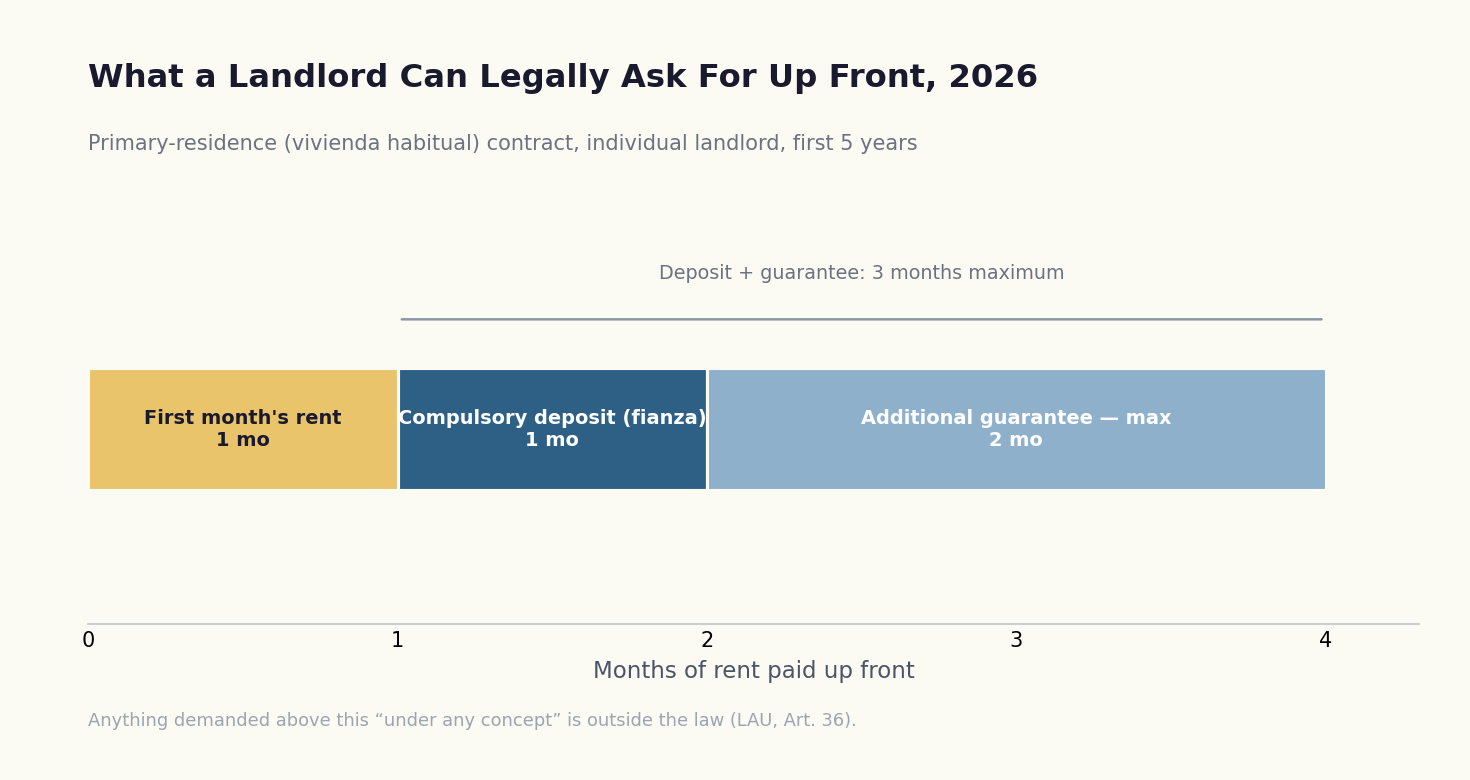
This is where foreigners are overcharged most often, so the rules are worth knowing precisely. Under Article 36 of the LAU, the compulsory deposit (fianza) for a primary residence is one month’s rent. On top of that legal deposit, a landlord may ask for additional guarantees (garantías adicionales), such as extra deposit or a bank guarantee, but during the first five years (seven if the landlord is a company) these additional guarantees are capped at a maximum of two months’ rent.
In practice, this means the maximum a landlord can lawfully require up front is three months in total: one month’s compulsory deposit plus up to two months of additional guarantee (plus, of course, the first month’s rent itself). Anyone demanding more than that “under any concept” is acting outside the law.
Two further deposit rules protect you. First, the landlord is legally obliged to lodge your compulsory deposit with the relevant regional housing body (for example IVIMA in Madrid, INCASÒL in Catalonia, and equivalents elsewhere); a landlord who fails to do this can be sanctioned, and it affects their ability to withhold your money later. Second, at the end of the tenancy the deposit must be returned, with the law providing that any amount still unpaid one month after you hand back the keys accrues statutory interest in your favour. The deposit exists to cover unpaid rent, unpaid utilities, or damage beyond normal wear and tear, and it cannot be used by you to pay the final month’s rent, nor withheld by the landlord as a penalty for leaving.
Two Things a Landlord Cannot Charge You
Since the 2023 Housing Law, two charges frequently pushed onto foreign tenants are now clearly prohibited on primary-residence contracts.
- Agency fees. The cost of the estate agency and of drawing up the contract must be paid by the landlord, not the tenant. If an agency tries to charge you a month’s rent as commission on a long-term residential let, that is not lawful.
- Rent increases above the legal cap. Annual rent increases are tied to an official reference index for residential leases, which has replaced the older CPI-based system, and the landlord can only apply an increase on the contract’s anniversary, in writing. If they do not formally notify you, the rent does not go up.
Spain’s consumer authorities have also flagged several contract clauses as abusive and therefore void, including any clause forbidding you from registering on the padrón, penalties that are wildly disproportionate, and clauses making the return of your deposit conditional on completing the entire contract term. A clause that contradicts the LAU is null even if you signed it, though you may have to challenge it to enforce your right.
Stressed Market Areas: An Extra Layer in Some Cities
The 2023 Housing Law also created the concept of the zona de mercado residencial tensionado (stressed residential market area), which autonomous communities can declare for specific municipalities or districts where rents have risen sharply relative to household income.
Where such a declaration is in force, additional limits apply to what a landlord can charge on a new contract, broadly tying the rent to the previous contract’s level or to an official reference price, with tighter conditions for large landlords. The practical difficulty is that declarations are made regionally rather than nationally, so the rules differ sharply between communities, and the list of declared areas changes as new declarations are made and older ones expire or are renewed.
If you are renting in a major city, it is worth checking with your autonomous community’s housing department whether your specific address falls inside a declared area before accepting a quoted rent, since in a declared zone the asking price is not necessarily the price the landlord is entitled to charge.
The Scams That Target Foreigners Most
Many rental scams deliberately target newcomers, on the assumption that they do not know the market, the language, or their rights. These are the patterns to recognise.

- The “pay before you view” scam. A too-good-to-be-true listing, a “landlord” who is conveniently abroad, and a request to wire a deposit to hold the flat before you can see it. Once you pay, they vanish. Never pay anything before viewing the property in person (or at minimum by live video) and verifying who owns it.
- The fake-landlord scam. Someone who does not actually own the property, perhaps a previous tenant, “rents” it to you and disappears with your deposit. Protect yourself by requesting a nota simple from the Land Registry (Registro de la Propiedad), an inexpensive document that confirms who the legal owner is, and checking that it matches the ID of the person signing.
- The invented-damage deposit grab. At move-out, the landlord withholds the deposit for “damage” that was never documented at the start. The defence is simple and powerful: take dated photographs of the entire property when you move in, send them to the landlord in writing, and repeat the exercise when you leave. An initial inventory (inventario) attached to the contract is your best friend here.
- The pressure-to-sign-blind tactic. “Just sign, it’s our standard contract.” Never sign under pressure. You are entitled to take the contract away, read every clause, and have it translated into plain language before committing.
Your Pre-Signing Checklist
Before you sign anything or transfer any money, run through this short list.
- Verify the owner. Request a nota simple from the Land Registry and confirm the signatory’s ID matches.
- Confirm the contract type is vivienda habitual if this is your main home, not a seasonal contract in disguise.
- Check the deposit does not exceed three months in total, and get written confirmation it will be lodged with the regional housing body.
- Confirm you are not being charged agency fees on a long-term residential let.
- Check whether the address sits in a declared stressed market area, which may cap the rent below what is being asked.
- Make sure the contract allows you to empadronar, since you will likely need it for your NIE, TIE, and healthcare.
- Photograph everything on move-in and attach a signed inventory.
- Never pay before viewing, and use traceable payment methods, never cash you cannot document.
The connection to your paperwork is direct: a rental contract that permits registration on the padrón is often the key that unlocks everything else, from your residence card to your access to public healthcare. If you are weighing renting against buying, our guide to property purchase taxes in Spain sets out the upfront costs on the ownership side, and our guide to the annual taxes of owning property covers the recurring ones. For the wider picture, see our overview of how to move to Spain in 2026.
Frequently Asked Questions
Can I rent without an NIE?
Generally yes. You can usually sign a contract with a valid passport if the landlord accepts it, and you often need the resulting contract to obtain your empadronamiento and then your NIE. The practical challenge is convincing the landlord of your reliability, not any legal bar to renting.
How much deposit is normal, and is it refundable?
For a primary residence, the compulsory deposit is one month, with additional guarantees capped at two months during the first five to seven years, so three months total is the lawful maximum up front. It is fully refundable at the end minus any documented unpaid rent, unpaid utilities, or damage beyond normal wear and tear, and interest accrues in your favour if it is still outstanding a month after you return the keys.
What do I do if I think I have been scammed?
Report it to the National Police, contact your bank immediately to try to stop or trace the payment, and seek legal advice. Keep every message, listing, and receipt. The best protection, though, is prevention: verifying ownership and never paying before viewing eliminates the large majority of these scams.
Can the landlord raise my rent whenever they want?
No. Rent can only be increased once a year, on the contract’s anniversary, in line with the official reference index and any legal cap, and only if the landlord notifies you in writing. Without that formal notification, the rent stays the same, and no increase can be applied mid-year.
Does my landlord have to accept me registering on the padrón?
A clause forbidding padrón registration is considered abusive and has no legal effect, and registration is a right tied to where you actually live rather than something the landlord grants. In practice, however, a landlord who resists it will make your life difficult, so treat any reluctance on this point as a serious warning sign before you sign.
This article is for general informational purposes only and does not constitute legal advice. Rental law, deposit limits, rent-increase indices, stressed-area declarations, and tenant protections change and vary by autonomous community and individual circumstances. Before signing a rental contract, transferring any money, or acting on a dispute, verify the current rules and consult a qualified Spanish lawyer or a recognised tenants’ association about your specific situation.
Leave a Reply