
The moment you become a Spanish tax resident, you inherit an obligation that catches many foreigners off guard: an annual reckoning with the Impuesto sobre la Renta de las Personas Físicas (IRPF), Spain’s personal income tax, calculated not just on what you earn in Spain but on your worldwide income. It is progressive, it is split between the national government and your autonomous community, and it works differently from the US, UK, or most other systems newcomers arrive from. This guide explains, in plain English, how the brackets work, what deductions actually reduce your bill, who has to file, and how the declaración de la renta process runs, so the tax year holds no nasty surprises.
The Threshold Question: Are You a Spanish Tax Resident?
Everything about IRPF hinges on one prior determination. You are generally a Spanish tax resident if you spend more than 183 days in Spain during the calendar year, or if your main centre of economic or vital interests sits in Spain. Once you cross that line, you are taxed on your worldwide income under IRPF, not merely on Spanish-source earnings.
If you are not a tax resident, you fall under a different regime entirely, the Non-Resident Income Tax (IRNR), which taxes only your Spanish-source income (typically at flat rates) and is filed on different forms. This guide covers the resident IRPF system. A crucial point for anyone with income abroad: being a Spanish resident does not mean paying full Spanish tax on top of foreign tax, because Spain’s double taxation treaties allocate taxing rights and grant credits for tax already paid overseas. If you have UK or US income, read this guide alongside our detailed explainer on the US-Spain and UK-Spain double taxation treaties, which explains exactly how pensions, dividends, and gains are allocated between countries.
How IRPF Is Structured: Two Separate Tax Bases
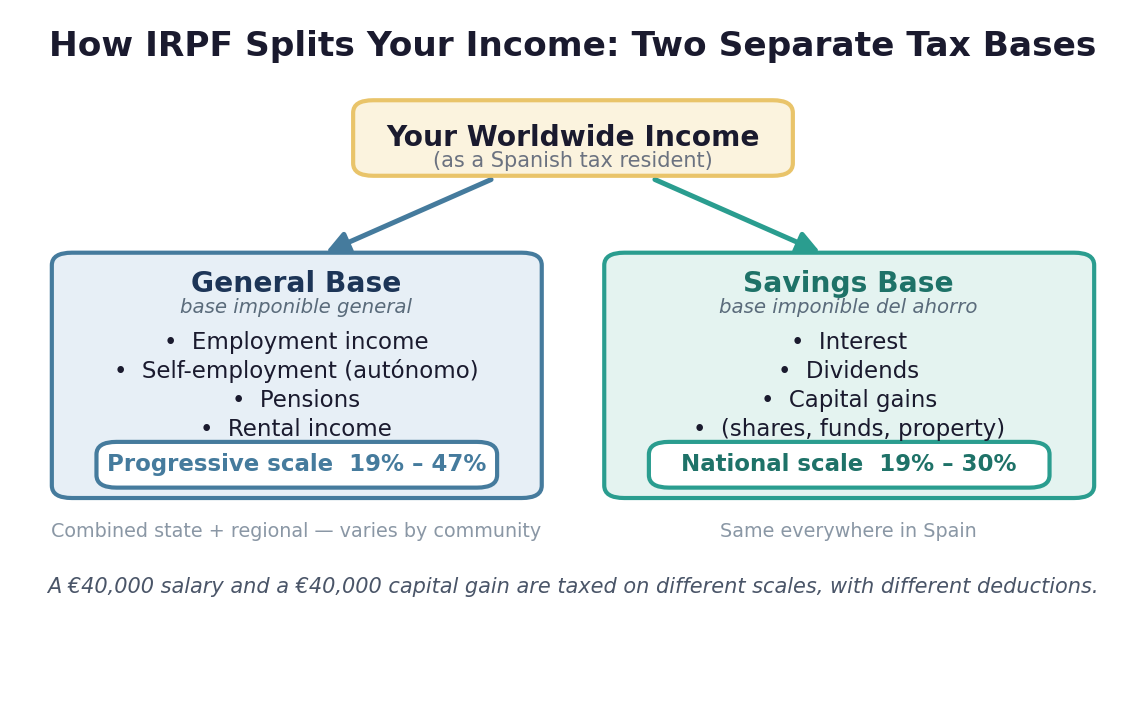
The single most important structural fact about IRPF, and the one that surprises most newcomers, is that it splits your income into two entirely separate pools, each taxed on its own scale.
- The general tax base (base imponible general) covers employment income, self-employment (autónomo) profits, pensions, and rental income. This is taxed on the progressive general scale, which combines a state portion and your autonomous community’s portion.
- The savings tax base (base imponible del ahorro) covers investment income: interest, dividends, and capital gains from selling assets such as shares, funds, or property. This is taxed on a separate, lower national scale that is the same regardless of where in Spain you live.
Keeping these two straight is essential, because a €40,000 salary and a €40,000 capital gain are taxed at very different rates, and the deductions that apply to one do not necessarily apply to the other.
The General Income Brackets
The state portion of the general scale is identical everywhere in Spain. For the 2025 tax year, declared during the spring 2026 campaign, the combined state-plus-reference brackets run as follows. Remember this is progressive: only the slice of income falling within each band is taxed at that band’s rate, so reaching a higher bracket never means your whole income is taxed at the top rate.
| Taxable income (general base) | Combined marginal rate (reference scale) |
|---|---|
| Up to €12,450 | 19% |
| €12,450 – €20,200 | 24% |
| €20,200 – €35,200 | 30% |
| €35,200 – €60,000 | 37% |
| €60,000 – €300,000 | 45% |
| Over €300,000 | 47% |
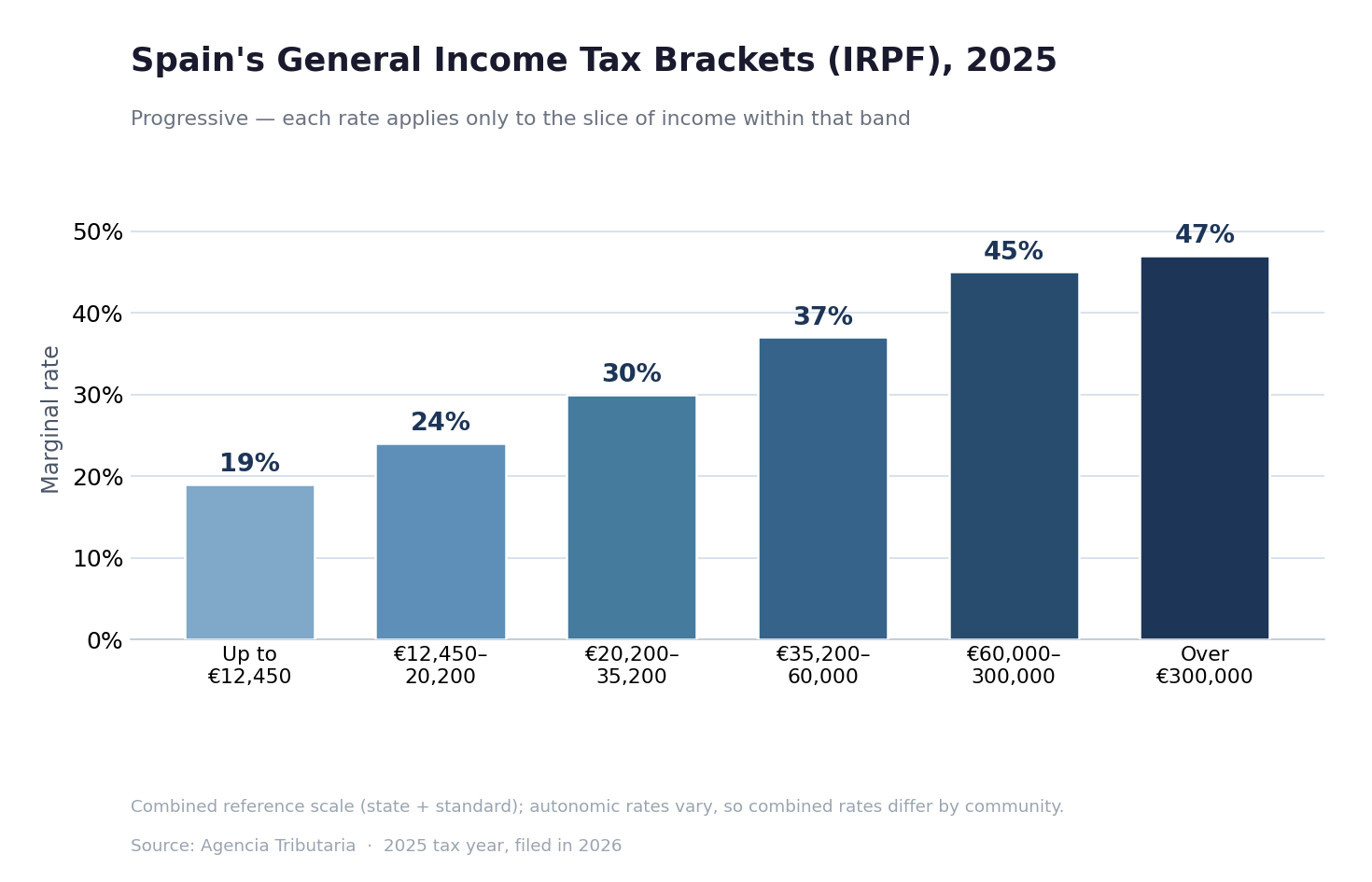
The critical caveat: these are reference figures combining the state scale with the standard scale used as a baseline. If you are a resident, the second half of your tax, the autonomic portion, is set by your specific autonomous community, and those scales vary significantly. Madrid applies among the lowest regional rates (a bottom marginal rate around 8.5% and a top around 20.5% on the autonomic half), while Catalonia sits at the higher end (roughly 10.5% to 25.5%, producing a top combined rate around 50%). Two people with identical incomes can therefore owe noticeably different amounts depending purely on where they live, which is why it is worth checking your own community’s scale rather than relying on a single national figure. Our comparison of the real cost of living across Spain’s main cities looks at how that regional tax wedge stacks up against property and living costs.
The Savings Income Brackets
Investment income (interest, dividends, capital gains) is taxed on its own national scale, the same across all of Spain. For the 2025 tax year, filed in 2026, the savings scale is:
| Savings income | Rate |
|---|---|
| Up to €6,000 | 19% |
| €6,000 – €50,000 | 21% |
| €50,000 – €200,000 | 23% |
| €200,000 – €300,000 | 27% |
| Over €300,000 | 30% |
The top band was raised to 30% (from 28%) for income above €300,000 under Law 7/2024, effective from the 2025 tax year, a change that affects only large investors and asset sales; the vast majority of individual savers sit within the 19% and 21% bands. For a deeper treatment of how gains on crypto and other assets fit here, along with the reporting quirks, see our guide to cryptocurrency and Web3 taxation in Spain.
The Personal and Family Minimum: Income That Isn’t Taxed
Before any tax is calculated, IRPF applies a tax-free personal minimum (mínimo personal y familiar), generally €5,550, which rises if you are over 65 or 75, have a recognised disability, or have dependent children or ascendants living with you. Rather than being deducted from income, this minimum is taxed at the lowest bracket rate and that amount is subtracted from your bill, which in practice shields a base layer of income from tax entirely. Larger families and older taxpayers benefit from progressively higher minimums, and several autonomous communities set their own, more generous figures on top.
Deductions and Reductions That Actually Lower Your Bill
Spain distinguishes between reducciones (which reduce the taxable base before rates apply) and deducciones (which reduce the final tax owed). Both matter, and the ones available to you depend heavily on your circumstances and your region. The most commonly relevant for foreign residents include:
- Employment income reduction. Employees automatically benefit from a reduction on work income, weighted toward lower earners, with a further deduction available to workers on modest net employment income.
- Pension plan contributions. Contributions to qualifying Spanish pension plans reduce the general taxable base, within annual limits (individual limits are relatively low, though employer-linked schemes allow more).
- Autónomo business expenses. The self-employed deduct legitimate business expenses to arrive at net profit, which is what IRPF actually taxes, not gross invoicing. Getting this right is one of the biggest levers a freelancer has, and it starts with registering correctly; our guide to registering as an autónomo or setting up an SL covers how to get set up on the right footing.
- Rental income reductions. Landlords of long-term residential property can apply substantial reductions on net rental income, commonly in the range of 50% to 90% depending on the property, the tenant, and whether it sits in a designated stressed rental market area, following the reshaping introduced by the 2023 Housing Law. Our guide to renting a home in Spain explains how those stressed-area declarations work.
- Regional deductions. Autonomous communities offer their own deductions, for things like childcare, elderly-dependant care, education costs, or rent paid, and these vary enormously by region. Because they are easy to miss, they are one of the most common sources of overpaid tax among people who file without checking their community’s specific list.
- Charitable donations and certain home-related costs also generate deductions in defined circumstances.
The Beckham Law: A Flat-Rate Alternative for New Arrivals
One option that transforms the arithmetic for higher earners is the special impatriate regime, widely known as the Beckham Law. Qualifying individuals who move to Spain to take up employment (and, since the 2022 Startup Act, certain founders and administrators) can elect to be taxed at a flat 24% on Spanish-source employment income up to €600,000, rather than on the progressive scale, and are treated broadly like non-residents for most foreign income for up to six tax years. With the top ordinary marginal rate at 47%, the gap can be as much as 23 percentage points, which makes the regime extremely valuable for the right profile.
The catches are significant, though: you must not have been a Spanish tax resident in the preceding five years, you must apply within six months of starting your activity, classic multi-client freelancers generally do not qualify, and for US citizens the regime can complicate the foreign-residency claim their US filing relies on. It also extends to wealth tax, where impatriates are assessed only on Spanish-situs assets rather than worldwide holdings. It is a decision to model carefully before moving, not after; our guide to digital nomad taxes and cross-border residency covers how it interacts with the US and UK systems.
Who Actually Has to File?
Not every resident must file a return, but the exemptions are narrower than people assume. In broad terms, you generally must file if your employment income from a single payer exceeds €22,000 in the year. Where you have more than one payer, that threshold drops to €15,876 if the combined total from the second and subsequent payers exceeds €1,500 in the year (below that €1,500 figure, the €22,000 limit still applies). Separately, every autónomo must file, regardless of income level, and anyone with significant investment income, rental income, or capital gains typically must file too. The Agencia Tributaria sets out the full list of thresholds and exceptions in its official guidance on who is obliged to file. When in doubt, filing is the safer course, since the penalties for failing to file when required outweigh the effort of filing when you did not strictly need to.
How the Declaración de la Renta Works, Step by Step
The annual filing is done through the Agencia Tributaria’s Renta WEB system using Modelo 100, and the process is more automated than in many countries because the tax office pre-populates a draft (borrador) with the data it already holds.
- Gather your data. You will need your NIF/NIE, digital certificate or Cl@ve credentials, and records of all income, foreign income included, plus any deduction receipts (pension contributions, donations, childcare, rent).
- Access your borrador in Renta WEB. The draft appears on the Agencia Tributaria’s electronic site once the campaign opens. Fiscal data is typically viewable from mid-to-late March, with the filing window running roughly from early April to 30 June.
- Review and correct it, do not just confirm blindly. The borrador reflects only what Spain already knows, so it frequently omits foreign income, regional deductions, and prior-year loss carryforwards. This is where most avoidable errors, in both directions, occur.
- Add worldwide income and applicable deductions. Foreign salaries, overseas dividends, foreign rental income, and foreign pensions must be declared by residents, with treaty relief applied where available. If your pension entitlement was built across several countries, our guide to the totalization of contributions explains how those separate pensions arise.
- Submit and settle. If the result is a payment (a ingresar), you can pay in full or split it into two interest-free instalments (60% on filing, 40% due in early November). If it is a refund (a devolver), the tax office has until the end of the year to pay it, though refunds for early filers often arrive within weeks.
Three related filings often accompany the renta for foreign residents and should not be confused with it: Modelo 720, the declaration of foreign assets over €50,000 in any category; Modelo 721, the separate declaration for cryptoassets held on foreign platforms; and Modelo 714, the wealth tax return. These are separate obligations with their own deadlines, and Modelo 720 and 721 are informative filings that do not themselves generate a tax charge. Our guide to Spain’s Wealth Tax covers how they interact with your overall tax position, including the 60% cap that limits the combined total of income tax, wealth tax, and the solidarity tax to 60% of your taxable income.
The Mistakes Foreign Residents Make Most Often
A handful of errors recur again and again among newcomers, and all of them are avoidable. Failing to declare foreign-source income, on the mistaken belief that income already taxed abroad is invisible to Spain, when residents are taxed on worldwide income and Spain increasingly receives that data automatically. Confirming the borrador without adding regional deductions, and overpaying as a result. Missing the six-month Beckham Law application window. Forgetting that autónomos must file regardless of income. And treating Modelo 720 as optional, when it remains a mandatory (if now less harshly penalised) filing. If your situation is anything beyond a single Spanish salary, professional help in your first year usually pays for itself.
If you are self-employed, your IRPF interacts directly with your social security contributions and with the choice between operating as an autónomo or incorporating a company, a decision that turns on where your profit level sits relative to the break-even point. Our guide to choosing between autónomo and a Sociedad Limitada works through that calculation, along with the RETA contribution brackets and the reduced flat rate available in your first year. And if you are still planning your move, the broader picture is set out in our overview of how to move to Spain in 2026.
This article is for general informational purposes only and does not constitute legal, tax, or financial advice. IRPF brackets, the personal minimum, deductions, and regional scales change frequently and depend on your specific autonomous community, income types, and personal circumstances; the figures cited are indicative for the 2025 tax year filed in 2026. Before filing or making tax-planning decisions, verify current rates with the Agencia Tributaria and consult a qualified Spanish tax adviser (asesor fiscal) about your individual situation.
Leave a Reply