
You have decided to work for yourself in Spain, and immediately hit the first real decision: do you register as an autónomo (self-employed sole trader) or set up a Sociedad Limitada (SL, the Spanish equivalent of a limited liability company)? The two routes have completely different costs, timelines, paperwork, and tax consequences. Choosing wrong at the start can mean paying for a formal company you did not need, or exposing your personal assets when you should not have. And the decision is not permanent: many foreign founders start as autónomos and incorporate later, once profits justify it.
This guide covers both halves of the problem. Part One explains how to choose, including where the financial break-even point actually sits. Parts Two to Four walk through the registration process for each structure step by step, with the real costs and the actual forms. Part Five covers the planning tools that become available once you incorporate.
Part 1: Making the Choice
Two Entirely Different Tax Worlds
As an autónomo, you and your business are legally the same person. Every euro of profit is taxed as your personal income through Spain’s progressive IRPF scale, which runs from 19% up to roughly 47% at the top bracket once regional rates are included. You pay this tax on your entire profit each year, whether you spend it, save it, or reinvest it in the business. There is no mechanism to defer taxation or split your income across different treatments.
An SL is a separate legal entity. It pays Corporate Tax (Impuesto sobre Sociedades) on its profits at a rate that is considerably lower than the top IRPF brackets. You then pay personal tax only on what you actually withdraw, typically structured as a mix of salary (taxed under IRPF, but deductible as a company expense) and dividends (taxed separately on the savings scale, which runs from 19% at the bottom to 30% on amounts above €300,000). Profit left inside the company is not taxed again at the personal level until it is eventually distributed.
That structural difference is the foundation of every planning strategy available to an SL and unavailable to an autónomo.
The 2026 Corporate Tax Rates
Spain’s corporate tax rates were restructured by Ley 7/2024, which introduced a phased reduction for smaller companies through a transitional schedule. The rates applicable to tax periods beginning in 2026 are:
| Company type | 2026 rate |
|---|---|
| Micro-enterprise (turnover under €1 million) | 19% on the first €50,000 of taxable base, 21% on the remainder |
| Small company / reduced-dimension entity (turnover €1–10 million) | 23% |
| General rate | 25% |
| Newly created company (first profitable year and the following one) | 15% |
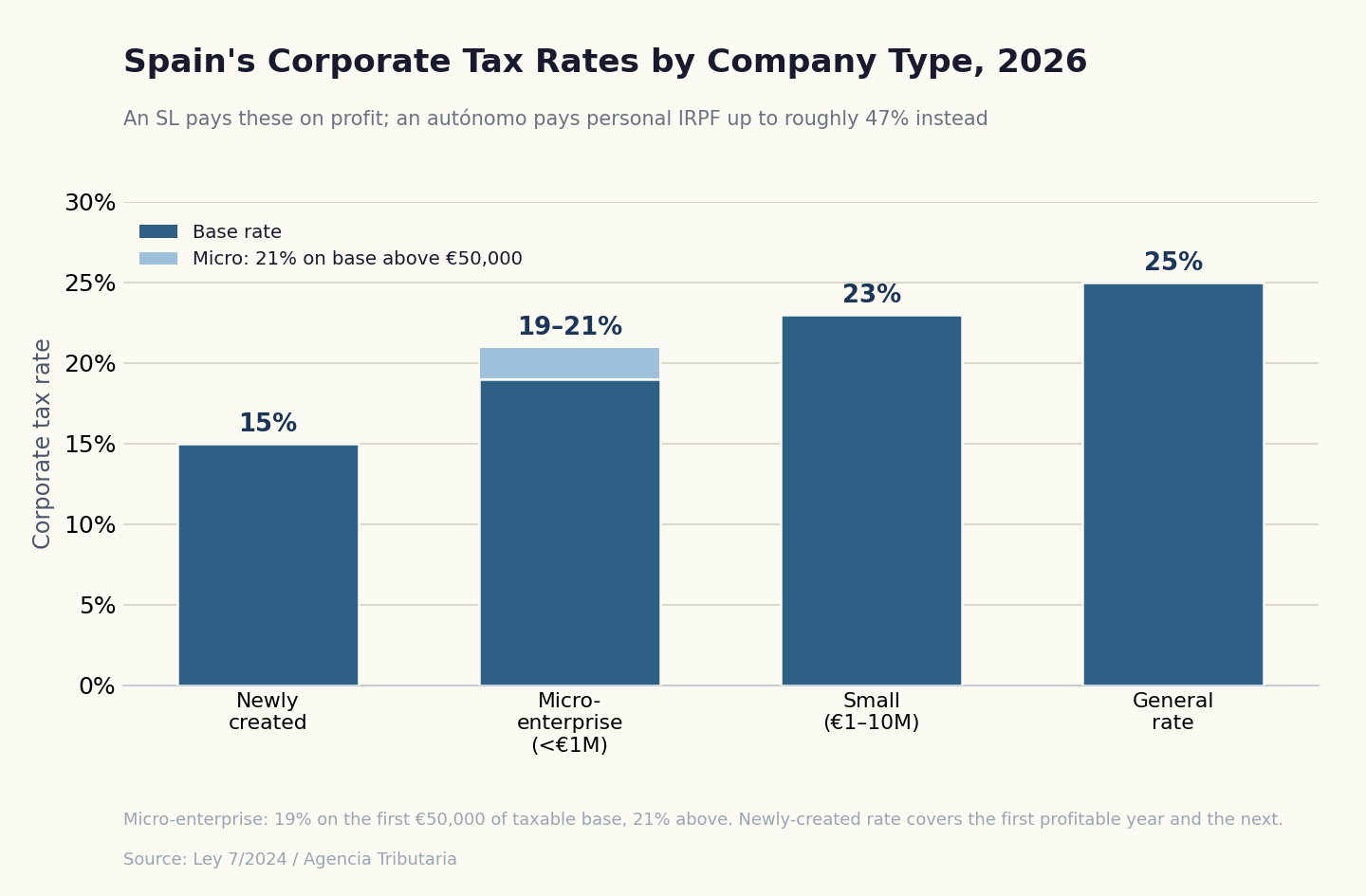
Two details catch founders out. First, the classification depends on the previous year’s net turnover, so a company can move between brackets from one year to the next. Second, in a short first tax period (common in the year of incorporation), the €50,000 first-band limit is prorated: a six-month period gets a €25,000 band, not €50,000.
Note that the 15% rate for newly created companies is a different, shorter relief from the one available to companies formally certified as empresas emergentes under the Startup Law, which extends the same rate over a longer initial period. That certification route is covered in Part Five and in our guide to the Entrepreneur Visa and startup certification.
The reduction schedule continues beyond 2026, with further cuts planned for micro-enterprises and reduced-dimension entities in subsequent years, so the gap against the general rate is set to widen.
Where the Break-Even Point Actually Sits
Despite the confident claims you will find online, tax professionals converge on a consistent range: incorporation typically starts to make financial sense once annual net profit reaches roughly €40,000 to €60,000, and only if you do not need to withdraw every euro to cover personal living costs. That second condition matters as much as the first.
Below that range, an SL’s fixed costs work against you. A company director’s monthly Social Security contribution sits meaningfully above the lowest autónomo band. Proper corporate accounting costs several times what autónomo bookkeeping does. Add the annual accounts filing and the administrative overhead, and the tax advantage is eroded or wiped out entirely at lower profit levels.
Above €100,000 of annual profit the gap widens considerably in the SL’s favour, and by €200,000 the comparison tips decisively: the autónomo’s marginal IRPF rate is deep in the 45%+ territory, while the SL pays its corporate rate and retains full control over how and when profit reaches the owner personally.
The critical caveat is that these are general thresholds, not your numbers. The real break-even depends on your profit level, your region, how much you need to withdraw, and whether you can use the reserves described in Part Five. Modelling your actual figures with an asesor fiscal before incorporating is worth the consultation fee.
Asset Protection: The Non-Tax Reason That Often Decides It
For many foreign entrepreneurs, limited liability settles the question before the tax maths is even run. As an autónomo you are personally liable for business debts with your entire personal estate: your home, your savings, everything. A client lawsuit, a failed contract, or a business insolvency can reach directly into your personal assets.
An SL is a distinct legal person. Shareholders’ personal assets are generally protected and liability is limited to the capital invested, although directors can still face personal liability for mismanagement or specific legal breaches. For anyone in a higher-risk sector, or holding substantial personal wealth outside the business, that protection often justifies incorporation regardless of where the tax break-even falls.
A Practical Decision Framework
Stay autónomo if: your annual net profit is consistently below €40,000; your income is unpredictable or seasonal; you need to withdraw essentially all profit for living expenses; and your business carries minimal liability risk.
Set up an SL if: annual net profit consistently exceeds €50,000–€60,000; you do not need to withdraw every euro immediately; your business carries meaningful liability exposure; you plan to hire, bring in partners, or raise investment; you are negotiating contracts where clients expect a corporate counterparty; or you hold significant personal assets you want ring-fenced from business risk.
If you are starting out and genuinely unsure, starting as an autónomo and incorporating later is the lower-risk sequence. Converting is administratively tedious but entirely routine, and it is far cheaper than running an SL you did not need for two years.
Part 2: The Prerequisite Both Routes Share
Neither path is possible without a Spanish tax identification number. For foreigners that means an NIE (Número de Identidad de Extranjero), and for non-EU nationals the right to actually work self-employed usually requires the appropriate residency authorisation as well, commonly the self-employment work visa or the Digital Nomad Visa route for remote workers.
Sort this out first: everything downstream, opening a bank account, filing tax forms, signing a deed, depends on having a valid NIE in hand. EU/EEA citizens obtain one relatively simply. Non-EU founders should confirm their visa actually permits self-employed economic activity before registering, since a tourist entry does not. Our guide to NIE, TIE, and empadronamiento covers the process and the order in which to tackle these documents.
Part 3: Registering as an Autónomo, Step by Step
The autónomo process is short and can largely be completed online with a digital certificate or Cl@ve.

- Register with the tax office (Hacienda) using Modelo 036 or 037. This is the alta censal, declaring that you are starting an economic activity. You select your activity code (epígrafe IAE), which tells the tax office what you do, along with your address and your VAT and income-tax regime. Choosing the correct epígrafe matters, since it determines your ongoing obligations and can affect which expenses you may deduct.
- Register with Social Security in the RETA regime. You enrol in the Régimen Especial de Trabajadores Autónomos (RETA), ideally on or before the day you start activity, through the Social Security’s Import@ss portal. Since 2023, autónomo contributions are based on real net income, with the monthly quota scaled to what you actually earn, running from roughly €205 at the lowest income bracket to around €607 at the highest.
- Claim the tarifa plana if you qualify. New autónomos who have not been registered recently can typically access a reduced flat monthly Social Security quota (the tarifa plana, around €80 per month) for the first 12 months, extendable to 24 months under income conditions, before moving to the income-based scale. This is a significant saving in year one and must be claimed at registration, not afterwards.
- Set up your invoicing and tax-filing rhythm. As an autónomo you file quarterly: VAT (Modelo 303) and, depending on your regime, a fractional income-tax payment (Modelo 130), plus annual summaries. Your net profit then flows into your annual IRPF return.
That is the whole process. Many autónomos complete it in two to five days, and the only recurring cost beyond your Social Security quota and taxes is a gestor or accounting software to keep the quarterly filings straight.
Part 4: Setting Up a Sociedad Limitada, Step by Step
Forming an SL is a genuine legal incorporation with more moving parts, but the sequence is well established and, via the telematic CIRCE system with standardised statutes, faster than it used to be.
- Reserve the company name. Apply to the Central Mercantile Registry for a certificación negativa de denominación social, confirming your chosen name is free. This certificate is required before the notary stage and takes a few days.
- Decide your share capital and draft the statutes. Since the “Crea y Crece” law, an SL can technically be formed with as little as €1 of share capital, but most founders still contribute around €3,000 to give the company solvency and avoid certain restrictions on distributing profits. The statutes (estatutos sociales) define your company’s purpose (objeto social), governance, and administration structure. Draft the purpose carefully: one that is too narrow forces a costly notarised amendment later if you diversify.
- Open a company bank account and deposit the capital. Open a sociedad en constitución account, deposit the share capital, and obtain the bank certificate proving it, which the notary requires.
- Sign the deed of incorporation before a notary. With the name certificate, statutes, and capital proof, you sign the public deed (escritura de constitución) before a Spanish notary, who typically files it with the Mercantile Registry electronically the same day.
- Obtain the provisional NIF and complete the tax registration (Modelo 036). You apply to Hacienda for the company’s provisional tax number (a NIF beginning with “B”), declaring the activity, registered address, and tax obligations. The provisional NIF lets the company operate and invoice while registration completes.
- Register the deed in the Provincial Mercantile Registry. Until this inscription is complete, the company lacks full legal personality and the founders can still be personally liable. Do not sign major contracts until the registration confirms and the NIF becomes definitive.
- Register the administrator in Social Security. An administrator or working partner with effective control of the company (broadly, owning more than 50% directly or with family, or 33% with management duties) must register in RETA as an autónomo societario, even without drawing a salary. The €80 tarifa plana does not apply to company administrators, who contribute on a higher minimum base. This is the cost first-time founders most often overlook when budgeting.
What an SL Actually Costs to Set Up
Beyond the share capital (which is an asset of the company, not a cost), the mandatory official fees are modest, though a gestoría adds convenience for a fee.
| Item | Approximate cost |
|---|---|
| Name reservation (Registro Mercantil Central) | ~€15 |
| Notary (deed of incorporation) | ~€250–€400 |
| Provincial Mercantile Registry inscription | ~€150–€250 |
| Gestoría fees (optional but common) | ~€200–€500 |
| Typical total (excluding share capital) | ~€350–€800 |
Incorporating a company is exempt from ITP/AJD transfer tax, though some regions still require a zero-result self-assessment (Modelo 600) to document the exemption. For a full breakdown of when ITP and AJD do apply, see our guide to property purchase taxes in Spain.
The Ongoing Obligations You Are Signing Up For
Registration is only the beginning. Each structure carries recurring duties worth understanding before you commit.
- Autónomo: quarterly VAT (Modelo 303) and income-tax (Modelo 130 where applicable) filings, annual summaries, the annual IRPF return, and monthly RETA contributions. Bookkeeping is comparatively light.
- SL: quarterly VAT and withholding filings (Modelos 303, 111, 115 where relevant), fractional Corporate Tax payments (Modelo 202), the annual Corporate Tax return (Modelo 200), plus formal double-entry accounting, approval and deposit of annual accounts at the Mercantile Registry, official company books, and an annual beneficial-ownership confirmation. This is why almost every SL retains a gestoría.
Missing the annual accounts deposit is not a minor slip: it triggers fines and a registry block that prevents changes to company management or capital structure until resolved.
Foreign founders should also plan for Spain’s Verifactu electronic invoicing requirements, which bring certified invoicing software with real-time reporting capability into force for companies on a phased timetable. Confirm the current deadline applicable to your entity type with your gestoría and choose compliant invoicing software well before it arrives, rather than scrambling afterwards.
Part 5: The Planning Tools That Open Up Once You Incorporate
The Salary–Dividend Split
The central planning tool for an SL owner is deciding how to take money out. Salary is deducted as a company expense, reducing the corporate tax base, but is then taxed personally on the progressive IRPF scale. Dividends are taxed separately at savings-income rates, after the company has already paid corporate tax on the underlying profit. That savings scale runs from 19% on the first €6,000, through 21% and 23%, to 27% and finally 30% above €300,000, as set out in our guide to IRPF for foreign residents.

The optimisation is to pay yourself a salary sufficient to cover personal needs and sit sensibly within your IRPF bracket, while leaving remaining profit inside the company taxed only at the corporate rate. That retained profit can be distributed later, in a lower-income year, or reinvested in the business. This flexibility, deciding how much to withdraw and when, simply does not exist for an autónomo, who pays personal tax on the entire profit every year regardless of cash-flow needs.
There is a limit to this. The salary must be defensible as reasonable for the work performed; artificially suppressing it to shift everything into dividends invites scrutiny from the Agencia Tributaria.
The Two Reserves Autónomos Cannot Use
Spanish corporate tax law includes two incentive mechanisms available only to companies.
The capitalisation reserve (reserva de capitalización, Article 25 LIS) rewards companies for retaining profit rather than distributing it. A qualifying SL that increases its net equity can reduce its taxable corporate base by a percentage of that increase. Ley 7/2024 raised this reduction from 15% to 20%, and it can reach 30% where the company increases its workforce by more than 10% and maintains that level for three years, subject to the conditions and limits in the legislation.
The equalisation reserve (reserva de nivelación), available to reduced-dimension entities, allows a further reduction of the taxable base in profitable years by setting aside a reserve against future losses, smoothing tax liability across good and bad years.
Used together, these mechanisms can reduce an SL’s effective taxable base meaningfully below its raw accounting profit. Neither has any equivalent under the autónomo regime, where the full profit feeds into the IRPF scale every year with no deferral or reduction tool.
Social Security Works Differently Too
As an autónomo, your monthly RETA contribution is calculated on your actual net income through a tiered system of income bands. As the director of an SL who works in the business, you register as an autónomo societario, which carries a higher minimum contribution base.
The key difference is what the contribution is calculated on. An autónomo with €100,000 of profit contributes against that full income. An SL owner who declares a €30,000 salary contributes only against that lower declared figure, which produces real savings at higher profit levels. The trade-off is future pension entitlement, which is based on your contribution history, so a decade of minimum contributions has consequences you will feel at retirement. Our guide to how pension totalization works in Spain explains how contribution records translate into entitlement, and sets out Spain’s current retirement ages.
Two Special Regimes Worth Knowing About
The Canary Islands Special Zone (ZEC) offers a corporate tax rate as low as 4% for companies genuinely established and operating within its framework, subject to specific activity, investment, and job-creation requirements. The requirements are substantive rather than nominal, so this suits businesses that can actually base qualifying operations there, not those looking for an address.
Empresa emergente (startup) status under Spain’s Startup Law, particularly with ENISA certification, extends the 15% reduced rate over a longer initial period than the ordinary newly-created-company relief, and unlocks additional benefits including improved treatment of employee stock options. This is aimed at scalable, innovation-driven businesses rather than traditional service operations, and the certification bar is real; our guide to the Entrepreneur Visa and the Digital Nomad Visa explains what ENISA actually looks for.
The Mistakes Foreign Founders Make Most Often
A few errors recur across both routes:
- Choosing the wrong IAE activity code on Modelo 036, which creates the wrong obligations and can block deductions.
- Drafting an objeto social that is too narrow, forcing an expensive notarised amendment when the business expands.
- Signing contracts through an SL before its Mercantile Registry inscription is confirmed, leaving founders personally exposed.
- Budgeting for the €80 tarifa plana as an SL administrator, when the higher autónomo societario base applies instead.
- Incorporating too early, at profit levels where the fixed costs exceed the tax saving.
- For Americans specifically, assuming a Spanish SL neatly replaces a US structure, when the interaction of the two systems is complex, as our guide on living in Spain with a US LLC explains.
Whichever route you choose, your business profits ultimately connect back to your personal tax position, so read this alongside our companion guide to IRPF for foreign residents, which explains how autónomo income is taxed on the personal scale. If you are still planning the wider move, see our overview of how to move to Spain in 2026.
This article is for general informational purposes only and does not constitute legal, tax, or financial advice. Registration procedures, costs, Social Security contribution rules, and tax rates change frequently and depend on your nationality, residency status, activity, and individual circumstances; the figures cited are indicative for 2026. Before registering as an autónomo or incorporating a company, confirm current requirements with the Agencia Tributaria and the Tesorería General de la Seguridad Social, and consult a qualified Spanish gestor, lawyer, or asesor fiscal about your specific situation.
Leave a Reply