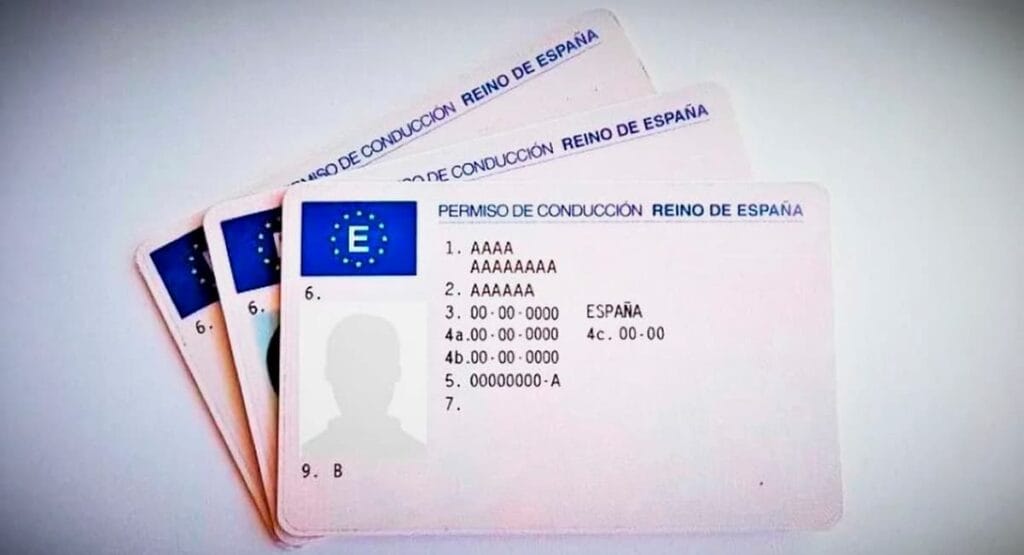
Somewhere between six and twelve months after arriving in Spain, most non-EU newcomers hit the same unpleasant surprise: the driving licence that got them through the airport, the car rental counter, and their first few months on Spanish roads quietly stops being valid, and Spanish traffic authority websites and third-party blogs offer wildly inconsistent answers about what to do next. The reality is narrower and more specific than most of that advice suggests. This guide sets out exactly which countries actually have a licence-exchange agreement with Spain in 2026, what happens if yours does not, and how to complete the process (called a canje) correctly the first time.
First, the Rule Everyone Gets Wrong: The Six-Month Clock
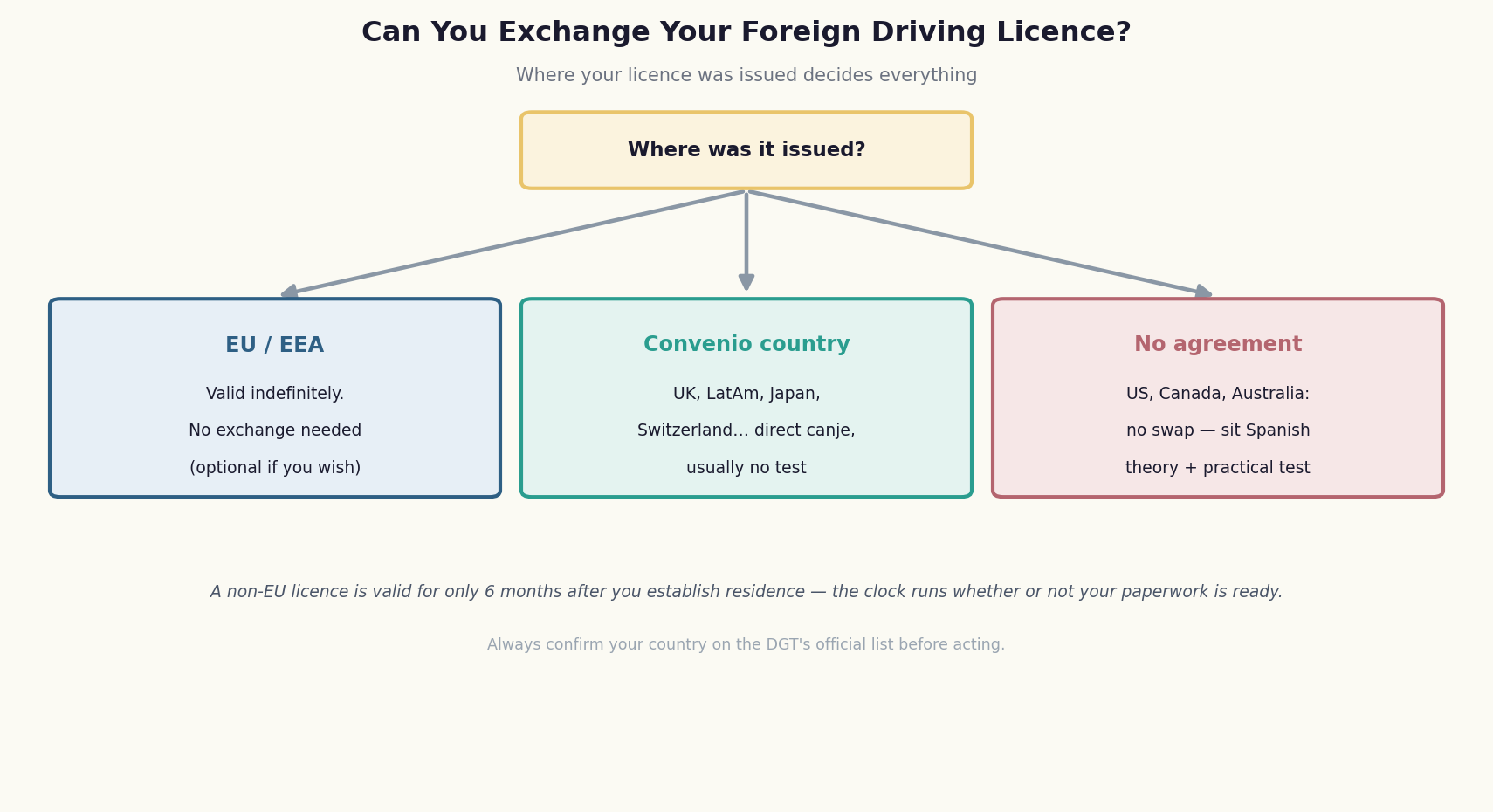
If your driving licence was issued outside the EU/EEA, Spain’s Dirección General de Tráfico (DGT) gives you a maximum of six months from the date you establish normal residence in Spain (not the date you arrived on holiday, and not the date your visa was approved) during which your foreign licence remains valid for driving here. After that window closes, the licence has no legal validity in Spain at all, whether or not it is still valid in its country of origin. If a country you hold a licence from has no exchange agreement with Spain, this six-month window is not an extension you can apply for; once it closes, driving on that foreign licence is driving without a valid permit.
EU and EEA licences (including Iceland, Liechtenstein, and Norway) are the exception: they remain fully valid for as long as they are current, with no six-month deadline and no exchange required, though an exchange is available voluntarily.
The Two Categories That Actually Matter
Every non-EU licence falls into one of two groups, and confusing them is the single most common and most expensive mistake newcomers make.
Group 1: Countries with a bilateral exchange agreement (canje possible)
If your licence was issued by one of the countries on the DGT’s official list, you can generally exchange it directly for a Spanish licence without sitting either the theory or the practical driving test. As of 2026, that list includes: Andorra, Algeria, Argentina, Bolivia, Brazil, Chile, Colombia, South Korea, Costa Rica, Ecuador, El Salvador, the Philippines, Georgia, Guatemala, Honduras, Japan, North Macedonia, Morocco, Moldova, Monaco, Nicaragua, New Zealand, Panama, Paraguay, Peru, the United Kingdom (including Northern Ireland), the Dominican Republic, Serbia, Switzerland, Tunisia, Turkey, Ukraine, and Uruguay.
Two cautions on that list. It is updated as agreements are signed or amended, so it should never be taken from a third-party article, including this one. And being on the list does not always mean identical treatment: Japan, for example, has a bilateral treaty with Spain that does not extend to full reciprocal recognition of national driving licences, and Morocco’s agreement was amended in relation to professional categories. The definitive answer for your specific case comes from the DGT’s current country list, and from the country selector on the DGT’s electronic headquarters, which returns the exact requirements, any aptitude tests, and the fee for the country that issued your licence.
Group 2: Countries with no agreement
This is where most of the confusion arises, and where a large share of North American newcomers find themselves. The United States and Canada do not appear on the DGT’s convenio list, at either the federal or provincial/state level, despite persistent rumours online (often based on outdated or unofficial “agreements in progress”) suggesting otherwise. Australia and most other non-listed countries are in the same position.
The practical consequence is the one that matters: without a convenio, you cannot simply swap your licence for a Spanish one on the strength of the driving experience it represents. The route to legal driving in Spain after the six-month window is to obtain a Spanish licence through the Spanish testing system, sitting the theory exam and the practical driving test, as a first-time Spanish driver would. This is genuinely one of the more frustrating realities of relocating from North America, and it is a diplomatic limitation rather than an administrative one, so a gestoría cannot shortcut it.
One nuance worth knowing rather than assuming: the DGT’s own guidance indicates that holders of licences from non-convenio countries can still be processed through a documented procedure subject to meeting requirements, rather than being turned away entirely, and the exact path can depend on your licence categories and circumstances. Before enrolling anywhere or paying anyone, run your specific country through the DGT’s selector and confirm what applies to you.
The British Exception: A Convenio With a Hard Deadline
British licence holders occupy a specific middle ground worth spelling out clearly. The UK does have a valid exchange agreement with Spain, in force since 16 March 2023, but it comes with a strict enforcement point: UK residents in Spain have six months from the relevant trigger date for their situation (arrival or the date they obtain Spanish residency, as the DGT determines) to complete the exchange, and letting that window lapse without filing can complicate the process even though the underlying convenio still exists. In practice, this means British nationals should treat the exchange as a task to complete promptly after establishing residency, not something to leave for “whenever,” since a lapsed UK licence with no timely exchange application on file can leave a gap where no licence is technically valid.
How the Exchange Process Actually Works
For eligible countries, the canje follows a consistent sequence, though it can now be started digitally for many nationalities via the DGT’s electronic headquarters (sede electrónica) rather than requiring an in-person appointment from day one.

- Confirm your country is listed and check for vehicle-category exceptions. Licences that only cover cars and motorcycles (categories A and B) generally exchange without any test. Licences that include trucks or buses (categories C and D) usually require an additional aptitude test, which carries its own fee and adds time to the process.
- Gather your documents. You will typically need your valid foreign licence (the original, which will be retained by the DGT during the exchange), your NIE or TIE, proof of legal residence in Spain, and, for many countries, a certified Spanish translation of the licence carried out by a sworn translator, a Spanish consulate in your home country, or the home country’s consulate in Spain.
- Pass a psychophysical aptitude test. Every exchange requires a basic medical and vision check at an authorised Centro de Reconocimiento de Conductores (CRC), a straightforward, same-day appointment that produces the certificate the DGT requires as part of your file.
- Submit the application and pay the fee. This can typically be started online via the DGT’s electronic headquarters with a digital certificate or Cl@ve system, or in person at a Jefatura Provincial de Tráfico. A processing fee applies, and the DGT’s country selector shows the exact current amount for your country; always confirm the live figure there rather than relying on a number quoted elsewhere, since fees are revised periodically.
- Surrender your original foreign licence and receive a provisional permit. Once your file is processed, you hand over your original licence at the Jefatura, and you are issued a provisional authorisation that lets you keep driving legally in Spain, typically valid for up to six months, while your physical Spanish licence is manufactured and mailed to your home address.
One detail that surprises many applicants: a licence you exchanged in a third country does not carry the same rights forward. A Canadian licence that was previously exchanged for a British one in the UK, for example, cannot then be exchanged again for a Spanish licence on the strength of the UK convenio, because the DGT looks through to the licence’s true country of original issue, and Canada itself has no agreement with Spain.
A useful point in the other direction: the canje homologates all the driving authorisations you held in your home country in one go. If you held motorcycle, car, and bus entitlements there, your Spanish licence carries the equivalents; you do not file a separate exchange for each category.
A Note on the International Driving Permit
An International Driving Permit (IDP) from your home country is a useful document for short visits and rental cars in the early weeks after arrival, but it is not a substitute for the canje and does not extend the six-month window in any way. It has no independent legal validity on its own; it functions only alongside your underlying national licence, and once that underlying licence stops being valid in Spain after six months of residency, the IDP built on top of it stops helping you as well.
What the Exchange Costs
The fee is smaller than most people expect, and it is not where the money goes. For exchanges that require no aptitude test, the DGT applies its tariff II.3, which stands at €28.87. The DGT states this explicitly for European exchanges, which never require examinations for either group of categories; for non-EU convenio countries the applicable tariff depends on whether your licence categories trigger an additional test, which is exactly what the country selector on the DGT’s site tells you.
The real cost sits in the two items around it. The psychophysical aptitude certificate from an authorised centre is paid separately and directly to the centre, and prices are not regulated nationally, so they vary by province and by clinic. If your licence is not in Spanish, the sworn translation is a second private cost, and several countries additionally require the document to be apostilled or legalised before the DGT will accept it. That last requirement is the one that quietly adds weeks, because an apostille has to be obtained in the country that issued the licence, not in Spain. If your licence is in a language other than Spanish, start the translation and any legalisation before you do anything else, because the rest of the process moves faster than that step does.
What You Actually Receive: A Spanish Licence, With Spanish Rules Attached
This is the part almost no English-language guide covers, and it matters more over time than the exchange itself. When the canje completes you do not hold a recognised foreign licence: you hold a Spanish one, and it is governed by the Spanish rules on validity and on penalty points from that day forward. Two consequences follow.
Your licence now expires, and renewal includes a medical
Spanish licences carry an expiry date tied to your age rather than to a fixed term from issue. For cars and motorcycles — categories AM, A1, A2, A and B — the DGT sets a validity of ten years until the holder turns 65, and five years from that point on. Professional categories for trucks and buses run on five years until 65 and three years afterwards. Each renewal requires passing the psychophysical examination again, and the DGT is explicit that a doctor who finds a condition that may deteriorate can issue a shorter validity than the standard term.
Two practical points. You can file the renewal from three months before the expiry date without losing a single day of validity, because the extension is counted from the date the current licence lapses rather than from the date you applied. And an expired licence can be renewed at any time afterwards, however long it has been — but you cannot legally drive in the interval. For anyone arriving from a country where the licence is valid for decades or effectively for life, this is a genuine change of habit rather than a formality.
You enter the penalty points system
Spain runs a points-based licence. Drivers hold a balance that infractions deduct from, and when the balance reaches zero the licence loses its validity: you then have ten days to file representations, and if the loss is confirmed you must hand the licence in and stop driving until you complete a recovery course and regain it.
The starting balance is not the same for everyone. The DGT’s general rule is a balance of twelve points, with novice drivers and anyone obtaining a licence after a previous one was withdrawn starting on eight. Drivers who exchange a licence backed by only a short driving history can find themselves treated as novices rather than as experienced drivers, so it is worth checking your actual balance in the DGT’s online consultation once the exchange completes rather than assuming you started at twelve.
Recovering points works in three ways, and knowing them in advance is more useful than discovering them after a fine. Two full years without committing an infraction that deducts points restores the initial balance of twelve. A twelve-hour awareness and road re-education course recovers up to four points, and can be taken once every two years, or once a year for professional drivers. Separately, safe and efficient driving courses add two bonus points up to a ceiling of fifteen, once every two years for each course type.
What Happens If You Drive On a Licence That Is No Longer Valid Here
It is tempting to treat the six-month window as a soft deadline, on the reasoning that a licence which is perfectly valid at home is unlikely to attract attention at a roadside check. The enforcement figures say otherwise. In a public statement on driving without documents in order, the DGT reported 21,606 penalties in a single year against people driving in Spain on a licence that was not valid here. That is not a rounding error in a database; it is a category of infraction that traffic officers actively check.
The related offence is worse. Driving a vehicle your licence does not entitle you to drive is classed as a very serious infraction carrying a €500 fine and the deduction of four points, and the DGT recorded 7,266 such cases in 2023. Beyond the fine, the point that tends to concentrate the mind is insurance: a motor policy is written on the assumption that the driver holds a valid licence, and an accident caused while driving on a permit that has no validity in Spain puts that assumption, and therefore the cover, in question.
Frequently Asked Questions
I’m American. Do I really have to take the Spanish tests?
In practical terms, yes. As of 2026 the United States does not appear on the DGT’s convenio list, regardless of the state that issued your licence, so there is no straight swap on the basis of your US driving record. You will need to work through the Spanish testing system: the theory exam (available in English in most regions) and the practical driving test. Many driving schools in expat-heavy areas run accelerated or intensive programmes for exactly this situation, which can shorten, though not eliminate, the process. Confirm the current position and the exact procedure for your case on the DGT’s site before committing to a course.
What if I obtained my foreign licence after I already became a Spanish resident?
The DGT explicitly excludes this scenario. A licence issued by a convenio country after the date you became legally resident in Spain is not eligible for exchange, precisely to prevent residents from travelling abroad to obtain a licence and bypassing the Spanish testing system. The exchange only applies to licences genuinely obtained before establishing Spanish residency.
Can I drive during the exchange process while my original licence is with the DGT?
Yes. Once you formally submit your original licence as part of the exchange, the DGT issues a provisional permit valid for driving in Spain while your definitive licence is produced, so there is no gap where you are unable to drive legally, provided you filed before your six-month window closed.
Does this affect my ability to import or register a vehicle in Spain?
Not directly, a valid licence and vehicle registration are separate processes, but if you are also bringing a car into Spain as part of your move, it is worth planning both at once. Our guide to moving vehicles, pets, and belongings to Spain covers the separate tax exemption and registration deadlines that apply when importing a car under a transfer-of-residence. Once the car is registered here, remember that Spanish law requires it to be insured continuously; our guide to compulsory car insurance in Spain explains what cover you must hold and the penalties for going without it.
What do I need in place before I can start the canje?
Proof of legal residence and your NIE or TIE, plus in most cases a padrón registration to evidence your Spanish address. If those are not yet sorted, our guide to the NIE, TIE, and empadronamiento explains the order to do them in, which matters here because the six-month clock runs whether or not your paperwork is ready.
Still working through the earlier stages of your move? Our full guide to moving to Spain in 2026 covers the visa, residency, and practical logistics steps that typically come before this one.
Verified August 2026 against Dirección General de Tráfico guidance on the exchange of foreign driving licences, on licence validity and renewal, on the penalty points system, and against the DGT’s own published enforcement figures for driving on a licence not valid in Spain. This article is for general informational purposes only and does not constitute legal or immigration advice. The list of countries with a licence-exchange agreement, applicable fees, and procedural requirements change periodically, and treatment can differ between listed countries. Before relying on any information in this guide, confirm your specific country’s status and the current process directly on the DGT’s official website or at your local Jefatura Provincial de Tráfico.