The moment you need emergency care in Spain is the worst possible moment to work out how it functions. You will be frightened, probably in pain, possibly translating for someone else, and standing in front of a system whose vocabulary does not map onto the one you grew up with. There is no equivalent of a British A&E department that also functions as a walk-in centre, no equivalent of an American emergency room that bills you before it treats you, and the word urgencias covers at least three different places.
This guide sets out how emergency and urgent care in Spain actually works: which number to call, which door to walk through, why you may wait four hours with a broken wrist, who ends up paying, and the rule that stops any hospital turning you away.
112, and what most guides get wrong about it
112 is the number. It works throughout Spain and across the European Union, it is free, and it reaches police, fire and ambulance from a single call. It works from a mobile with no credit, and in most cases from a phone with no SIM card at all or outside your own operator’s coverage. You do not need a Spanish phone or a Spanish number.
Two things about it are almost never explained in English, and both matter when you are the one calling.
It is not one national service. The number is identical everywhere, but the calls are answered by the autonomous communities, so there are nineteen separate emergency call centres, each covering its own territory. That is why the questions you are asked and the resources dispatched can differ between Andalucía and Catalonia, and why local knowledge from a forum post about one region may not describe yours.
There is an interpreter on the line. The service operates around the clock with tele-translation available in a large number of languages — the Madrid tourist authority puts the figure at up to eighty. Say the name of your language slowly in English and wait. Do not hang up because the operator answered in Spanish and you panicked; hanging up and redialling loses you the location data already captured. If you are alone with a casualty, put the phone on speaker and keep working while the operator talks you through what to do.
Some regions also operate a dedicated medical emergency number, commonly 061, which routes directly to health services rather than through the general emergency switchboard. Both work. If you are unsure, 112 is always the safe choice.
Which door to walk through
Spain separates urgent care across several levels, and choosing correctly is the difference between forty minutes and five hours.
| Where | What it handles | When to choose it |
|---|---|---|
| 112 or 061 | Chest pain, stroke signs, severe breathing difficulty, major trauma, loss of consciousness, serious bleeding | Anything that might be life-threatening. Do not drive yourself |
| Hospital urgencias | Suspected fractures, serious wounds, acute abdominal pain, anything needing imaging or admission | Serious but you can safely travel |
| Centro de salud, in hours | Infections, minor injuries, sudden but non-severe illness | Your first call for anything not obviously an emergency |
| Out-of-hours urgent care | The same, at night, at weekends and on public holidays | Known regionally as PAC, SUAP or centro de urgencias de atención primaria among other names; ask your health centre which one covers you |
| Farmacia | Minor complaints, advice, a surprising range of medicines without prescription | Before any of the above, for small things. There is always one open |
The Spanish pharmacy deserves a paragraph of its own, because arrivals from the UK and the US consistently underuse it. Pharmacists are highly trained, they will look at a rash or a burn across the counter, they dispense a range of medicines that would need a prescription elsewhere, and every municipality operates a rota so that one pharmacy is open through the night. The rota is posted in the window of every closed pharmacy. For a great many complaints that would send someone to a hospital in Britain, the pharmacy is the correct and much faster answer.
Why you wait: triage explained
Nothing generates more foreign frustration than the waiting room, and almost all of it comes from a misunderstanding. Spanish emergency departments do not operate a queue.
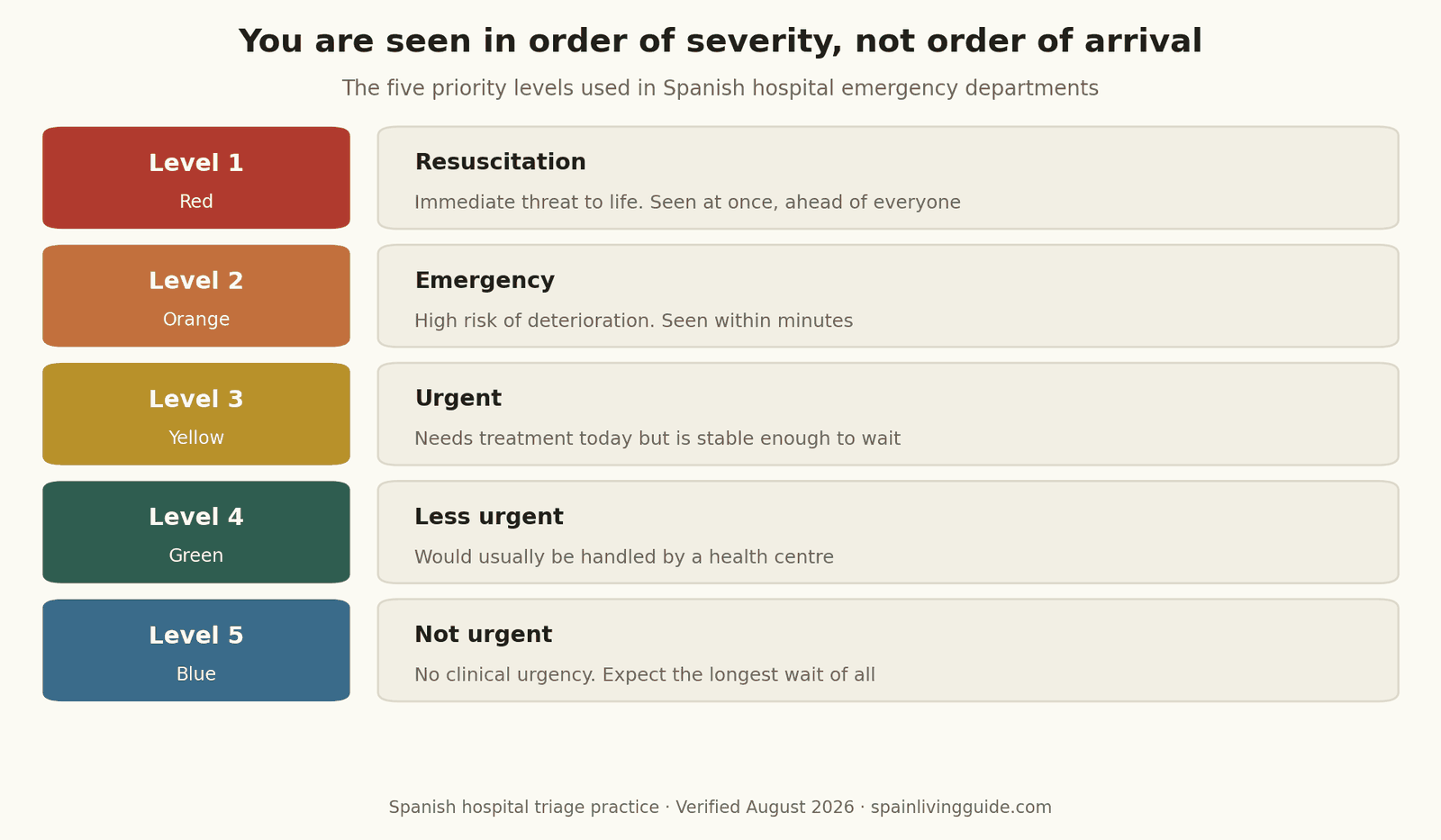
On arrival you register at admisión and are then assessed by a triage nurse, who assigns a priority level. From that point you are seen in order of clinical severity. Someone who arrived an hour after you and looks perfectly well may be taken through immediately, because the machine that measured their blood pressure disagreed with how they looked.
Three consequences follow, and knowing them in advance makes the experience considerably less maddening.
- Arriving by ambulance does not move you up the list. It gets you assessed en route and delivered to the right hospital. Once there, you are triaged like everyone else.
- A long wait is reassuring, not insulting. It means a trained professional judged you stable. Nobody with a genuinely time-critical problem sits in that room for hours.
- Tell the triage nurse if things change. Priority can be revised upward. New pain, worsening breathing or a fever climbing are all reasons to go back and say so rather than waiting politely.
Nobody can turn you away
This is the single most important point in the article, and it is worth stating without qualification: emergency care in Spain cannot be refused on administrative grounds.
Whether an episode is urgent is a clinical question, not a bureaucratic one. Spanish law defines urgent care by reference to the patient’s condition requiring immediate attention. Who ultimately funds that care is a separate question, answered afterwards by reference to your insurance, your European card, a bilateral convention, or a right recognised against public funds. An episode being billable later does not make the clinical need disappear now.
The practical importance of this is that hospital admissions desks have historically displayed signs demanding a DNI or a health card, and people without either have read them, turned around and left. That is the outcome the rule exists to prevent. Health authorities have instructed hospitals to remove such notices. If you are told at a desk that you cannot be seen without documentation, ask to be triaged anyway and ask for the refusal in writing. It will not be given, because the refusal is not correct.
The wider legal backdrop is that Spain restored universal access to the national health system by decree in 2018, decoupling the right to healthcare from social security contributions and attaching it to residence instead. The framework for people in Spain without legal residence was developed further by Real Decreto 180/2026 of 11 March, which also underpins the registration process described in our guide to getting your tarjeta sanitaria.
Who pays for your emergency treatment?
Select your situation. In every case you are treated first — this only tells you who receives the bill.
How this is worked out
Urgent care is defined clinically rather than administratively, so treatment is not conditional on documentation. Funding is settled separately. Residents registered with the system are covered directly. Visitors from the EU and EEA are covered for medically necessary treatment on presentation of a European Health Insurance Card, and UK visitors through the GHIC or, for those protected by the Withdrawal Agreement, a UK-issued EHIC. Visitors without either are private patients and are invoiced. People living in Spain who have not completed registration may be invoiced initially and can seek recognition of their entitlement afterwards.
Neither the EHIC nor the GHIC gives practical access to routine primary care in Spain, because booking a health centre appointment requires a regional health card. In practice those cards cover emergencies and unplanned necessary treatment.
Verified August 2026 against Spanish and European public guidance. General information, not medical or legal advice. In an emergency, call 112 first and settle the paperwork afterwards.
What emergency care in Spain costs, and who gets the invoice
For a registered resident, emergency treatment in a public hospital is free at the point of use. There is no attendance charge and no bill afterwards. Medication prescribed on discharge carries the ordinary pharmacy co-payment, a percentage that varies with your circumstances rather than a flat fee.
For visitors from the EU and EEA, a valid European Health Insurance Card entitles you to medically necessary treatment on the same terms as a Spanish patient. British visitors hold the equivalent through the GHIC, or a UK-issued EHIC where they are protected by the Withdrawal Agreement. Present the card at admisión, and do so before discharge — retrospective claims are far harder than showing a card at the desk.
What neither card does is give you a route into everyday care. Booking an appointment at a health centre requires a regional health card, which a visitor does not have. In practice the European cards cover emergencies and unplanned necessary treatment, and nothing else. For anything routine, a visitor is effectively a private patient.
Visitors from outside the EU are private patients of the public hospital and will be invoiced. This is the reason travel insurance matters, and the reason Spain requires proof of health cover for most long-stay visas, discussed in our guide to the Non-Lucrative Visa and in our comparison of public healthcare and private insurance in Spain. Pensioners whose care is funded by another country through an S1 are covered as ordinary Spanish patients once the form is registered — the mechanics are in our guide to the S1 form.
If you do receive an invoice you believe is wrong, do not simply pay it. Ask the hospital’s admission office how the episode was classified and what evidence would change it. People living in Spain who were billed while their registration was incomplete frequently have those invoices set aside once entitlement is recognised.
What to have with you, and what to say
Keep a photograph on your phone of your health card, your European card if you have one, your insurance policy number, and a short list of your regular medications with their active ingredients rather than brand names. Brand names differ between countries; active ingredients do not, and a Spanish doctor reading paracetamol and omeprazol understands you instantly.
A handful of phrases carry more weight than fluency.
| Spanish | Meaning |
|---|---|
| Necesito una ambulancia | I need an ambulance |
| Dolor en el pecho | Chest pain — say this and everything accelerates |
| No puedo respirar | I cannot breathe |
| Soy alérgico a… | I am allergic to… |
| Estoy tomando estos medicamentos | I am taking these medicines |
| ¿Puede venir un intérprete? | Can an interpreter come? |
Before you leave the hospital, collect your informe de alta, the discharge report. It records the diagnosis, what was done and what to do next, and you will need it for your own doctor, for any insurance claim, and for follow-up. Ask for it if it is not offered.
Mistakes that cost time, money or worse
- Driving yourself with chest pain. The ambulance begins treatment on the way and takes you to the hospital equipped for it. Your car does neither.
- Going to hospital urgencias for something a health centre handles. You will be triaged low and wait for hours behind everyone sicker than you.
- Leaving without the discharge report. No report, no insurance claim and no continuity of care.
- Not presenting your European card before discharge. Sorting it out afterwards is disproportionately difficult.
- Assuming a European card covers routine care. It covers emergencies and unplanned necessary treatment.
- Walking away from an admissions desk. Emergency care cannot be refused for administrative reasons. Ask to be triaged.
- Paying a disputed invoice immediately. Ask how the episode was classified first.
- Overlooking the pharmacy. For minor complaints it is faster, competent, and always open somewhere nearby.
Frequently asked questions
Is an ambulance free in Spain?
An ambulance dispatched by the emergency services for a genuine emergency is part of public provision and is not billed to a covered patient. Non-urgent transport arranged privately, and transport for a patient who is not covered, are different matters. Never let cost hesitation delay a 112 call.
Can I go to a private hospital in an emergency?
Yes, and it will be quicker for minor problems. Two cautions. Public hospitals generally hold the more advanced emergency resources for serious cases, particularly outside major cities. And an ambulance called through 112 goes to the appropriate public hospital, not to the one your policy covers, which is the correct clinical decision even when it complicates the paperwork.
Do I need a health card to be seen in urgencias?
No. It speeds up registration and settles the funding question, but treatment does not depend on it. Bring identification if you can; go anyway if you cannot.
What if I have been in Spain less than 90 days?
Administrations often treat people in their first three months as temporary visitors and decline to register them, which is a recurring source of dispute. Emergency care is unaffected: it is judged clinically. For anything else in that window, rely on travel or private insurance, and press ahead with registration in parallel.
How do I find out where the out-of-hours service is?
Ask at your health centre when you register and write the address down, because searching for it at two in the morning is not the moment. The name differs by region. Your regional health service website lists them, and a certificado digital makes those portals considerably easier to use.
Where does emergency access fit into moving to Spain?
Registering with the health system should be among the first things you do after your NIE and empadronamiento, precisely so that an emergency does not find you unregistered. Our complete guide to moving to Spain sets out the order, and our guide to the real cost of living in Spain covers what private cover adds to a household budget.
This article is general information, not medical or legal advice, and nothing in it should delay seeking help. If you believe you are facing a medical emergency in Spain, call 112. Organisational details, the names of out-of-hours services and triage practice vary between autonomous communities. The legal framework was verified in August 2026 against the Real Decreto-ley 7/2018 on universal access to the National Health System; Real Decreto 180/2026 of 11 March on recognition of the right to healthcare for foreign nationals in Spain without legal residence; and the European Commission’s Your Europe guidance on unplanned healthcare and the European Health Insurance Card. Confirm the arrangements in your own autonomous community with your regional health service.