
Two identical flats, same size, same year of construction, same cadastral value of €100,000. One is in a town that charges the legal minimum. The other is twenty minutes down the coast in a town that charges the legal maximum. The first owner pays €400 a year. The second pays €1,100. Neither of them chose that outcome, and almost none of the English-language material on buying in Spain mentions that the choice existed.
The IBI in Spain is the annual municipal property tax, and it is the one recurring cost of ownership that varies most between one town hall and the next. This guide explains how your rate is decided, how to look up the exact figure for any Spanish municipality using the government’s own database, why the bill can rise sharply without the town hall raising anything, and what the 2023 surcharge on empty homes does and does not do to a second residence.
How the bill is put together
The calculation is simple, and every component is decided by a different body. That is the part worth understanding, because it tells you who to argue with when something looks wrong.
| Component | Who sets it | Can you challenge it? |
|---|---|---|
| Valor catastral | The Dirección General del Catastro, a national body | Yes, but at the Catastro, not the town hall |
| Base liquidable | The valor catastral, less any transitional reduction | Only by challenging the underlying value |
| Tipo de gravamen | Your town hall, within limits fixed by national law | Politically, not individually |
| Bonificaciones | Your town hall, mostly optional | You must apply; they are rarely automatic |
| Recargo | Your town hall, for permanently unoccupied homes | Yes, by proving the property is used |
This split matters practically. Owners who believe their flat has been overvalued frequently complain to the town hall, which cannot help them, and never file with the Catastro, which can.
The band your town hall chooses within
The rate of IBI in Spain is not a national figure. It is a local decision taken inside a corridor that national law defines, and the corridor is wide.
Article 72 of the consolidated Local Finance Law sets a floor and a ceiling. For urban property the minimum and default rate is 0.4 per cent and the maximum is 1.10 per cent. For rural property the range runs from 0.3 to 0.9 per cent, and properties of special characteristics have a default of 0.6 per cent.
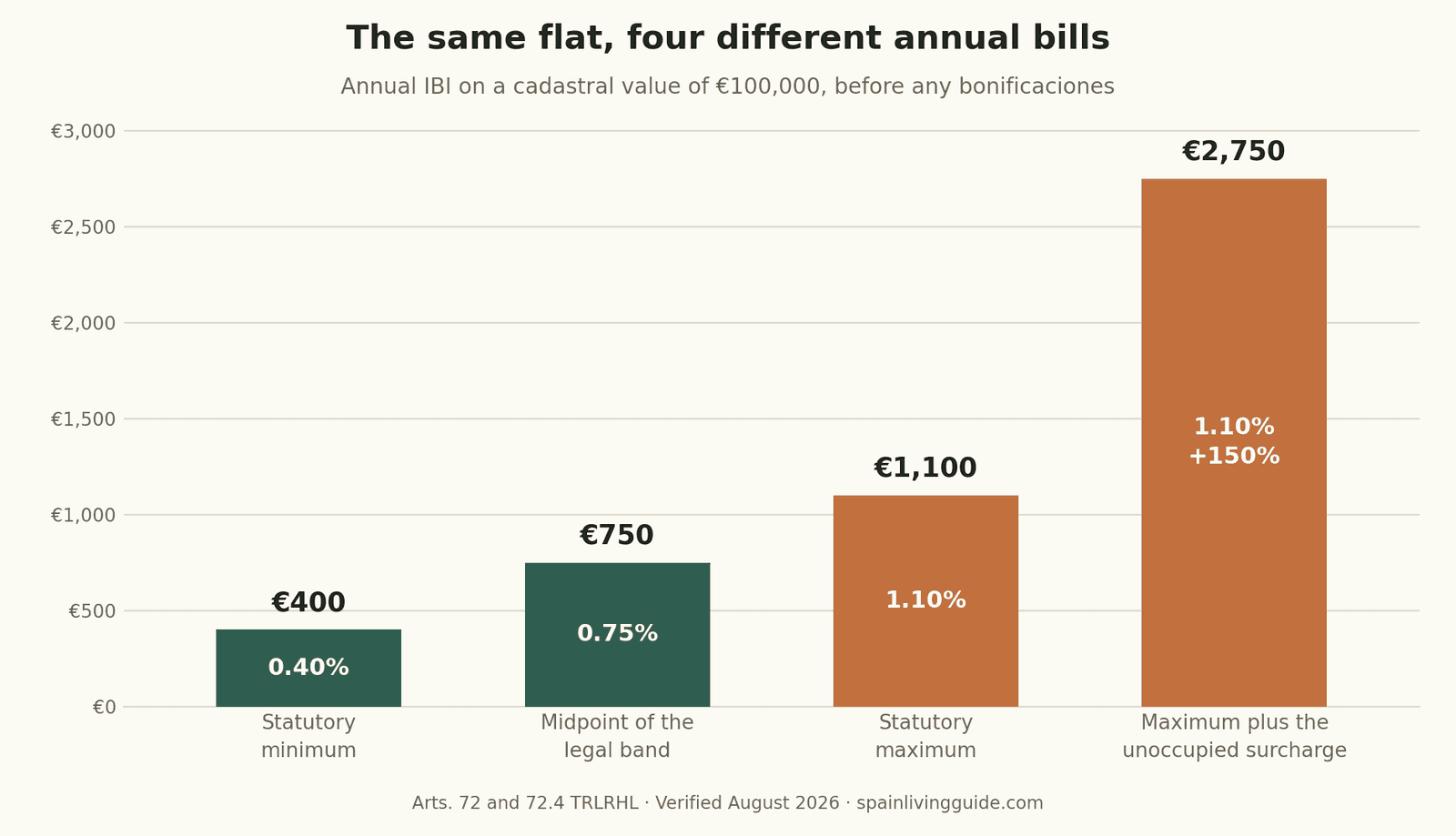
The top of the urban band is nearly three times the bottom. That is the entire explanation for why two comparable properties on the same stretch of coast can carry annual bills that differ by several hundred euros, and it is a difference that compounds every year you own.
Two refinements are worth knowing. Municipalities may set higher differentiated rates for non-residential urban property above a value threshold they define, which is why a commercial premises can carry a much higher rate than the flat above it. And a set of statutory increments allows municipalities providing certain services to raise the ceiling above 1.10 per cent, which is why capital cities and large towns sit at the top of the range more often than villages.
How to look up the exact rate for any municipality
This is the practical core of the article, and it is the piece missing from every English-language guide we have seen.
The Ministerio de Hacienda maintains a public consultation service covering every municipality in the common regime, going back to the year 2000. It requires no login and no certificate. You choose a province and a municipality, and it returns the rate applied to residential urban property, the rural rate, and from 2004 onwards the rate for properties of special characteristics. The same service covers the vehicle tax, the business activity tax, the construction tax and the municipal capital gains tax, and it lets you download the ministry’s annual publication of rates and coefficients as a PDF.
The data set is the national statistic on local taxation, included in the National Statistical Plan for 2025 to 2028. It excludes the Basque Country and Navarre, which set their local taxes under their own fiscal arrangements and must be checked with the relevant provincial authority.
Use it before you make an offer, not after you complete. Comparing two shortlisted towns takes four minutes and can change which one you buy in. If you want the definitive figure for the current year rather than the last published one, the town hall’s own ordenanza fiscal reguladora del IBI is the binding text, published on its electronic office and in the provincial official bulletin.
Estimate your annual IBI bill
Take the cadastral value from last year’s receipt or from the Catastro, and the rate from your town hall’s ordenanza or the ministry lookup described above.
How this is calculated
The IBI is the rate applied to the base liquidable, which is the cadastral value less any transitional reduction still running after a general revaluation. This estimate applies the rate directly to the cadastral value, so where a reduction is still in force the real bill will be lower. Bonificaciones reduce the cuota íntegra to produce the cuota líquida, under articles 73 and 74 of the consolidated Local Finance Law. The surcharge for permanently unoccupied residential property is applied to the cuota líquida under article 72.4 of the same law, as amended by the third final provision of Ley 12/2023.
Article 72 fixes the urban band at 0.4 per cent minimum and 1.10 per cent maximum, with statutory increments available to municipalities providing certain services. The band shown in the result reflects the ordinary limits.
Verified August 2026 against the consolidated text of the Ley Reguladora de las Haciendas Locales published by the Boletín Oficial del Estado. An estimate, not a tax assessment. Your receipt is the binding figure.
Why the bill rises when the rate does not
Owners often report that their IBI went up in a year when the town hall announced no increase. Usually nothing has been hidden from them. What has happened is a general revaluation.
When the Catastro carries out a collective valuation of a municipality, cadastral values are restated, often substantially. The law softens the landing with a transitional reduction applied to the base liquidable, phased out over a period of years. During that phase-out the taxable base climbs towards the new value even though the rate is untouched, and the bill rises every year until the reduction is exhausted.
Two consequences follow for a buyer. First, ask whether the municipality has recently revalued, because a bill that looks manageable today may have several scheduled increases still to come. Second, the revaluation of a coastal municipality with a large stock of foreign-owned second homes is a local political event with a long tail; the deed you sign is not the last word on what the property will cost to hold.
The empty-homes surcharge, and what it really targets
Since Ley 12/2023 came into force, English-language coverage has repeatedly told second-home owners that their holiday flat now faces a 150 per cent surcharge. That is a misreading, and it has frightened a lot of people unnecessarily.
The law defines a permanently unoccupied property as one that has stood empty, continuously and without justified cause, for more than two years, and that belongs to an owner holding four or more residential properties. Those two conditions are cumulative. An owner of a single Spanish holiday home does not meet the second one, whatever the first says about their usage.
The scale of the surcharge is graduated. The base figure remains 50 per cent of the cuota líquida. It can rise as vacancy continues, and municipalities may add up to fifty percentage points more where the owner holds two or more unoccupied residential properties in the same municipality, which is how the ceiling of 150 per cent is reached.
Three further points keep this in proportion. The surcharge is optional: it applies only in municipalities whose ordenanza fiscal has adopted it, and most have not. The town hall must establish the requirements, means of proof and procedure in that ordinance, including a hearing, so it cannot be imposed without giving you the chance to answer. And the law itself lists justified causes of temporary vacancy. Keep utility bills and evidence of occupation for a property you use seasonally, and the question resolves itself on paper.
Bonificaciones: money left on the table
Reductions in IBI are governed by articles 73 and 74 of the Local Finance Law. A few are compulsory for every municipality; most are optional, and among the optional ones the common threads are large families, officially protected housing, and renewable energy installations. Rates and conditions differ from one town to the next, which is exactly why they go unclaimed.
The critical procedural point is that discretionary bonificaciones are applied on request. Nobody at the town hall will notice that you have installed solar panels or that your family qualifies. There is normally an application window before the tax period begins, and missing it costs you the whole year. Read your municipality's ordinance once, apply for whatever fits, and the work is done for as long as you own.
Paying it, and the trap of a stale direct debit
IBI accrues on 1 January and falls due to whoever owned the property on that date. Each municipality sets its own voluntary payment period, commonly in the late spring or early autumn, and many now offer instalments. Set up a direct debit and take the discount if your town hall offers one for doing so.
The trap catches foreign owners more than anyone. If the receipt cannot be collected — a closed account, a card change, a bank that has merged — the town hall will send a notice to the address it holds, which is frequently the address the previous owner gave years ago. Nothing reaches you. Surcharges and interest accumulate, and the first you hear of it may be an embargo on the property.
Two habits prevent this entirely. Keep a Spanish bank account funded and current — our guide to banking in Spain for foreign residents covers the practicalities. And obtain a certificado digital, which lets you check your municipal tax account and read your notifications from anywhere in the world.
When you buy and when you sell
Because the tax accrues on 1 January, the seller is the taxpayer for the entire year in which the sale happens. Spanish practice is to apportion the bill between the parties from the date of the deed, and Supreme Court doctrine supports apportionment where the parties have not agreed otherwise, but the town hall will still pursue the person who owned it on 1 January. Put the apportionment in the deed explicitly rather than relying on custom.
More importantly for a buyer: unpaid IBI attaches to the property. Ask for the last receipt, check the cadastral reference against the nota simple, and confirm the municipal tax account is clear before signing. That check belongs alongside the community debt certificate in the due diligence we set out in our guide to the Spanish property purchase process. If you are selling as a non-resident, the interaction with the municipal capital gains tax is covered in our guide to selling property in Spain as a non-resident.
Mistakes that cost owners money
- Not comparing rates before choosing a town. Four minutes in the ministry database, and the difference persists for as long as you own.
- Complaining to the town hall about the cadastral value. Wrong authority. Cadastral value goes to the Catastro.
- Never applying for a bonificación. Discretionary reductions are granted on request and there is usually a deadline.
- Assuming a stable rate means a stable bill. A revaluation raises the taxable base for years without the rate moving.
- Panicking about the empty-homes surcharge. It requires four or more residential properties and only applies where the ordinance has adopted it.
- Letting the direct debit lapse. The most expensive administrative error a non-resident owner can make.
- Buying without checking for arrears. Unpaid IBI attaches to the property you are acquiring.
- Forgetting the rest of the bill. Rubbish collection is usually charged separately and is not included in the IBI figure you compared.
Frequently asked questions
What is a typical IBI bill?
There is no useful national typical figure, because the two inputs both vary enormously. What is meaningful is your own: cadastral value multiplied by your municipality's rate. A modest coastal apartment often produces a bill in the low hundreds; a villa with a high cadastral value in a town near the ceiling can run into four figures.
Do non-residents pay the IBI in Spain?
Yes. The tax follows ownership, not residence. Non-resident owners also file an annual return on imputed income for a property kept for their own use, which is a separate national tax and is covered in our guide to the annual taxes of owning property in Spain.
Can I appeal my cadastral value?
Yes, through the Catastro, and it is worth doing when the recorded surface area, use or condition of the property is plainly wrong. Success depends on demonstrable error rather than on the value feeling high. Deadlines are short and run from notification of the value, not from the tax bill.
Does the IBI change when I buy?
The purchase price does not alter the cadastral value, so the bill does not jump because you paid more than the previous owner. What changes the value is a cadastral revision or a declared alteration such as an extension or a pool. Undeclared works that later surface generate back-dated bills.
Is the IBI deductible against rental income?
For residents letting a property, yes, among other expenses. For non-residents the position depends on where you are resident, and the difference is substantial. Our guides to IRPF for foreign residents and to the annual property taxes set out how rental income is taxed in each case.
Should the IBI rate influence where I buy?
It should be one input among several rather than the deciding one. A difference of several hundred euros a year is real money over a decade, but it is smaller than the differences in purchase tax, service quality and property price between regions. Our comparison of buying property in Málaga versus Valencia and our guide to the real cost of living in Spain put it in context, and our complete guide to moving to Spain covers the sequence of the move itself.
This article is general information, not tax advice. IBI rates, bonificaciones and surcharges are set by each municipality in its own fiscal ordinance and change from year to year, and the Basque Country and Navarre operate outside the common regime described here. The legal framework was verified in August 2026 against the consolidated text of the Ley Reguladora de las Haciendas Locales, in particular articles 72, 73 and 74; the Ley 12/2023 por el derecho a la vivienda, whose third final provision amended the surcharge on permanently unoccupied homes; and the Ministerio de Hacienda's published procedure for consulting local tax rates, indices and coefficients, accessible through its municipal tax information consultation service. Always confirm the current figure with your own town hall's fiscal ordinance before relying on it.