Buying a home in Spain is not difficult. It is unfamiliar, which is a different problem and a more dangerous one, because unfamiliar processes fail quietly. The Spanish property purchase process runs on a sequence of documents whose names are usually left untranslated in English-language guides, and whose legal effect is usually described wrongly. The nota simple is not a guarantee. The arras contract does not automatically let you walk away. And ownership does not pass when you pay.
This guide follows the transaction from first viewing to the moment the Land Registry recognises you as owner, with the legal reasoning behind each step and the specific points where foreign buyers lose money. It assumes a resale property; buying off-plan is a different process, covered in our guide to buying off-plan property in Spain.
The shape of the Spanish property purchase process
Spanish conveyancing has no equivalent of the English exchange-and-completion split, and no equivalent of the American escrow company holding the ring. In its place there is a notary, a registrar, and a body of civil law that assumes both parties know what they are signing.
| Stage | What it is | Typical timing |
|---|---|---|
| Reserva | A small holding deposit paid to the agent to take the property off the market | Day 0, optional |
| Due diligence | Nota simple, cadastral check, planning position, community and utility debts | Days 1–14 |
| Contrato de arras | Private contract fixing price, deadline and the consequences of withdrawal | Weeks 1–3 |
| Escritura pública | Signature before the notary, payment, handover of keys | Weeks 6–12 |
| Tax and registration | Transfer tax filed, then inscription in the Land Registry | Weeks 12–20 |
One structural point governs everything that follows. Under Spanish law ownership passes by título y modo: a valid contract plus delivery. Signing at the notary and receiving the keys is what transfers ownership. Registration does not create your title. What registration does is make your title unassailable against the rest of the world, and that distinction is the reason the last stage matters as much as the first.
The nota simple, and what it does not tell you
The nota simple is an extract from the Land Registry describing the property, naming the registered owner, and listing the charges recorded against it: mortgages, embargoes, easements, conditions, court annotations. It costs a few euros and it is the single most useful document in the whole transaction. Read it, or have it read, before you pay anything.
What most guides omit is that the nota simple is expressly informative. It has no probative force of its own; the document that carries registry certification is the certificación registral, which costs more and is rarely obtained on ordinary purchases. In practice the nota simple is reliable, but it is a snapshot of a moment, and the moment passes.
Three specific gaps are worth naming, because none of them appears on the document.
- Unregistered charges. Unpaid community fees, unpaid IBI, and unpaid utility bills do not appear on the nota simple, and two of the three follow the property rather than the seller.
- Planning irregularities. A closed-in terrace, a converted basement or a pool built without a licence will not show up. The registry records title, not compliance.
- Tenants. Most residential leases are not registered. A tenant in occupation can have rights that survive the sale, which is why our guide to renting a home in Spain matters to buyers as well.
Alongside the nota simple, obtain the cadastral record. The Registry and the Cadastre are separate systems describing the same property, and they disagree more often than newcomers expect: different surface areas, different boundaries, sometimes a different number of rooms. A mismatch is not fatal but it must be resolved before signature, because it will resurface when you sell.
Arras: the most expensive misunderstanding in Spanish conveyancing
Every English-language guide describes the arras contract the same way: you pay ten per cent, and if you pull out you lose it, while if the seller pulls out they pay you double. That description is of one specific type of arras, and it is not the type you get by default.
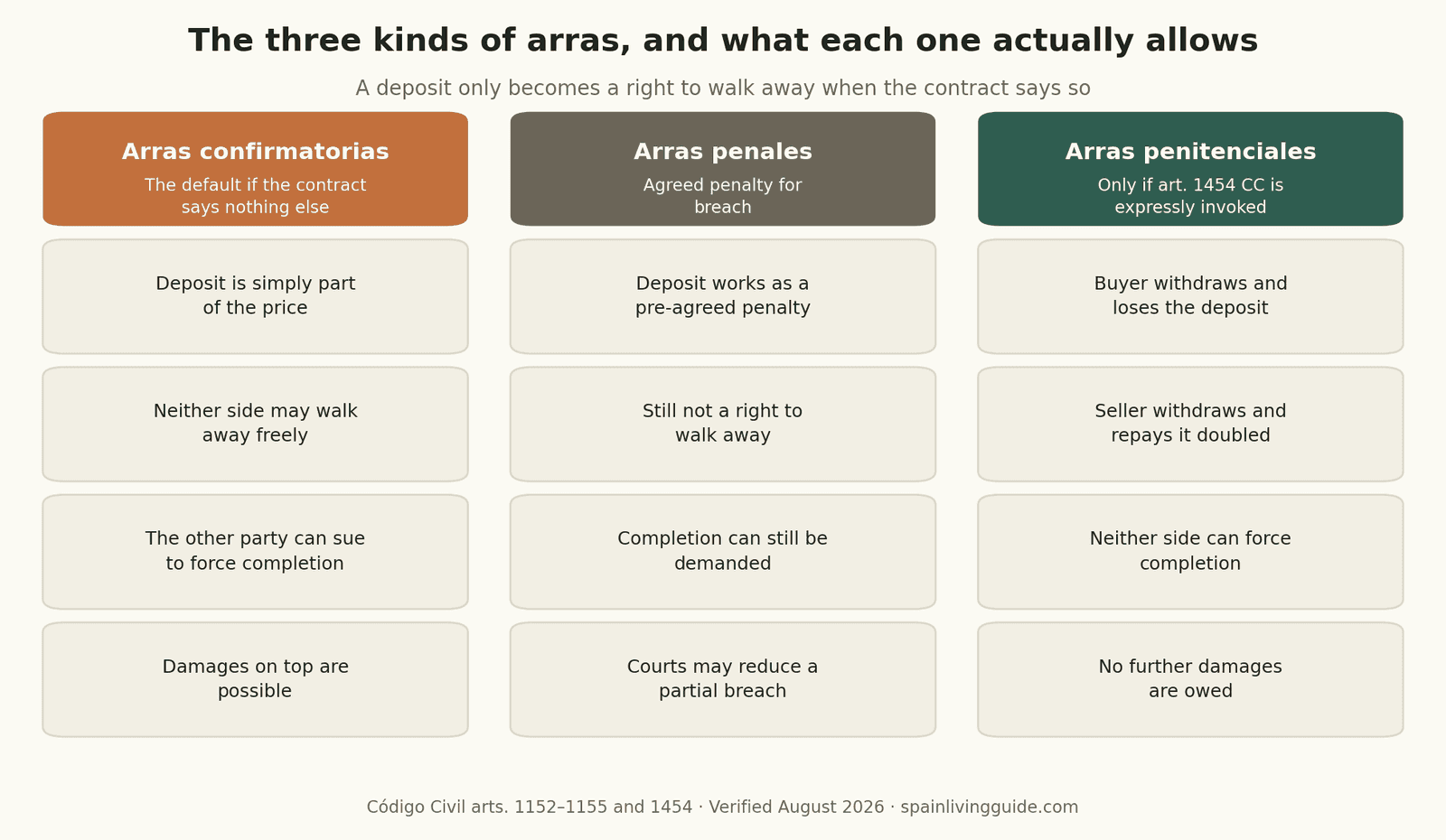
Spanish law recognises three kinds of deposit, and the difference between them is the difference between a paid exit and a lawsuit. Article 1454 of the Civil Code is the provision that allows a party to withdraw by forfeiting or returning the deposit doubled — and the Supreme Court treats that article as exceptional, requiring restrictive interpretation and an unambiguous shared intention before a deposit is read that way.
The practical consequence is blunt. If your contract does not expressly invoke article 1454, the presumption is that your deposit is confirmatoria: proof that a binding sale exists, and part-payment of the price. You have not bought an exit. The seller can go to court and demand that you complete, and can claim damages beyond the deposit. Buyers who believed they had a ten per cent walk-away option have discovered otherwise at exactly the wrong moment.
Read your arras contract for the phrase arras penitenciales and an express reference to article 1454. If neither is there, ask for both in writing before you transfer a cent. This single sentence is worth more than every other paragraph in this article.
A regional refinement that catches buyers in Barcelona and Girona: Catalonia has its own civil code, and its treatment of penitential deposits sets a maximum period for exercising the right to withdraw and extinguishes that right once the parties begin performing the contract. A deposit structure that works in Málaga does not necessarily behave identically in Catalonia.
Debts that follow the property, not the seller
This is where money is genuinely lost, and it is almost entirely preventable.
Under the Horizontal Property Law, a buyer of a flat responds with the property itself for community charges left unpaid by previous owners, covering the elapsed part of the year of purchase and the three full calendar years before it. The debt attaches to the flat. Buying in good faith and registering your title does not clear it.
The law protects you, but only if you let it. The seller must declare that community charges are current and must produce a certificate from the community confirming it, and the notary may not authorise the deed without that certificate — unless the buyer expressly waives it. Waiving is presented as a routine time-saver and is nothing of the kind. Never waive the certificate. On a large urbanisation with a swimming pool, lifts and a special levy for a roof repair, four years of arrears is not a small sum.
IBI, the annual municipal property tax, carries a similar attachment through local tax legislation, so unpaid IBI can be pursued against the property. Ask for the last receipt and check that it matches the cadastral reference on the nota simple. Our guide to IBI, plusvalía municipal and the annual taxes of owning a Spanish home covers what you will be paying from the year after purchase.
One further trap applies specifically when the seller is not resident in Spain. In that situation the buyer becomes substitute taxpayer for the municipal plusvalía, meaning the town hall can pursue you for a tax on the seller’s gain. Retain the amount at completion. We explain the mechanics from the other side in our guide to selling property in Spain as a non-resident.
What does your arras clause actually give you?
Set the deposit and the wording of your contract to see what each side can do if the deal falls apart.
How this is worked out
Article 1454 of the Civil Code provides that where arras have been given, the contract may be undone by the buyer forfeiting them or the seller returning them doubled. Spanish case law treats this as an exceptional remedy requiring restrictive interpretation, so a deposit is read as penitential only where the parties’ intention to that effect is unequivocal. Absent that wording, a deposit is presumed confirmatory: evidence of a concluded sale and part payment of the price, leaving the injured party free to demand performance or termination with damages under article 1124. Arras penales operate as an agreed penalty under articles 1152 to 1155 and do not, by themselves, create a right of withdrawal.
Figures shown are the contractual amounts at stake. They exclude legal costs, and they exclude any damages a court might award beyond the deposit.
Verified August 2026 against the consolidated text of the Código Civil published by the Boletín Oficial del Estado. General information, not legal advice. Have any arras contract reviewed by a Spanish lawyer before signing.
What to have ready before the notary
The notary is a public official, not your representative. Their duty is to verify identity and capacity, confirm the legality of the act, read the deed, and record what happens. They will flag obvious problems and answer questions, but they do not negotiate for you and they do not investigate your interests. If you want someone on your side, that is a lawyer, and it is a separate cost.
You will need:
- An NIE. Non-negotiable, and the first thing to arrange. Our guide to NIE, TIE and empadronamiento explains how.
- A Spanish bank account. Practically essential for the bank drafts used at completion and for the direct debits that follow. See our guide to banking in Spain for foreign residents.
- Cleared funds in Spain, well in advance. International transfers of this size attract compliance checks. Start ten days before, not two.
- Your passport, and a translator if you need one. The notary must be satisfied you understand the deed. If your Spanish is not up to a legal document read aloud, an interpreter is required rather than optional.
- A power of attorney if you cannot attend. Granted before a Spanish notary, or before a notary abroad with a Hague apostille and a sworn translation.
- The energy performance certificate and, where the region requires it, the habitation licence. Both are the seller’s responsibility to produce.
Payment at completion is made by bank draft, and the amounts and their origin are recorded in the deed. Cash is effectively excluded at these values by anti-money-laundering rules. Expect to be asked to evidence where the money came from; this is normal and applies to everyone.
Signing day, and the protection nobody explains
The signing itself is brisk. The notary confirms identities, reads the deed, both parties sign, drafts change hands, keys change hands. You leave with a copia simple of the deed; the authorised copy follows once the taxes are filed.
Here is the part that resolves an anxiety most buyers do not know they should have. Between signature and registration there is a window during which the registry still shows the seller as owner. In principle, a third party who registered first could defeat you, because the mortgage law protects the good-faith purchaser who has inscribed their right.
Spanish practice closes that window. Ask the notary to send the electronic notification to the Land Registry on the day of signature. This generates an entry that secures your priority from that moment, so anything presented afterwards ranks behind you. It is standard, it costs almost nothing, and it converts a theoretical exposure into none. Ask for it by name.
Tax, then registration
The Registry will not inscribe your purchase until the transfer tax has been filed. For a resale that is ITP at a rate set by the autonomous community; for a new-build it is IVA plus AJD. The filing deadline is short and the difference between regions is large enough to affect where you buy. We set out the rates and the mechanics in our guide to property purchase taxes in Spain, and compare two of the most popular markets in our guide to buying property in Málaga versus Valencia.
Once the tax is filed, the deed goes to the Registry for inscription. Allow a few weeks. Then do the last two things almost everyone forgets: transfer the utility contracts and the IBI direct debit into your name, and notify the community administrator. And make a Spanish will covering your Spanish assets, because Spanish succession law is unlike anything you are used to — our guide to estate planning and wills in Spain explains why this matters more than it sounds.
What it costs on top of the price
| Item | Who pays, by default | Order of magnitude |
|---|---|---|
| Transfer tax (ITP, or IVA + AJD) | Buyer | By far the largest cost; varies by region and property type |
| Notary fees | Buyer, by custom | Set by official scale, based on the declared value |
| Land Registry fees | Buyer | Set by official scale, lower than the notary |
| Gestoría | Buyer | Optional unless a lender requires it |
| Lawyer | Buyer | Commonly quoted around 1% of the price |
| Estate agent | Seller | Already inside the asking price |
| Plusvalía municipal | Seller — but the buyer substitutes when the seller is non-resident | Depends on the municipality and the years of ownership |
Budget ten to fourteen per cent above the price. Buyers who budget the price alone and discover the rest at the arras stage are the ones who end up borrowing badly or walking away from a deposit.
Mistakes that cost buyers real money
- Signing arras without checking the type. The single most expensive error in this article, and the easiest to avoid.
- Waiving the community debt certificate. You inherit up to four years of arrears attached to the flat.
- Using the seller’s lawyer, or the agent’s. Instruct your own, independent of everyone earning commission on the sale.
- Paying a reserva before seeing the nota simple. Reserva deposits are frequently non-refundable in practice.
- Under-declaring the price. Still occasionally proposed. It is tax fraud, the regional authority will value the property independently, and it inflates your own capital gain when you sell.
- Assuming registry and cadastre agree. Resolve discrepancies before signing, not when you come to sell.
- Ignoring planning status on rural property. Rural builds carry their own regime, and an unlicensed house can be unsellable and uninsurable.
- Leaving no margin on the arras deadline. If your mortgage is not approved by the date in the contract, it is your deposit at risk, not the bank’s.
Frequently asked questions
Do I need a lawyer to buy property in Spain?
Not legally. In practice, yes, if you are foreign. The notary verifies legality but does not act for you, the agent is paid by the seller, and nobody else in the room is checking planning status, tenancy, or the wording of your arras clause. On the sums involved, roughly one per cent buys the only independent professional in the transaction.
Can I buy without being resident in Spain?
Yes. There is no residency requirement for buying, and no nationality restriction on ordinary residential property. You need an NIE. Owning property does not by itself grant residency; the routes that remain are covered in our guide to Golden Visa alternatives in Spain.
How long does the whole process take?
Six to twelve weeks from arras to signature is normal for a cash purchase, and the arras contract sets the deadline. The Spanish property purchase process is rarely delayed by the notary; it is delayed by lenders and by missing paperwork. With a mortgage, allow longer and negotiate a deadline that reflects your lender’s timetable rather than the seller’s optimism.
What happens if the seller has an outstanding mortgage?
It is routine. The lender issues a settlement figure, the buyer pays that amount directly to the bank at completion by separate draft, and the mortgage is cancelled and removed from the registry. Make sure the arras contract obliges the seller to deliver the property free of charges and that the cancellation costs fall on them.
Is a private contract enough, or do I have to go to the notary?
A private contract is valid between the parties, and either can compel the other to convert it into a public deed. But only a public deed can be registered, and only registration gives you full protection against third parties. Skipping the notary to save a few hundred euros is a false economy of a spectacular kind.
What ongoing costs should I expect after buying?
IBI, community fees, rubbish collection, insurance, utilities and, if you are not tax resident in Spain, an annual non-resident return on imputed income even when the property sits empty. Our guides to the annual taxes of owning property and to the real cost of living in Spain put realistic figures on it.
Where does buying fit in the wider move?
Later than most people assume. Get the NIE and a bank account first, rent for a season in the area you think you want, and buy once you know the neighbourhood in winter as well as August. Our complete guide to moving to Spain puts the sequence in order.
This article is general information, not legal or tax advice. Conveyancing practice varies between autonomous communities and between individual notaries and registries, and Catalonia, Aragón, Navarre, the Basque Country, Galicia and the Balearic Islands apply their own civil law in areas relevant to this process. The legal position was verified in August 2026 against the consolidated texts published by the Boletín Oficial del Estado: the Código Civil, in particular articles 1124, 1152 to 1155, 1279, 1280 and 1454; the Ley Hipotecaria and its consolidated text, in particular articles 32, 33 and 34 on the protection of the registered purchaser; the Reglamento Hipotecario; and the Ley 49/1960 de Propiedad Horizontal, in particular article 9.1.e) on liability for a previous owner’s community debts. Instruct an independent Spanish lawyer before signing anything.