
The advertised price of a Spanish property is never the price you actually pay. Between the transfer tax, the notary, the Land Registry, and the gestoría who files it all correctly, buyers typically add somewhere between 10% and 14% on top of the purchase price, and which end of that range you land on depends heavily on one thing most buyers never think to check: which autonomous community the property sits in. This guide breaks down the property purchase taxes in Spain that apply in 2026, region by region, so you can budget accurately before you make an offer rather than discover the real number at the notary’s table. It covers the one-off taxes you pay to acquire a property; the recurring taxes that start the day after completion, IBI, the IRNR imputed income charge and the plusvalía municipal you meet on selling, are a separate subject covered in our guide to the annual taxes of owning property in Spain. Read this one before you buy and that one before you complete.
The Fork in the Road: New Build vs. Resale
Every property purchase in Spain falls into one of two tax regimes, and the difference between them is substantial. Buy a resale property (segunda mano) from a private seller, and you pay ITP (Impuesto de Transmisiones Patrimoniales). Buy a new build directly from a developer or promoter (a “first delivery”), and you instead pay IVA (VAT) plus AJD (Actos Jurídicos Documentados, a stamp duty on notarised documents). The two systems are mutually exclusive on the same transaction: you never pay both ITP and IVA on the sale itself, though AJD can apply alongside either one in specific circumstances, most commonly on the mortgage deed.
This single distinction is worth understanding before you fall in love with a specific property, because it changes your total cost by several percentage points, and it is not always obvious from a listing whether you are buying from the original developer or from a subsequent owner.
ITP: The Tax on Resale Property
ITP is a regional tax, ceded by the state to each autonomous community under Real Decreto Legislativo 1/1993, which means the rate you pay depends entirely on where the property is located, not where you live or your nationality. It is calculated on the higher of the price stated in the deed or the property’s official “valor de referencia” set by the Catastro (Spain’s land registry valuation body); if you declare a price below that reference value, the tax office can assess the difference and add a surcharge.
General ITP rates in 2026 range from 4% to 13% depending on the region, with most of the popular expat destinations sitting between 6% and 10%. The buyer, not the seller, pays this tax, and it is due within 30 working days of signing the deed, self-assessed and filed using Modelo 600 with the regional tax authority rather than the Agencia Tributaria, since this is a devolved tax. That distinction trips people up, and filing with the wrong administration does not stop the 30-day clock. In Catalonia the Modelo 600 goes to the Agència Tributària de Catalunya; in Madrid to the Dirección General de Tributos of the Comunidad; in Andalusia to the Junta’s own tax agency. Find the right one before completion, not after.
One warning before the table below. Because ITP is regional, rates change on each community’s own timetable, and often mid-year rather than on 1 January. The Valencian Community, for instance, cut its general rate with effect from 1 June 2026, meaning a purchase completed in May of that year was taxed differently from one completed in June. Always confirm the rate in force on the date your deed is actually signed, not the rate that applied when you started looking.
ITP and AJD Rates by Region in 2026
The gap between regions is large enough to change where some buyers choose to look. On a €300,000 resale property, the ITP alone runs to €18,000 in Madrid against €30,000 in Catalonia, and the gap widens sharply above €600,000 where Catalonia’s banded scale starts biting.
| Region | ITP (resale, general rate) | AJD (new build / mortgage) |
|---|---|---|
| Madrid | 6% (4% for large families buying a habitual home; separate 10% rebate on the tax due under €250,000) | 0.75% |
| Andalusia | 7% (6% on a habitual home up to €150,000; 3.5% for buyers under 35, large families, or disability of 33%+, up to €250,000) | 1.2% |
| Valencia Region | 9% up to €1,000,000; 11% on the portion above (since 1 June 2026) | 1.4% (since 1 June 2026) |
| Catalonia | Banded: 10% to €600,000, 11% to €900,000, 12% to €1,500,000, 13% above (since 27 June 2025). 20% for large holders | 1.5% |
| Balearic Islands | Scaled 8% to 13% by property value | 1.2% |
| Canary Islands | 6.5% | 0.75% (IGIC applies instead of IVA on new build) |
| Murcia | 8% (5% reduced for qualifying young buyers) | 1.5% |
| País Vasco (foral) | 4% | Set by each foral territory |
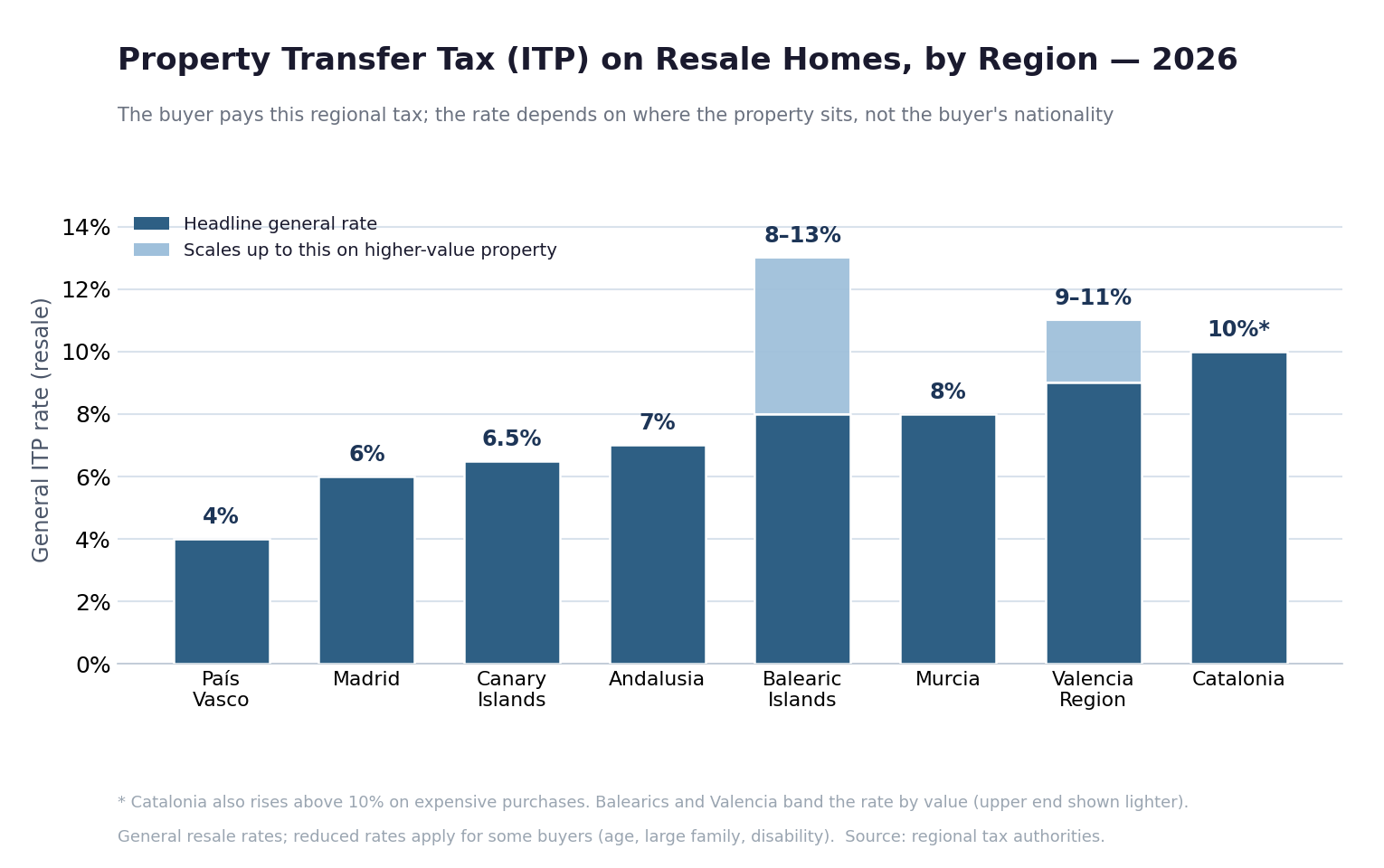
These are general rates only, and the reduced rates are worth more attention than they usually get, because they differ in kind and not just in size. Some regions cut the rate; others apply a rebate to the tax due; some cap by property value and others by the buyer’s income. Three examples show how little they resemble each other. The Comunidad de Madrid reserves its 4% rate for large families buying a habitual home, with no value ceiling, and separately gives a 10% rebate on the tax itself below €250,000; its headline 100% relief for under-35s applies only in municipalities of fewer than 2,500 inhabitants. The Junta de Andalucía uses value bands instead, 6% on a habitual home to €150,000 and 3.5% to €250,000 for qualifying buyers. Catalonia gates its 5% youth rate on income, requiring an IRPF general base under €36,000, with the age limit raised from 32 to 35 in June 2025.
The practical lesson is that you cannot carry an assumption across a regional border. Check your own community’s current rules against your own profile before you budget, because the saving frequently runs into thousands of euros and the conditions are precise enough that near-misses are common.
Note also that several regions apply a progressive scale rather than a flat rate. The Balearic Islands and the Valencian Community both work this way, and Catalonia joined them on 27 June 2025 under Decret llei 5/2025, replacing its old flat 10% with four bands. Crucially, banded means banded: only the slice of value inside each band pays that band’s rate, so a €700,000 Catalan purchase pays 10% on the first €600,000 and 11% on the remaining €100,000, not 11% on the lot. If you are buying above about €600,000, check whether your region bands the rate rather than assuming the headline figure applies to the whole price.
One further Catalan rule catches investors and, occasionally, families buying together. The Agència Tributària de Catalunya applies a flat 20% where the buyer is a gran tenidor, meaning an individual or company owning more than ten residential properties or over 1,500 m² of residential floor space, dropping to just five properties inside a declared stressed-market area. The same 20% applies to the purchase of an entire residential building even where the buyer is not a large holder, with carve-outs for social developers, non-profits, and individuals buying a building of no more than four dwellings for their own or their family’s use. Garages and storage rooms do not count towards the property tally.
IVA and AJD: The Tax on New Build Property
Buy directly from a developer and the transaction is subject to national VAT instead of regional ITP. The standard rate is 10% on residential property anywhere in mainland Spain and the Balearics (the Canary Islands apply their own indirect tax, IGIC, generally at a lower rate), with a reduced 4% rate reserved for certain publicly protected housing (VPO). Unlike resale purchases, new build always carries AJD on top of the sale itself, typically around 0.75% to 1.5% depending on the region, because IVA does not cover the separate documentary stamp duty the way ITP does.
The practical effect is that new build almost always costs more in transaction taxes than an equivalent resale property. A €300,000 new-build home in Madrid, for example, carries roughly €30,000 in IVA plus €2,250 in AJD (about 10.75% combined), against roughly €18,000 in ITP (6%) for a comparable resale home in the same region. If you are weighing a new development against an established property, this gap deserves a line in your budget spreadsheet, not just a mention in passing. For buyers specifically considering an off-plan purchase, where the tax point and payment schedule interact with legal protections on deposits, our guide to buying off-plan property in Spain covers the additional safeguards you need in place before paying a deposit.
AJD on the Mortgage: Who Actually Pays It
A separate AJD charge applies to the mortgage deed itself, whenever a buyer takes out a home loan. Since a 2018 legal reform, the bank, not the borrower, is legally the taxpayer for this specific AJD charge, so buyers financing their purchase generally no longer see this cost on their own settlement, though lenders sometimes factor it into their overall fee structure indirectly. It is still worth confirming with your lender exactly how their fees are structured, since practices vary between institutions.
Notary, Land Registry, and Gestoría Fees
Beyond the tax itself, three further costs apply to every Spanish property purchase, and none of them are negotiable away entirely, though the notary and registry fees are set on a fixed government scale rather than freely priced.
- Notary fees are set by a state-regulated fee scale (arancel notarial) based on the property’s declared value, generally working out to roughly 0.2% to 0.5% of the price, with a floor of a few hundred euros even on lower-value properties. You are legally free to choose your own notary, and shopping around within the permitted scale can still save a modest amount.
- Land Registry fees (Registro de la Propiedad) for recording the change of ownership follow a similarly regulated scale, typically around 0.1% to 0.25% of the property value. Registration is what makes your ownership enforceable against third parties, so this step is not optional in practice even though Spanish law technically allows an unregistered sale.
- Gestoría fees for the administrative agent who typically handles filing the tax self-assessment (Modelo 600), registering the deed, and coordinating between notary and registry usually run from roughly €300 to €800, depending on complexity and region. Foreign buyers in particular tend to find this a worthwhile expense given the paperwork involved and the tight 30-working-day filing deadline for ITP.

Adding these three together with the property tax typically brings total transaction costs to roughly 10% to 12% of the purchase price for a resale home, and 12% to 14% for a new build, on top of the price itself and any mortgage arrangement fees. Buyers considering a beachfront or coastal property should also budget time, if not additional tax, for verifying the property’s status under Spain’s coastal law before signing anything; see our guide to the Ley de Costas and beachfront property for what that verification involves.
A Worked Example: Same Price, Different Regions
To make the regional gap concrete, here is how a €250,000 resale purchase compares in three popular expat destinations, covering tax alone and excluding notary, registry, and gestoría costs, which add a further €1,500 to €2,500 in any region.
| Region | ITP rate | Tax due on €250,000 |
|---|---|---|
| Madrid | 6% | €15,000 |
| Andalusia | 7% | €17,500 |
| Valencia Region | 9% | €22,500 |
A €7,500 swing on an identical property, purely based on which side of a regional border it sits, is exactly why comparing markets is worth doing before you commit to a specific area, and the gap widens considerably at higher prices where banded rates kick in. Our comparison of buying in Málaga versus Valencia works through exactly that, alongside lifestyle and market factors for buyers weighing both regions.
Deadlines, Penalties, and the Registry Lock
ITP and AJD must be self-assessed and paid within 30 working days of signing the deed, using Modelo 600 (Modelo 601 covers certain exempt or non-subject operations). Miss the deadline and a late-filing surcharge applies, starting at 1% and increasing by a further percentage point for each full month of delay, with interest and potential penalties added on top if the tax authority has to formally chase the payment. Beyond the financial cost, Article 254 of the Mortgage Law (Ley Hipotecaria) creates a practical lock: no entry can be made in the Land Registry without first proving that the applicable taxes have been paid, so an unpaid or unfiled ITP return leaves your ownership unregistered even after the deed is signed.
Frequently Asked Questions
Do I pay ITP or IVA if I buy a resale property from a company rather than an individual?
Generally still ITP, since ITP applies to transfers between parties acting outside the ordinary course of a VAT-liable business activity. IVA applies specifically to a “first delivery” from a developer or a business selling as part of its taxable activity. A company selling a property it holds as an investment, rather than as stock built for sale, would typically still fall under ITP; this distinction can get technical, so confirm it with your gestoría or lawyer for anything other than a straightforward developer purchase.
Can I negotiate the ITP rate down?
No. The rate is fixed by the region based on the property’s value and your qualifying profile (age, family status, disability); it is not open to negotiation with the tax office. The only “negotiation” available is confirming you qualify for every reduced-rate category that applies to you before you file.
The rate changed after I agreed the price. Which one applies?
Generally the rate in force on the date the taxable event occurs, which for a purchase is when the deed is signed, not when you agreed a price or paid a deposit. Where a region announces a change with a specific effective date, as the Valencian Community did on 1 June 2026, the timing of your signing can therefore change what you owe. If a completion date sits close to a known change, it is worth raising with your lawyer or gestoría before fixing the date.
Does buying a property in a low-ITP region affect my other Spanish taxes?
ITP itself is a one-off transaction tax, but owning the property brings its own recurring obligations: the annual IBI, the IRNR imputed-income tax for non-residents, and the plusvalía municipal when you eventually sell, all covered in our guide to the annual taxes of owning property in Spain. The property will also count toward your net worth for Spain’s annual Wealth Tax if you become a Spanish tax resident, and regional wealth tax rules vary just as widely as ITP does. It is worth reading these alongside each other rather than in isolation; see our guide to Spain’s Wealth Tax for how regional exemptions interact with property ownership. One further distinction is worth carrying with you: ITP is regional, but IBI is municipal, so a low-ITP region can still contain expensive town halls, and neighbouring municipalities can charge noticeably different amounts on near-identical homes. Our guide to how the IBI rate is set and how to look yours up explains how to check the real figure for a specific address before you commit to it.
What happens if I under-declare the purchase price to reduce the tax?
Since 2022, the taxable base for ITP cannot be lower than the Catastro’s official “valor de referencia,” regardless of what price is written in the deed. You can look it up in advance, and should: the Sede Electrónica del Catastro publishes and certifies the figure for any property from its cadastral reference, so there is no reason to discover it after signing. If your declared price is below that reference value, the regional tax authority can issue a complementary assessment for the difference, plus interest. If you genuinely believe the reference value overstates the property’s real worth, you can challenge it, typically through an independent appraisal, but the default assumption works against under-declaring.
If I am gifted a property rather than buying it, does ITP still apply?
No. Gifts fall under a different tax entirely, the Impuesto sobre Sucesiones y Donaciones, with its own regional rules, its own 30-business-day deadline, and a separate capital gains charge on the donor where the property has appreciated. Our guide to Spain’s gift tax sets out what a family property transfer actually costs.
Planning to relocate to Spain as part of this purchase? Our step-by-step overview of how to move to Spain in 2026 walks through the visa, residency, and healthcare decisions that typically run alongside a property purchase.
Verified August 2026 against Real Decreto Legislativo 1/1993 as published in the Boletín Oficial del Estado; the published ITP and AJD rates and reductions of the Comunidad de Madrid, the Junta de Andalucía and the Agència Tributària de Catalunya; and the Dirección General del Catastro on the valor de referencia. Regional rates change on each community’s own timetable and frequently mid-year, as both Catalonia and the Valencian Community did within twelve months of each other, so confirm the rate in force on the date your deed will actually be signed.
This article is for general informational purposes only and does not constitute legal, tax, or financial advice. ITP, IVA, and AJD rates, regional bonifications, and reporting deadlines change frequently, often mid-year and on each autonomous community’s own timetable, and depend on the buyer’s individual profile and the nature of the transaction. Before making an offer on a property, confirm the current rates and any applicable reductions with your regional tax authority (Hacienda autonómica) and consult a qualified Spanish lawyer or gestoría about your specific situation.