Almost every guide written in English about retiring to Spain reduces the S1 form to a single reassuring sentence: get one from your home country, hand it to the Spanish social security office, and enjoy free healthcare. That sentence is true, and it leaves out everything that actually goes wrong. It does not explain which country is legally responsible for you, why drawing a small Spanish pension can quietly destroy your entitlement, why an S1 holder is barred from two of the alternative routes into the system, or why the official British guidance on how to apply has been out of date for years.
This guide covers the S1 form in Spain as it works in 2026, for both UK and EU pensioners: who is entitled, how the entitlement is decided, how to apply, how to register it with the INSS, and the specific traps that leave people uninsured at exactly the age when that matters most.
What the S1 form in Spain actually gives you
The S1 is a portable document issued under the European rules that coordinate social security systems. It is not insurance and it is not a health card. It is a certificate stating that one country accepts financial responsibility for your healthcare while you live in another, and it functions as a bill-transfer arrangement between two governments. You are treated by the Spanish public health service on exactly the same terms as a Spanish citizen, and the country that issued your S1 reimburses Spain.
Two consequences follow, and both matter. First, the S1 is worthless until it has been registered in Spain — holding the certificate confers nothing by itself. The NHS Business Services Authority states this plainly: you do not have cover automatically when you receive an S1, and you will usually need to register it before you can get a medical card. Second, because you are treated as a local patient, you inherit local conditions, including Spanish prescription co-payments. You do not get the healthcare you were used to at home; you get the healthcare Spain provides.
The document was formerly known as the E121 for pensioners and the E106 for workers, and both names still circulate in older paperwork and forum posts. They refer to the same thing.
The rule that decides everything: which country is competent
Before asking how to apply, establish who is responsible for you. The European coordination rules answer this cleanly, and the answer is not always the one people expect.
The country responsible for your healthcare is the country that pays your pension. If you receive pensions from more than one country and one of them is the country where you live, your country of residence takes over responsibility for you and your family members.
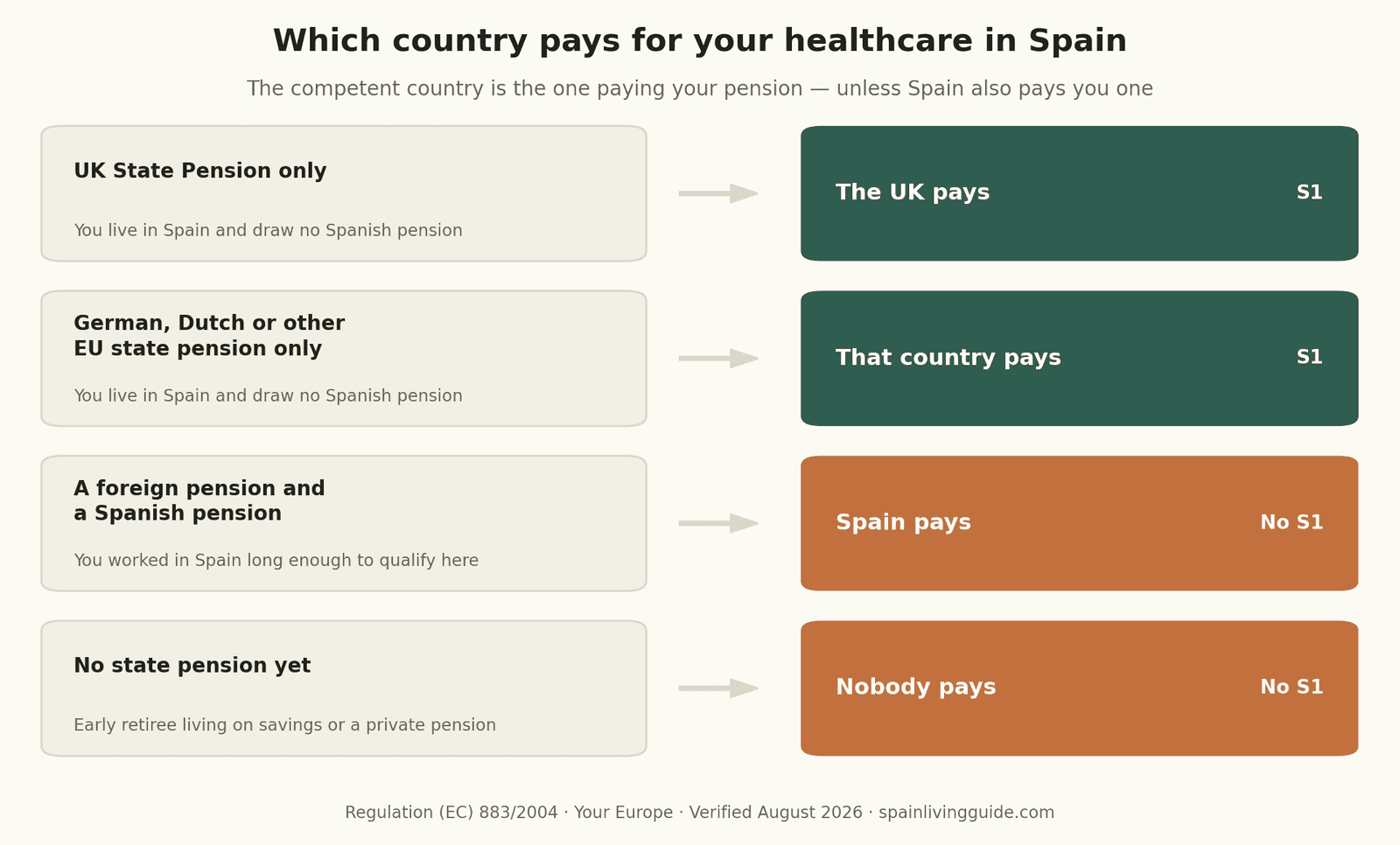
Read the third row of that table carefully, because it is the single most expensive misunderstanding in this subject. If you spent part of your career working in Spain and eventually qualify for a Spanish contributory pension — even a modest one, even one built largely on years aggregated from abroad under the totalisation rules we cover in our guide to pensions for people who contributed in several countries — Spain becomes the competent state. Your foreign S1 entitlement ends. In practice this is usually harmless, because a Spanish contributory pension carries Spanish healthcare rights with it. But the transition is not automatic in your paperwork, and people have been caught in the gap between the two systems, which is a bad place to be if you are mid-treatment.
The fourth row is the one that catches early retirees. If you are 58, living comfortably on investments and a private pension, and not yet drawing any state pension, no country is responsible for you. There is no S1 and there will not be one until your state pension actually starts being paid. Until then you need private cover, which is also the reason healthcare is a standing obstacle for applicants to the Non-Lucrative Visa.
Who qualifies for a UK-issued S1
Brexit did not abolish the S1 for British pensioners. The arrangement survived, and the qualifying categories in 2026 are as follows.
| Category | Position in 2026 |
|---|---|
| UK State Pension recipients | Entitled, and this is the route the overwhelming majority use. Cover extends to dependants |
| Recipients of certain other exportable benefits | Sometimes entitled, but not every benefit that can be paid abroad carries healthcare cover with it. This must be checked individually |
| Frontier workers | Potentially entitled. Eligibility is determined by HMRC rather than the pension authorities |
| Posted workers | Separate arrangements apply, using a GHIC, an EHIC or an S1 depending on the posting |
| Early retirees with no state pension | Not entitled |
| Remote workers and the self-employed in Spain | Not entitled. You contribute to the Spanish system instead |
The distinction between “exportable” and “healthcare-conferring” deserves emphasis. A benefit you can continue to receive while living abroad does not necessarily bring UK-funded healthcare with it. These are two separate tests and guides routinely conflate them.
Applying for a UK S1: the guidance is out of date
Here is a discrepancy worth knowing about before you waste an afternoon on hold. The Department of Health and Social Care guidance page on healthcare in Spain — the page every English-language article links to — instructs you to request an application form by telephone from Overseas Healthcare Services. That page was last updated in July 2022.
The NHS Business Services Authority, which actually runs the service, now offers an online application. If you are being paid your UK State Pension, you can apply online for an S1 up to 90 days before you move to an EU country. You need an address in the destination country for the certificate to be issued, and a temporary address is accepted, with an obligation to update it once you have something permanent.
Two practical notes that follow from the same source. The online route is not available for Switzerland, Norway, Iceland or Liechtenstein, where you still have to telephone. And if you need the certificate for a visa application, you can ask for it to be sent to your UK address rather than a Spanish one — useful for anyone assembling a residency file from Britain.
The 90-day window is generous and worth using in full. An S1 in hand before departure is one of the cleanest ways to satisfy the proof-of-healthcare requirement that Spain imposes at the visa or residency stage, and it removes any need to buy a year of private insurance you will never use.
Applying for an S1 from an EU country
For pensioners from other EU or EEA states the principle is identical and the counterparty differs. You request the S1 from whichever body insures you for sickness in the country paying your pension: your Krankenkasse in Germany, the CAK in the Netherlands, CPAM in France, the relevant institution elsewhere. Spanish nationals moving in the other direction request theirs from the INSS.
Apply before you move rather than after. Retrospective applications are possible but leave a gap in cover during which you are neither insured at home nor registered in Spain, and that gap is precisely when an unexpected hospital admission becomes a personal bill.
One right that EU pensioners hold and British ones generally do not: if the country responsible for you is one of a specific list — Austria, Belgium, Bulgaria, Cyprus, Czechia, France, Germany, Greece, Hungary, Iceland, Liechtenstein, Luxembourg, the Netherlands, Poland, Slovenia, Spain, Sweden or Switzerland — you may return there for treatment under the same conditions as before you moved. The United Kingdom does not appear on that list. A German pensioner in Alicante can go home for a procedure as of right; a British pensioner in the same street generally cannot, and must arrange planned treatment through the separate S2 route instead.
Registering the S1 with the INSS
This is the step that converts a certificate into healthcare, and it is done at the Instituto Nacional de la Seguridad Social. There are three ways to do it: online through the social security portal, in person at an INSS office by appointment, or by lodging the papers at a public registry that forwards them.
The online route is the pragmatic default, because INSS appointments in coastal provinces with large foreign populations can be genuinely scarce. Assemble digital copies of the following before you start.
- Your S1 form, scanned in full
- The completed healthcare application form, downloadable from the INSS registration page. It is in Spanish and must be completed in Spanish
- Your passport
- Your residency document — the green A4 or credit-card-sized certificate, or your TIE card. If you have applied but not yet received the card, the favourable resolution from the Spanish authorities is accepted in its place
- Proof of relationship for any dependants included on the certificate
- An email address, a Spanish telephone number and your NIE
Two details save people a rejection. Documents attached to the online submission are subject to a total size limit, so scan at a sensible resolution rather than sending photographs from a modern phone camera. And dependants added to a file frequently need a birth or marriage certificate legalised with a Hague apostille — a request that arrives after submission and adds weeks if you have not anticipated it.
If you do not yet have your NIE and residency paperwork in order, that has to come first; our guide to NIE, TIE and empadronamiento sets out the sequence. A certificado digital is not strictly required for the S1 submission, but it makes every subsequent interaction with the INSS considerably easier.
From INSS acceptance to a health card
Once the INSS processes your registration it issues a Spanish social security number and a document confirming your entitlement. That document is not the health card. You take it to your local health centre, where you register, are assigned a family doctor, and are issued the regional health card that actually gets you seen. The card is issued by your autonomous community, not by the INSS, and the process varies by region — we cover it in detail in our guide to getting your tarjeta sanitaria.
If you need treatment while the registration is still working its way through the system, you are not stranded. Overseas Healthcare Services can issue a Provisional Replacement Certificate covering immediate treatment, which you present at the health centre or hospital. This is worth knowing before you need it rather than afterwards.
Are you entitled to an S1, and who pays?
Select your situation to see which country is responsible for your healthcare and what you should do next.
How this is worked out
Under the European rules coordinating social security systems, the country competent for a pensioner’s healthcare is the country paying the pension. Where pensions are received from more than one country and one of them is the country of residence, the country of residence becomes responsible instead. A pensioner who is not yet drawing any state pension has no competent country and therefore no S1.
British guidance is explicit that where the UK funds your healthcare through an S1, you may not instead register as a permanent resident for healthcare purposes and you may not join the Convenio Especial. The S1 replaces those routes rather than sitting alongside them.
Verified August 2026 against Department of Health and Social Care guidance, NHS Business Services Authority guidance and the European Commission’s Your Europe portal. General information, not legal advice. Confirm your position with the INSS and with the authority paying your pension.
What the S1 blocks, and why that matters
This is the part almost universally omitted, and it is stated unambiguously in the British guidance: if the UK pays for your healthcare through an S1, you cannot register for healthcare as a permanent resident, and you cannot join the Convenio Especial.
The S1 is not one option among several that you might stack for extra security. It is exclusive. It replaces the alternative routes rather than supplementing them, and it does so automatically, without you choosing.
That exclusivity cuts in your favour financially. Convenio Especial members pay the full price of prescription medication, while ordinary residents — including S1 holders — pay a percentage that varies with their circumstances. Over a retirement with regular medication, the difference is substantial. Convenio members also pay in full for non-urgent transport, orthopaedic supplies, prostheses and dietary supplies. If you are weighing the alternatives, our comparison of public healthcare and private insurance in Spain sets out how the Convenio Especial works for those who cannot use an S1.
The exclusivity also has a sharper edge. If you are not covered by the UK and want to register for healthcare as a permanent resident after five years, the INSS will ask for a legislation letter — a documento de no exportación — confirming that no other country is funding you. You request it from Overseas Healthcare Services. Turning up at the INSS without it is one of the more common wasted appointments in this whole process.
Travel, and going back for treatment
Once your S1 is registered in Spain, your travel cover comes from the issuing country rather than from Spain. UK S1 holders registered in an EU country receive a UK-issued EHIC or GHIC for necessary treatment elsewhere in the EU, Switzerland, Norway, Iceland and Liechtenstein. Which of the two you get depends on your status: those protected by the Withdrawal Agreement continue to receive an EHIC, while others receive a GHIC.
Treatment in Britain is more restrictive than most retirees assume. Because the NHS is residency-based, moving abroad permanently generally ends your entitlement to free NHS care. There is a carve-out worth knowing: UK nationals who were living in the EU on or before 31 December 2020 and hold a registered, UK-issued S1 are among the groups who do not pay for NHS treatment when visiting England. Those who moved later do not have that protection and should not plan around it.
For planned treatment abroad, whether in Britain or elsewhere in Europe, the correct instrument is the S2 rather than the S1, and it must be authorised in advance.
Mistakes that cost people their cover
- Treating the S1 as cover in itself. An unregistered S1 gives you nothing. The certificate is the beginning of the process, not the end of it.
- Applying after moving rather than before. The 90-day window exists precisely to avoid a gap, and applying late creates one.
- A dependant who starts drawing their own state pension. Cover held as a dependant of a pensioner is cancelled at that point. A new S1 is issued in the dependant’s own name and must be registered again with the INSS. Assuming continuity here is how couples discover, months later, that one of them has been uninsured.
- Failing to report a change of address or circumstances. The obligation to keep Overseas Healthcare Services informed sits with you, not with them.
- Assuming an EHIC or GHIC covers residents. Those cards are for temporary stays. They do not substitute for registration when Spain is your main home.
- Not deregistering on leaving Spain. If you return home permanently and tell nobody, your former country may continue paying Spain for a resident who no longer lives there.
- Expecting British healthcare in Spanish clothing. Dental and optical care are largely outside the Spanish public system, and most residents pay privately for both.
Frequently asked questions
Does the S1 cover my spouse?
Generally yes. A younger spouse who has not yet reached state pension age can normally be included as a dependant on the pensioner’s certificate. Bear in mind the trap above: when that spouse begins drawing their own state pension, the dependant cover ends and a fresh S1 has to be registered.
Is the S1 accepted as proof of healthcare for a visa or residency application?
Spain requires proof of healthcare cover before granting residency, and a registered S1 or the resulting INSS certificate is normally accepted for that purpose. Since the certificate can be issued up to 90 days before the move and sent to a UK address, the sequencing works in your favour if you plan ahead.
Does an S1 mean everything is free?
Basic state services are free once you are registered, but Spain operates a prescription co-payment system under which residents pay a percentage of medication costs depending on their circumstances. You may also pay a share for items such as orthopaedic services. The S1 gives you a Spanish patient’s terms, not better ones.
Does the S1 have an expiry date?
It is not usually issued with a fixed end date, but it is not permanent either. It can be reviewed or withdrawn when your circumstances change — most commonly when you start work in Spain, begin drawing a Spanish pension, or move your residence again.
What if I start working in Spain after registering my S1?
Working and contributing in Spain gives you healthcare entitlement in your own right, and Spain becomes responsible for you. This applies whether you are employed or register as self-employed, a decision we examine in our guide to choosing between autónomo and an SL. Tell Overseas Healthcare Services, or the equivalent body in your own country, when this happens.
Does holding an S1 change my Spanish tax position?
No. Healthcare responsibility and tax residency are governed by entirely separate rules. If Spain is your main home you will normally be taxed here on your worldwide income, including your foreign pension, subject to the relevant treaty. Our guides to IRPF for foreign residents and to the UK-Spain and US-Spain double taxation treaties cover how pension income is treated.
Where does the S1 fit in the overall sequence of moving?
Apply for the certificate before you leave, register your residency and NIE on arrival, then register the S1 with the INSS, then obtain your regional health card. Our complete guide to moving to Spain places these steps alongside everything else that has to happen, and our guide to retiring in Spain covers the financial side of the same move.
This article is general information, not legal, medical or financial advice. Entitlement to an S1 depends on individual circumstances, and administrative practice varies between INSS offices and between Spain’s autonomous communities. Requirements and procedures were verified in August 2026 against the Department of Health and Social Care guidance on healthcare for UK nationals living in Spain and its guidance on registering your S1 form in Spain online; the NHS Business Services Authority guidance on applying for healthcare cover for living abroad and on contacting Overseas Healthcare Services; the European Commission’s Your Europe pages on health insurance cover when living abroad and the accompanying frequently asked questions; Regulation (EC) No 883/2004 on the coordination of social security systems; and the Spanish social security service page for registering the S1 form for healthcare in Spain. Confirm your own position with the INSS and with the authority that pays your pension before making decisions.