
Most expatriates who acquire property or wealth in Spain plan as if they will live forever. The reality is simpler: the moment you buy a home, open a bank account, or invest in Spanish assets, you are also creating an inheritance problem. Spain’s succession law operates on premises entirely foreign to common-law countries: forced heirship reserves up to two-thirds of your estate for your children regardless of your wishes; inheritance tax is paid by beneficiaries, not the estate; and regional variations can swing the bill by tens of thousands of euros. Add in cross-border complications, the quirks of international wills, and the difficulty of enforcing trusts across jurisdictions, and it becomes clear that winging it is expensive. This guide explains how to structure your Spanish estate so your wishes are honoured, your heirs are not blindsided, and your global assets transfer cleanly without surprise tax bills.
The Two Systems Collide: Common Law vs. Spanish Civil Law
If you come from the UK, US, Canada, or another common-law country, Spanish succession law is a shock. In your home country, you have near-total freedom to decide who gets what. You can disinherit your children, leave everything to your spouse, gift your art collection to a museum, or divide your estate however you choose. Your will is your word.
Spain is civil law. It does not recognise that freedom. Spanish law mandates that your children have an inherent right to a legítima, a protected share amounting to two-thirds of your estate, regardless of what you write in your will.
It is worth understanding how those two-thirds break down, because the constraint is slightly less rigid than it first appears. Under the Civil Code the estate divides into three parts. The first third, the legítima estricta, must pass to your children in equal shares and you have no discretion over it at all. The second third, the mejora, must also go to children or descendants, but you choose how to distribute it among them, so you can favour one child over another within this portion. The final third, the tercio de libre disposición, is genuinely free: you can leave it to anyone, including a spouse, a friend, or a charity.
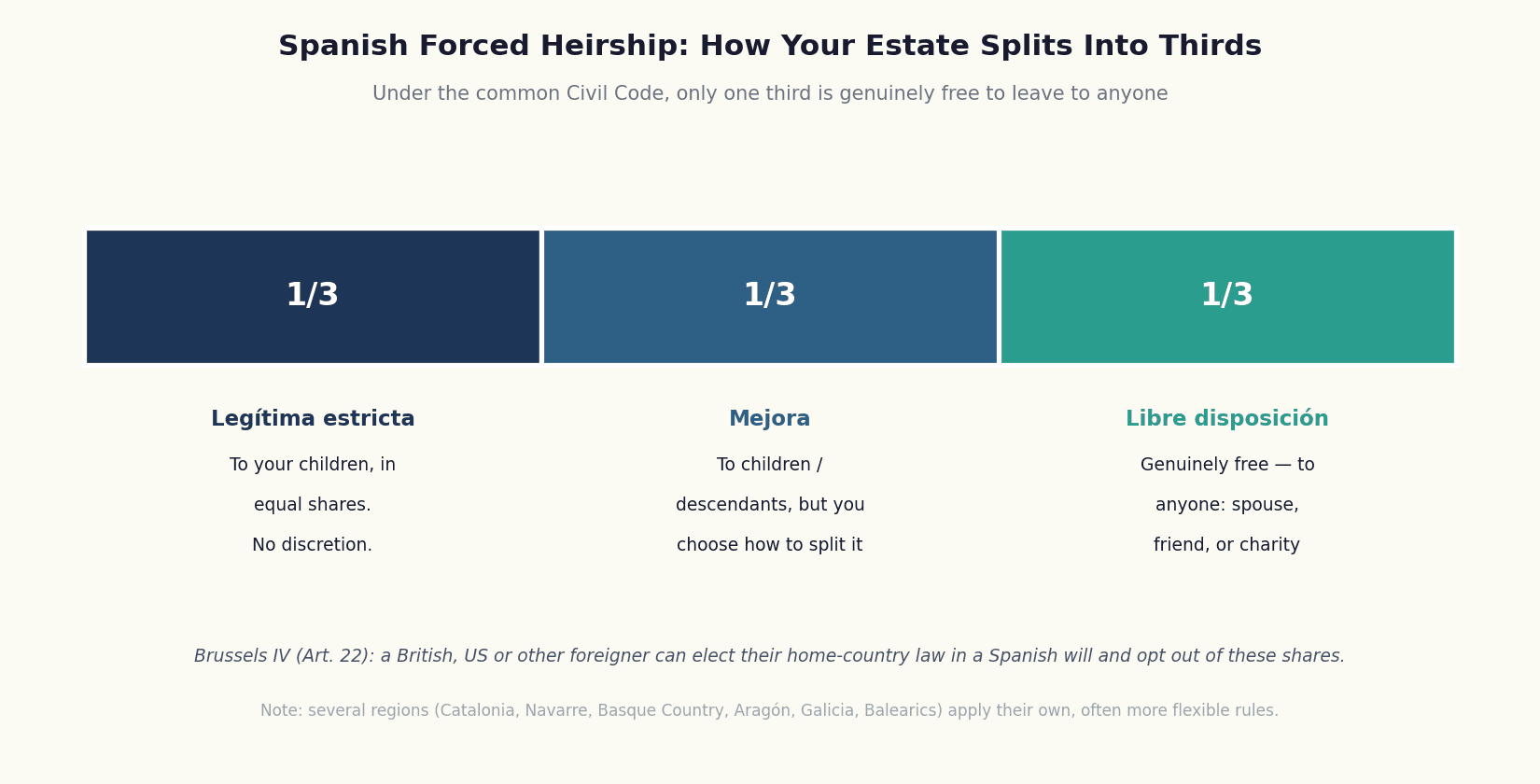
So a parent with children in Spain has full freedom over one third and meaningful discretion over a second third, but cannot disinherit their children from the first. This is not something you can waive by agreement, and it applies to your worldwide estate if Spanish law governs your succession.
Note also that several regions with their own civil law traditions, notably Catalonia, Navarre, the Basque Country, Aragón, Galicia, and the Balearic Islands, apply different forced-heirship rules from the common Civil Code, in some cases substantially more flexible. Which regional civil law applies to you is a separate question from which region’s tax rules apply, and both need checking.
For spouses, the picture is more nuanced. A surviving spouse does not have a forced share in the same way, but they do have rights, typically a usufruct, a life interest, over part of the estate. The exact share depends on whether there are children and which regional rules apply.
This system exists to protect families, which may make sense in context. But for an expat with adult children, a second marriage, business partners, or philanthropic wishes, it can feel like a straitjacket.
The Game-Changer: EU Regulation 650/2012 (Brussels IV)
The solution is EU Regulation 650/2012, commonly called Brussels IV, which came into force in August 2015 and fundamentally changed cross-border succession in Europe. Before it, determining which country’s law governed your estate was a legal minefield. After it, the default rule is simple: the law of your habitual residence at death governs your entire succession, worldwide assets included.
But there is a crucial exception: Article 22 allows you to elect the law of your nationality instead. If you are a British citizen living in Spain, you can write into your Spanish will: “I elect that the law of England and Wales shall govern my succession in accordance with Article 22 of EU Regulation 650/2012.” By doing so, you opt out of Spanish forced heirship entirely and apply the more flexible rules of your home country.
This election applies even to Spanish assets, and it is available to non-EU nationals too (US, Canadian, Australian, and so on), because the Regulation has universal application and does not require the elected law to be that of a member state. The election must be stated clearly and explicitly in your will.
One critical limitation that is frequently misunderstood. Brussels IV governs which country’s succession law applies, meaning who inherits and in what shares. It does not govern taxation. Electing English or US law does not exempt anyone from Spanish inheritance tax on Spanish assets, nor from Spanish tax on worldwide assets where the heir or the deceased was Spanish-resident. These are two entirely separate questions, and conflating them is one of the most common and most expensive planning errors expats make.
How Spanish Inheritance Tax (ISD) Actually Works
The tax is called Impuesto sobre Sucesiones y Donaciones (ISD), and it operates very differently from UK or US inheritance tax.
First, the tax is paid by each beneficiary individually, not by the estate. This means two siblings inheriting the same property may face completely different tax bills depending on their own wealth, residency, and relationship to the deceased. The burden falls on the heir, not on the deceased’s estate. This is the structural opposite of the UK and US systems, where the estate settles the tax before anything reaches the beneficiaries.
Second, the national tax rates range from 7.65% to 34% at state level before regional adjustments, and the effective rate is further affected by multiplier coefficients based on the heir’s kinship group and pre-existing wealth. But here is where it gets interesting: autonomous communities have broad power to apply their own reductions, bonuses, and reliefs, and many do so dramatically.
Third, the filing deadline is six months from the date of death, extendable by a further six months on request made within the first five. That is far more forgiving than the 30 business days that apply to lifetime gifts, but it still arrives quickly when heirs are abroad and documents need translating and legalising.
Regional Variations: The Real Game
Your region at death, or where your highest-value Spanish assets are located if you were a non-resident, determines the final bill. The regional variations are staggering. The summary below reflects the position as generally reported for 2026; regional ISD rules change frequently, so verify your own community’s current legislation before relying on any of it.
Madrid offers a 99% reduction on inheritance tax for direct heirs (spouses and children), making the effective rate close to zero for close family.
Andalucía provides a €1,000,000 tax-free allowance per beneficiary for spouses, children, parents, and grandchildren, with a 99% reduction applying to the tax quota above that. For a typical family inheritance the combined effect is close to full relief.
The Balearic Islands have effectively eliminated inheritance tax for direct heirs through near-total reliefs. The Canary Islands offer similarly generous treatment, with a 99.9% reduction for spouses and children.
Valencia has enhanced its reliefs substantially in recent years, though its treatment has historically been less generous than Madrid or Andalucía.
Catalonia, by contrast, offers modest reductions compared to other major regions, making it markedly less attractive for inheritance planning.
The practical consequence: dying in Madrid or Andalucía can result in near-zero inheritance tax for your spouse and children. Dying in Catalonia with the same heirs and the same assets can produce a substantially higher bill. The same regional competition drives Spain’s Wealth Tax and Solidarity Tax, and for the same structural reason.
Relocating to a more favourable region is legitimate planning rather than evasion, but it must be genuine and established well in advance. Regions generally look at where the deceased was habitually resident over a period of years before death, not on the final day, so a deathbed change of address achieves nothing.
The Non-Resident Trap
If you own Spanish property but are not a Spanish tax resident, you may assume you avoid Spanish inheritance tax. You do not. Non-residents are liable to Spanish ISD on assets located in Spain. A non-resident British or American citizen who owns a flat in Madrid leaves an asset on which Spanish inheritance tax is due when it passes, even if they never lived in Spain.
The good news: non-residents can now benefit from the same regional reliefs as residents. A Court of Justice of the European Union ruling established that EU and EEA residents could not be discriminated against, and subsequent Spanish case law extended that principle to residents of non-EU countries on free-movement-of-capital grounds. So a non-resident heir can, in principle, apply Madrid’s 99% reduction or Andalucía’s €1,000,000 allowance just as a resident can.
The mechanism, however, is not automatic. You must identify which region’s law applies (generally where the highest-value asset is located), understand the relevant rules, and actively claim the relief in the correct filing. Heirs who file without claiming often simply pay the state scale.
Wills: One, Two, or Both?
Most expatriates with assets in multiple countries should have two wills: a Spanish will covering Spanish assets, and a will in their home country covering assets there.
A Spanish will must be signed before a Spanish notary, who registers it with the General Registry of Last Wills (Registro General de Actos de Última Voluntad) in Madrid. This ensures it is formally valid under Spanish law and, just as importantly, that it can actually be found after death. A foreign will, even if valid in your home country, creates friction in Spain: it typically needs translating, legalising with an apostille, and processing through Spanish formalities, which is slow and expensive at exactly the wrong moment for a grieving family.
Critically, each will must explicitly state that it does not revoke the other. Two uncoordinated wills can accidentally revoke each other, leaving heirs in legal limbo.
If you have a Spanish will, include the Article 22 election within it, and mirror that election in your home-country will. This creates alignment and reduces the risk of a later challenge to your choice of law.
The Trust Problem
Common-law countries, particularly the UK and US, rely heavily on trusts for succession planning. Trusts allow assets to pass outside probate, provide privacy, enable contingent distribution, and offer tax efficiency. They are powerful tools.
Spain does not formally recognise trusts, having never ratified the Hague Convention on their recognition. Spanish law knows nothing of a trust’s distinction between legal and beneficial ownership. For Spanish tax and succession purposes, Spain may look through the structure to the underlying beneficiary, treat them as the owner, and calculate inheritance tax on their share even though legally the trustee holds the asset. This can create unintended double taxation if the UK or US simultaneously treats the assets as trust property under their own rules.
The solution is not to avoid trusts entirely, but to coordinate them carefully with Spanish law, ideally with advisers qualified in both jurisdictions. In some cases Spanish-law alternatives, or holding structures designed with Spanish treatment in mind, produce better outcomes for assets intended to be used or passed on in Spain.
Double Taxation and Treaty Relief
If you are a British or US citizen with assets in multiple countries, you face the risk of inheritance tax in more than one jurisdiction. The UK taxes the worldwide estates of those domiciled there, the US taxes the worldwide estates of its citizens, and Spain taxes residents on worldwide assets received. All three can bite on the same assets.

Spain has inheritance tax treaties with only a small number of countries, and neither the UK nor the US is among them, so relief is not automatic. Note that this is a separate question from the income tax treaties covered in our guide to the US-Spain and UK-Spain double taxation treaties: those treaties address income and gains during life, not estates at death. Unilateral relief may still be available under each country’s domestic law, but the key is advance planning: structuring which assets are held where, in what legal form, and in which jurisdiction they are taxable.
Life insurance, for example, can be arranged to provide heirs with liquidity to pay the tax without forcing a rushed sale of illiquid assets, which matters in Spain because the tax generally falls due before the heir can freely deal with the inherited property.
Gifts as Planning: Use With Caution
Lifetime gifts to heirs can reduce your estate and thus the eventual inheritance tax burden. Spain taxes gifts under the same overarching ISD framework, using comparable kinship groups, and most regions offer generous reliefs for gifts as well as inheritances.
The mechanics differ in ways that matter, though. As with inheritance, it is the recipient, not the donor, who declares and pays gift tax, filing Modelo 651 with their own autonomous community within 30 business days. And where the gift is appreciated property rather than cash, the donor faces a separate capital gains charge, because Spanish law treats a lifetime gift as a deemed disposal at market value even though no money changes hands. Our guide to Spain’s gift tax works through the full cost of a family transfer, including the municipal plusvalía that also applies to real estate.
That donor capital gains charge is precisely why gifts are frequently oversold online as a “solution.” An inheritance does not trigger it, and the heir’s acquisition cost resets to the value at death, so for long-held, heavily appreciated property, holding until death is often the cheaper route overall. Gifts also reduce your own financial flexibility. And in a forced-heirship regime, lifetime gifts to one child are generally brought back into account when calculating the legítima, so giving away assets does not necessarily escape the rules you were trying to work around.
Gifts should be part of a coordinated plan, not an isolated tactic. Work through the numbers before executing any substantial transfer.
The Practical Checklist
- Create or update your Spanish will with an explicit Article 22 election if you want your home-country law to govern who inherits. Sign it before a notary so it is registered.
- Coordinate all wills in each country where you own assets, ensuring each explicitly states it does not revoke the others, and make sure your heirs know they exist.
- Identify your habitual residence, since it determines both which succession law applies by default and which regional tax rules your heirs will face.
- Map your assets by location and by how they are held (sole, joint, in trust, through a company), because each structure carries different inheritance consequences.
- Review beneficiary designations on pensions, life insurance, and investment accounts. These often pass outside your will and should be coordinated with it.
- Plan for the heirs’ liquidity. Spanish inheritance tax generally falls due within six months, and often before the heir can freely sell the asset that generated it.
- Document the origin of your wealth, since clean records save time and argument if valuations are ever questioned.
- File Modelo 720 annually if you are a Spanish resident with foreign assets exceeding €50,000 in any category, as explained in our guide to Spain’s Wealth Tax and foreign asset reporting.
- Review your plan every few years or after any major change in family, residence, wealth, or tax law. Wills are not “set and forget.”
If you are still planning the move itself, our overview of how to move to Spain in 2026 sets out how residency, tax, and property decisions fit together.
Verified August 2026 against Agencia Tributaria guidance on the Impuesto sobre Sucesiones y Donaciones. This article is for general informational purposes only and does not constitute legal, tax, or financial advice. Spanish inheritance law, regional civil law variations, regional tax reliefs, EU Regulation 650/2012, the treatment of trusts, and double taxation relief are highly complex and fact-specific, and regional rules change frequently. Before making decisions about your estate plan, consult a qualified Spanish succession lawyer and a cross-border tax adviser who understand both Spanish law and the law of your nationality and country of residence.