You sell your UK house, and both HMRC and the Spanish Agencia Tributaria seem to want a share. You receive a US Social Security payment, and you are not sure whether Washington or Madrid has first claim. You hold US dividend-paying stock as a Spanish resident, and your broker withholds one rate while your Spanish tax return calculates another. This is the exact problem double taxation treaties exist to solve, and the US-Spain and UK-Spain treaties are two of the most consequential documents an American or British expatriate in Spain will ever rely on, yet most people have never actually read them. This guide explains, in plain terms, how each treaty works, what it does and does not protect you from, and the concrete steps to actually claim the relief you are entitled to in 2026.
What a Double Taxation Treaty Actually Does
A double taxation treaty (officially a “Convention for the Avoidance of Double Taxation”) is a bilateral agreement between two governments that allocates taxing rights over specific categories of income, salary, pensions, dividends, interest, royalties, capital gains, so that the same euro or dollar of income is not taxed at full rate by both countries simultaneously. Where both countries retain some right to tax an item of income, the treaty does not eliminate tax entirely; instead, it caps the source country’s rate and requires the residence country to grant a credit for tax already paid abroad.
It is essential to understand what a treaty is not. It is not a mechanism that lets you simply choose the lower-tax country and ignore the other. It is not a blanket exemption from filing obligations in either jurisdiction. It covers income and gains during your lifetime, not estates at death, which is a separate question addressed in our guide to estate planning and wills in Spain, since Spain has no inheritance tax treaty with either the UK or the US. And, for Americans specifically, it does not override the United States’ right to tax its own citizens on worldwide income regardless of where they live, a point explained in detail below.
The First Question Every Treaty Answers: Where Are You Actually Resident?
Before any treaty article on pensions, dividends, or capital gains becomes relevant, both treaties require establishing a single country of tax residence, since a person genuinely resident in both countries under domestic law needs a tie-breaker.
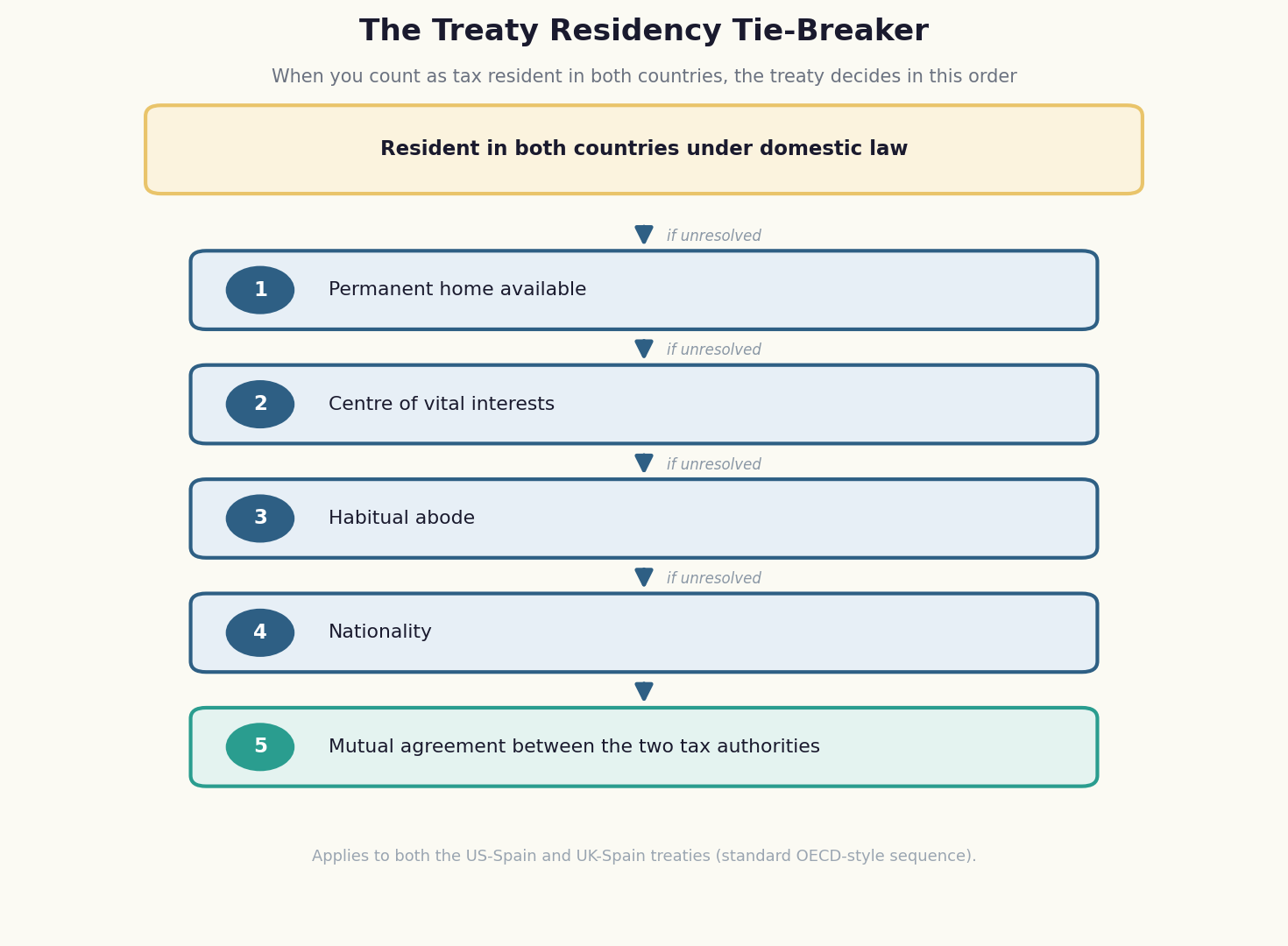
Spain’s domestic test is the same for both nationalities: you are a Spanish tax resident if you spend more than 183 days in Spain in a calendar year, or if Spain is the base of your main economic or family interests. The United States applies its own citizenship-based rule (discussed below) plus a substantial presence test for non-citizens, while the UK uses its Statutory Residence Test, weighing day counts against a list of specific connecting factors (home, work, family ties). When these domestic tests genuinely conflict, both treaties apply the standard OECD-style tie-breaker sequence: permanent home available, then centre of vital interests, then habitual abode, then nationality, and finally, mutual agreement between the two tax authorities as a last resort.
Two features of the Spanish test deserve more attention than they usually receive, and both come from the Agencia Tributaria rather than from either treaty. The first is that there is a third route into Spanish residence beyond day count and economic interests: where a spouse who is not legally separated and dependent minor children habitually reside in Spain, the individual is presumed resident as well. That presumption can be rebutted, but the burden sits with the taxpayer. The second is that sporadic absences are counted towards the 183 days unless you can produce a tax residency certificate from another country showing you were resident there instead. A pattern of long trips abroad does not, on its own, break Spanish residence, and building a plan around the assumption that it does is one of the more expensive mistakes available.
Getting this residency determination right, and documenting it with an official tax residency certificate, is the foundation everything else in this guide depends on. Once you are a Spanish resident, your worldwide income enters the Spanish system described in our guide to IRPF for foreign residents, with treaty relief applied on top.
The US-Spain Treaty: The Saving Clause Changes Everything
The US-Spain Convention was signed in 1990 and substantially amended by a protocol signed in January 2013. A crucial detail that explains a great deal of outdated advice online: that protocol was blocked in the US Senate for more than six years and only entered into force on 27 November 2019. Guidance written between 2013 and 2019, and anything copied from it since, frequently still quotes the pre-protocol rates.
The Spanish paper trail is worth knowing about, because it is where the wording that binds the Agencia Tributaria actually lives. Spain published the original convention, signed in Madrid on 22 February 1990, in the Boletín Oficial del Estado, and that page now carries a consolidated version in which every protocol change has already been merged into the article text, so you can read the current Article 10 or Article 11 as it stands rather than reconstructing it yourself from two documents. The 2013 protocol and its memorandum of understanding were published separately on 23 October 2019, and the memorandum in particular contains operational detail that appears almost nowhere in English-language summaries.
The treaty contains a provision that surprises almost every American who has not read it closely: the “saving clause.” This allows the United States to tax its citizens and residents as if the treaty did not exist at all, with only a narrow list of specific exceptions (covering things like government pensions, certain students, and a few other categories). In practice, this means a US citizen living in Spain remains fully within the US tax system, filing a US return on worldwide income every year, regardless of anything the treaty otherwise says.
The treaty’s real value for Americans, then, is not exemption from US filing; it is the mechanism for avoiding paying full tax twice on the same income, achieved primarily through the Foreign Tax Credit (Form 1116) and, for earned income specifically, the separate Foreign Earned Income Exclusion. For a deeper look at how these tools interact for remote workers and the self-employed, see our guide to digital nomad taxes and the FEIE.
How specific income types are actually treated
Government pensions (paid for prior service to the US federal, state, or local government) are generally taxed only in the United States. Spain exempts this income but still counts it when calculating the tax rate applied to your other Spanish-taxable income, a mechanism called exemption with progression.
Private pensions, including employer pensions and personal retirement accounts, are generally taxed only in Spain if you are a Spanish resident. US Social Security payments specifically may still be taxed by the US as well, in which case Spain grants a credit for the US tax paid, provided that tax was not imposed purely on the basis of citizenship under the saving clause.
Dividends from US companies may be taxed by both countries, but the treaty caps the US withholding rate at 15% for an ordinary portfolio investor resident in Spain, falling to 5% where the beneficial owner holds at least 10% of the voting rights, and to zero in limited cases (broadly, holdings of at least 80% of voting rights held for twelve months, and distributions to qualifying exempt pension funds). Spain then grants a credit against its own tax for the US tax actually withheld.
There is a trap in the fine print here that catches expatriate investors far more often than the headline rates suggest. Paragraph 7 of the protocol to the convention switches off the reduced 5% rate completely for several common vehicles, and restricts the 15% cap for some of them. On the Spanish side it covers dividends paid by a SOCIMI, the Spanish listed property vehicle regulated by Ley 11/2009, and by Spanish collective investment institutions under Ley 35/2003. On the American side it covers dividends paid by a US Regulated Investment Company, which is the legal form most US mutual funds and ETFs take, and by a US REIT. For a RIC the 15% cap still applies. For a REIT it applies only within defined ownership limits: broadly, where the beneficial owner is an individual or pension fund holding no more than 10% of the REIT, or holds no more than 5% of a publicly traded class of its shares, or holds no more than 10% of a REIT that is diversified as the protocol defines that term. Outside those limits the treaty ceiling simply does not apply to that dividend and US domestic withholding governs instead. If your portfolio holds property funds or REITs rather than ordinary equities, a rate different from the 15% you were expecting may be entirely correct.
Interest and royalties are, since the protocol took effect, generally exempt from withholding at source altogether, provided the recipient is the beneficial owner. The pre-protocol treaty applied a 10% cap on both, and that 10% figure still circulates widely in older guidance, so if a payer or broker is withholding at 10% on ordinary interest, it is worth checking whether the correct beneficial-owner documentation has been filed. There is an important qualification that most summaries drop, however, and it is why a flat statement that the 10% rate no longer exists is wrong: Article 11 retains two carve-outs. Contingent interest arising in the United States that does not qualify as portfolio interest under US domestic rules may still be taxed there, limited to 10% of the gross amount where the beneficial owner is a Spanish resident. And excess inclusion income from a residual interest in a REMIC, a US mortgage-backed securitisation vehicle, may be taxed by the United States under its own domestic law with no treaty ceiling at all. Neither touches a normal deposit account or a plain corporate bond, but both can reach structured or mortgage-linked holdings. In every case the income remains fully taxable in Spain under Spanish savings-income rules; what changed for ordinary interest is that the US no longer takes a slice first.
Capital gains on the sale of most property, including shares in a US company, are taxable only in the seller’s state of residence, so for a Spanish-resident seller the gain is reported and taxed under Spanish rules. This too was broadened by the protocol: previously the source state could tax gains on share transfers in certain circumstances. The exception is gains derived from real property, or from shares and rights that entitle the holder to the enjoyment of immovable property in the other state, where both countries retain taxing rights and Spain credits the US tax paid. The saving clause still requires US citizens to report the gain on their US return, claiming a credit for Spanish tax.
Claiming the relief in practice
On the US side, the Foreign Tax Credit is claimed via Form 1116, matched against the specific income category (or “basket”) the foreign tax relates to; any treaty-based position that differs from standard US rules generally also requires disclosure on Form 8833. On the Spanish side, the credit for US tax paid is claimed within the annual IRPF return (Modelo 100) under the corresponding international double taxation deduction. Spanish residents must separately remember that treaty relief is entirely different from, and does not replace, the obligation to file Spain’s foreign-asset declaration (Modelo 720) if overseas accounts, securities, or property exceed €50,000 in any category.

Note also that the protocol introduced a detailed Limitation of Benefits clause. For individuals with straightforward personal income this rarely bites, but anyone routing investments through intermediate structures should confirm the treaty benefits actually apply before assuming them.
Which US Retirement Accounts the Treaty Actually Recognises
One question dominates the inbox of every adviser working with Americans in Spain: will Spain tax the annual growth inside a 401(k) or an IRA, even in years when nothing is withdrawn? The concern is not paranoid. Spanish domestic law taxes many foreign investment wrappers on an accruals basis, and a retirement account that the US treats as tax-deferred does not automatically get the same treatment abroad. The 2013 protocol addressed this directly by adding a new paragraph 5 to Article 20.
That paragraph provides that where an individual resident in one country is a member, beneficiary or participant in a pension fund resident in the other, income arising within that fund may be taxed as that individual’s income only when, and to the extent that, it is paid to or for the benefit of that individual out of the fund. It also states that a transfer to another pension fund in the same country does not count as such a payment. In plain terms, the treaty position is that the taxable event is the distribution, not the internal growth, and that moving money between qualifying US retirement accounts is not itself a distribution.
The obvious next question is which accounts count as a pension fund for this purpose, and here the memorandum of understanding published alongside the protocol is unusually generous with detail. On the US side it names plans qualified under section 401(a) of the Internal Revenue Code, which expressly includes 401(k) plans, profit-sharing and stock bonus plans, qualified annuity plans under section 403(a), section 403(b) plans, individual retirement accounts under section 408, Roth IRAs under section 408A, SIMPLE accounts under section 408(p), simplified employee pension plans under section 408(k), trusts under section 457(g) providing benefits through a section 457(b) plan, and the federal Thrift Savings Fund. On the Spanish side it names pension plans and funds under Real Decreto Legislativo 1/2002, entities defined in article 64 of Real Decreto Legislativo 6/2004, and insurance companies covering the same retirement contingencies.
That list is worth reading carefully, because it settles arguments that are still being had in expatriate forums, most obviously about whether a Roth IRA is recognised at all. What it does not do is answer every downstream question. It fixes the timing of taxation under the treaty; it does not determine how Spain characterises the payment once it arrives, whether as employment-derived pension income or as savings income, which affects the rate applied. Nor does it disturb the saving clause, so a US citizen still reports the distribution on a US return and relies on the foreign tax credit. If retirement accounts are a meaningful part of your assets, this is precisely the point at which an adviser who works across both systems pays for themselves.
The UK-Spain Treaty: No Saving Clause, But Its Own Traps
The current UK-Spain Double Taxation Convention dates from 2013 and entered into force in June 2014, replacing an older 1976 treaty. Unlike the US treaty, it contains no saving clause, since the UK does not tax on the basis of citizenship; UK tax exposure is governed by residence and domicile status, not nationality. This makes the UK-Spain relationship structurally simpler for a British person who has genuinely become a Spanish tax resident: once residency shifts to Spain under the treaty’s tie-breaker rules, the UK’s competing claim over most income categories generally falls away.
The pension distinction that catches nearly every British retiree
This is, without question, the single most consequential and most misunderstood provision in the entire UK-Spain treaty, and getting it wrong is extremely common.
Private pensions, a category that explicitly includes the UK State Pension, workplace pensions, and personal pensions, are taxed only in your state of residence under Article 17. If you are a Spanish tax resident, this means your UK State Pension and private pension income become taxable in Spain, not the UK, even though the payments originate from the UK. Many British retirees mistakenly assume their State Pension remains a UK tax matter indefinitely; under the treaty, it does not.
The reason the State Pension falls on the Spanish side of the line is worth spelling out, because the standard objection is that it is paid by the British government and must therefore be a government pension. It is not, and the distinction is subtler than it looks. The split between Article 17 and Article 18(2) turns on the nature of the employment the pension arises from, private-sector or public service, and not on whether the entity issuing the payment is public or private. A State Pension built up through years in a private company is an Article 17 pension no matter who administers it. The Agencia Tributaria states the resulting position without hedging in its own guidance for Spanish residents with UK-source income: a pension arising from previous private-sector employment is taxable in Spain alone. The same guidance adds a detail that matters enormously for cash flow, which is that a UK pension payer has no obligation to withhold anything on account of Spanish IRPF. Nothing is deducted through the year and the entire liability arrives in one instalment when the annual return is filed, which is a genuinely unpleasant surprise for anyone who has spent forty years being taxed at source through PAYE.
Government service pensions, paid specifically for prior employment with the UK government, civil service, military, or local authorities, are taxed only in the UK under Article 18(2). The exception is narrow in wording but far from rare among long-settled expatriates: if the Spanish-resident recipient also holds Spanish nationality, the pension becomes taxable in Spain alone. Where it does remain taxable in the UK, Spain exempts it but applies exemption with progression, so if you must file a Spanish return for any other income, the exempt UK pension is still counted when working out the rate applied to everything else. The practical consequence is one that naturalisation guidance almost never mentions: a retired British civil servant who takes Spanish citizenship after years of residence changes the country that taxes their pension.
To stop UK tax being deducted at source from a private pension once you are genuinely Spanish tax resident, you apply to HMRC using the form DT-Individual Spain, accompanied by a Spanish tax residency certificate from the Agencia Tributaria. Until that form is processed, UK payers may continue withholding UK tax, which you would then need to reclaim, so submitting it promptly after establishing Spanish residency avoids an unnecessary cash-flow gap. How your contribution record across both countries translates into pension entitlement is a separate question, covered in our guide to totalization of pension contributions.
Property, dividends, and interest
Property sales follow the standard international rule: gains from selling real estate are taxable in the country where the property is located, regardless of where the seller is resident. A UK resident selling a Spanish property is taxed in Spain first (with the buyer generally required to withhold 3% of the price toward that liability), and can then claim a UK credit for the Spanish tax paid against any residual UK Capital Gains Tax due. The reverse applies for a Spanish resident selling UK property.
Dividends from UK sources paid to a Spanish resident who is the beneficial owner are capped under Article 10 at 10% of the gross amount. That rises to 15% where the dividend is paid out of income or gains derived from immovable property through an investment vehicle that distributes most of its income annually and is itself exempt on that property income, which is the treatment aimed squarely at UK real estate investment trusts and Spanish SOCIMIs. Spain then taxes the dividend under its own savings-income rules and gives credit for the UK tax up to that treaty ceiling, and no further: if more was withheld than the treaty permits, the excess is reclaimed from HMRC, not credited in Spain.
Interest is simpler, and better news than most people expect. Under Article 11, interest arising in the UK whose beneficial owner is a Spanish resident is taxable in Spain only, with no UK withholding at all. If a UK bank or bond payer is still deducting tax, the problem is paperwork rather than the treaty.
Share sales follow the ordinary residence rule, with one exception that matters to anyone who holds property through a company. Gains on shares that are not substantially and regularly traded on a stock exchange, and whose value derives more than 50% directly or indirectly from immovable property situated in the other country, may be taxed in the country where that property sits. Selling the company rather than the building does not, by itself, move the gain out of reach of the source country.
A Practical Comparison
| Feature | US-Spain Treaty | UK-Spain Treaty |
|---|---|---|
| Saving clause (citizenship-based taxation) | Yes — US citizens always file in the US | No — UK taxation is residence/domicile-based |
| Private pensions (incl. state pension) | Generally Spain only, if Spanish resident | Generally Spain only, if Spanish resident (Art. 17) |
| Government service pensions | Generally source country only | Generally source country only |
| Portfolio dividends withheld at source | Capped at 15%; 5% for a 10% corporate holding; carve-outs for RICs and REITs | Capped at 10%; 15% for exempt property-vehicle distributions |
| Interest withheld at source | Nil since 27 Nov 2019, except contingent interest (10%) and REMIC excess inclusions | Nil; taxable in Spain only |
| Relief mechanism | Foreign Tax Credit (Form 1116) / FEIE | Credit against UK or Spanish tax, per return |
| Key form to stop source-country withholding | Form W-8BEN (brokers) / residency certificate where required | DT-Individual Spain (via HMRC) |
| Property sale taxation | Location of the property, with a credit for the other country’s tax | Location of the property, with a credit for the other country’s tax |
| Inheritance tax covered? | No treaty | No treaty |
Common Mistakes That Undermine Treaty Relief
Assuming the treaty removes a filing obligation entirely. It does not. Americans always file a US return; Spanish residents of any nationality must still file Modelo 100 on worldwide income, and separately Modelo 720 for qualifying foreign assets.
Relying on pre-2019 guidance for the US treaty. Because the protocol sat unratified for six years, a great deal of otherwise reputable material describes rates that no longer apply, particularly the old 10% cap on interest and royalties.
Reading a bilateral treaty as though it were the only instrument that applies to it. Both Spain and the UK signed the OECD Multilateral Convention in 2017, usually shortened to the MLI, which modifies existing bilateral treaties automatically rather than through individual renegotiation. It took effect for the Spain-UK convention through notifications completed in 2022, and its compulsory content includes a general anti-abuse rule known as the principal purpose test, which denies a treaty benefit where obtaining that benefit was one of the principal purposes of an arrangement. Spain publishes synthesised texts showing each affected convention as modified, and those are what you should be reading rather than the 2013 text in isolation. For a retiree with a pension and a bank account this changes nothing at all in practice; for anyone holding assets through a structure it is a live consideration. The United States, notably, is not a party to the MLI, so the US-Spain convention is untouched by it and the 2013 protocol remains the last word.
Not obtaining an official tax residency certificate. Both source-country tax relief and destination-country credits typically require documentary proof of where you are actually resident. Without it, a bank or pension provider will often default to standard, higher withholding.
Confusing “taxed only in the country of residence” with “not taxed at all.” Both treaties reallocate which country taxes an item of income; they do not create tax-free income. A UK State Pension taxed “only in Spain” is still fully taxable, in Spain, under Spanish rules.
For Americans, forgetting that the saving clause applies even under Spain’s special regimes. Spanish tax structuring tools, including certain wealth-planning vehicles, do not exempt a US citizen from continuing to report and potentially owe US tax on the same underlying income; the two systems must be coordinated together, not treated as alternatives.
Leaving UK or US withholding running after becoming Spanish resident. Failing to file the DT-Individual Spain form (UK pensions) or update a broker’s withholding certificate (US dividends) means continuing to overpay at source and having to claim it back later, an avoidable cash-flow cost.
Why This Matters More the Wealthier You Are
For a retiree with a modest state pension, treaty mechanics may amount to a single form filed once. For someone with a diversified portfolio spanning UK or US dividends, US-situs securities, a UK or US property, and a pension drawn across borders, the treaty interacts directly with Spain’s own wealth taxes and estate rules. If your overall financial picture is substantial, it is worth reviewing treaty planning alongside our guides to Spain’s Wealth Tax and to transferring and protecting pensions and wealth in retirement, since decisions made in isolation, optimising treaty relief on one income stream while ignoring its wealth tax consequences, frequently cost more than they save. Americans running a business through a US entity while resident in Spain should also read our guide on living in Spain with a US LLC, since treaty relief on personal income does not automatically extend to corporate structures.
A Practical Checklist
- Confirm your tax residency clearly, and obtain the official certificate from the relevant authority (Agencia Tributaria if Spain, HMRC or the IRS if the UK or US) as your foundational document.
- Identify each income stream separately (pension type, dividends, interest, property, salary) since the treaty treats each category differently.
- Check that any withholding you are suffering reflects the current treaty, not the pre-2019 US rates or a default domestic rate applied because no documentation was on file.
- File the correct form to reduce source-country withholding: DT-Individual Spain for UK pensions and other UK income; the appropriate US withholding certificate or residency documentation for US-source income.
- Claim the credit correctly on your resident-country return: Form 1116 and, where relevant, Form 8833 for US filers; the international double taxation deduction on Modelo 100 for Spanish residents.
- Never assume a treaty benefit is automatic. Nearly every relief described in this guide must be actively claimed with the correct paperwork; none of it is applied by default.
- Coordinate treaty planning with your broader Spanish tax position, including wealth tax, Modelo 720, estate planning, and any business structure, rather than treating income tax relief as an isolated question.
What Separates Paying Correctly From Paying Twice
The US-Spain and UK-Spain double taxation treaties genuinely work, in the sense that a properly advised American or British resident of Spain should never end up paying the full, uncredited tax rate of both countries on the same income. But neither treaty is self-executing, neither removes your underlying filing obligations, and neither covers inheritance. The practical difference between an expatriate who pays exactly what they owe, once, and one who overpays or underpays and later faces a correction, almost always comes down to whether the right certificate was obtained and the right form was filed at the right time. Given how much money and how much risk sits on getting this right, this is an area where a qualified cross-border tax adviser, one who understands both the Spanish and the UK or US side, earns their fee many times over.
Verified 19 August 2026 against the consolidated text of the Spain-United States convention and the 2013 protocol and memorandum of understanding as published in the Boletín Oficial del Estado, against Agencia Tributaria guidance for Spanish residents with United Kingdom source income, and against Internal Revenue Service and UK government guidance on the treaties in force with Spain. This article is for general informational purposes only and does not constitute legal, tax, or financial advice. Double taxation treaty provisions, forms, and procedures are complex, subject to change, and depend heavily on your specific nationality, residency status, and type of income. Before relying on any treaty provision described here, consult the official treaty text via the IRS, HMRC, or Agencia Tributaria, and engage a qualified cross-border tax adviser to assess your individual situation.