
Spain is one of the very few countries in the European Union that still levies an annual tax on wealth itself, not just on income. For most relocators this is a minor footnote. For affluent global expats, it is often the single most important number in the entire decision to move, and the one most likely to spring an expensive surprise on the unprepared.
In 2026 the picture has two layers that must be read together: the regional Wealth Tax (Impuesto sobre el Patrimonio) and the national Solidarity Tax on Large Fortunes (ITSGF). Add the strict foreign-asset reporting rules on top, and you have a system where the right planning, done before you become resident, can mean the difference between a manageable bill and a painful one. Wealth tax also cannot be planned in isolation from how your income itself is taxed; see our guides to IRPF for foreign residents and, for US and UK nationals, the US-Spain and UK-Spain double taxation treaties. This guide explains how the wealth tax itself works and where the planning levers lie.
What the Wealth Tax Actually Is
Spain’s Wealth Tax is an annual levy on your net assets, the value of everything you own minus the debts directly attached to it, measured on 31 December each year. It is a state tax, but the autonomous communities have been given wide power to set their own minimum exempt amounts, approve their own rate scales, and apply “bonifications” (rebates) on the resulting bill. This is why the same portfolio can produce wildly different outcomes depending on which region you call home.
A foundational distinction: Spanish tax residents are taxed on their worldwide net assets, while non-residents are taxed only on assets located in Spain. You generally become a tax resident by spending more than 183 days a year in Spain or by having your main centre of economic or family interests there. Those on the special impatriate regime (the “Beckham Law”) are treated, for wealth tax purposes, like non-residents and taxed only on Spanish-situs assets.
What counts as an asset is broad: real estate in Spain and abroad, bank deposits, investment portfolios, company shares, life insurance, cryptoassets, art, jewellery, vehicles, and boats. Digital assets are firmly inside the net; our guide to cryptocurrency and Web3 taxation covers how holdings are valued and reported. Debts and charges directly linked to those assets, such as a mortgage on a property, reduce the taxable base when properly documented.
Allowances and Exemptions Every Expat Should Know
Every figure in this section is fixed by Law 19/1991 on Wealth Tax, in the consolidated text currently in force, which means each one can be checked against the article that sets it rather than taken on trust. Before any tax is due, generous allowances apply. The state default minimum exempt amount, set by Article 28 and applying only where the autonomous community has not legislated its own, is €700,000 per person, and residents get an additional allowance of up to €300,000 on their main home. Note that the primary-residence allowance is not available to non-residents. Several regions set their own minimum instead of the state default, and these differences are covered in the table below.
Several asset classes are exempt or favourably treated, including ordinary household contents, accrued pension rights, certain intellectual property held by its author, and shares in qualifying, actively managed family businesses. These exemptions are technical and condition-dependent, so the family-business exemption in particular should be confirmed with a specialist rather than assumed.
Valuation rules matter too. Real estate is generally valued at the highest of its cadastral value, acquisition price, or a value verified by the tax authorities. For recently purchased property, the purchase price is usually the reference. Getting valuations and deductible debts properly documented is one of the most common points where filings go wrong. If you own Spanish property, the wealth tax sits alongside the recurring charges covered in our guide to annual property taxes: IBI, plusvalía, and IRNR.
The state rate scale is progressive, running from around 0.2% on the first slice of taxable wealth up to 3.5% at the very top. Some regions have approved their own scales: Asturias reaches 3.75% at the top band, the highest in the common regime, and Aragón and Catalonia also apply their own tariffs. But the effective rate you actually pay depends overwhelmingly on your region’s bonification, not on the scale.
The Decisive Factor: Where You Live
This is where affluent expats win or lose. The regional differences in 2026 fall into four broad groups.
| Group | Regions | What it means in practice |
|---|---|---|
| 100% bonification (variable) | Madrid, Andalusia, Cantabria, Extremadura, La Rioja, Murcia | No wealth tax below roughly €3M of net wealth. Above that, see the Solidarity Tax section: the bonification is now structured so the equivalent amount is still collected |
| Partial bonification | Galicia | Around 50% of the resulting bill, applied regardless of wealth level |
| No general bonification | Catalonia, Valencia, Balearic Islands, Asturias, Aragón, Canary Islands, Castilla y León, Castilla-La Mancha | The tax is genuinely payable, on the regional scale where one has been approved |
| Foral regimes | Basque Country, Navarre | Separate systems with their own thresholds and scales |
The minimum exempt amount also varies. Where a region has not legislated its own, the €700,000 state default applies. The main departures are:
| Region | Minimum exempt amount |
|---|---|
| Balearic Islands | €3,000,000 |
| Valencia | €1,000,000 (Ley 5/2025) |
| State default (most regions) | €700,000 |
| Catalonia | €500,000 |
| Extremadura | €500,000 |
| Aragón | €400,000 |
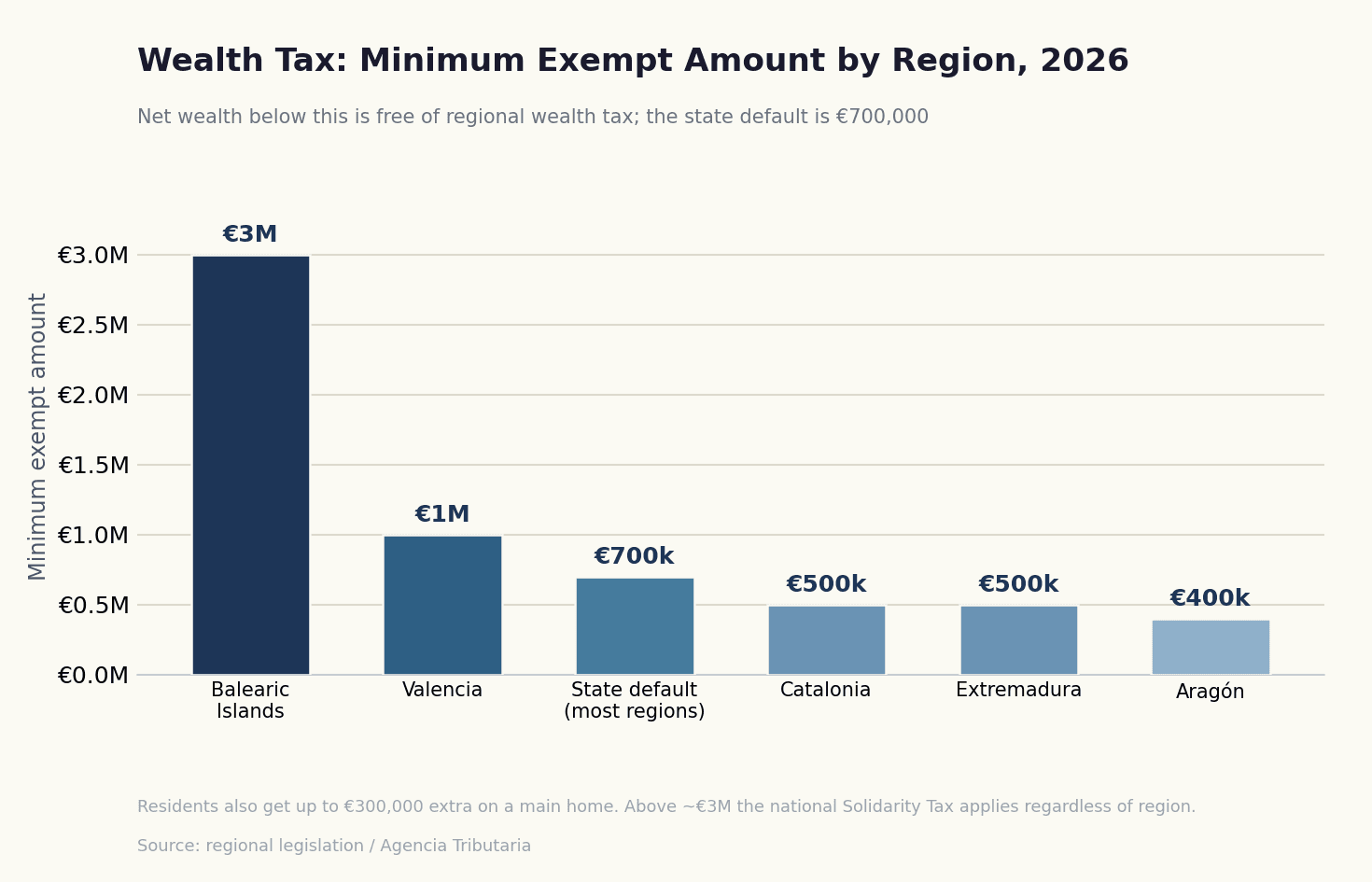
The pattern is clear enough. Madrid and Andalusia positioned themselves as magnets for international capital by effectively eliminating the regional wealth tax, and several other regions followed. The Balearic Islands took a different route, keeping the tax but lifting the threshold to €3 million. At the other end, Catalonia keeps both a low threshold and its own scale, producing among the heaviest burdens in Spain.
One critical caveat: your tax residence is determined by where you genuinely live (the 183-day or centre-of-interests test). Simply buying a property in a low-tax region is not enough; the tax authorities use utility bills, school records, and banking patterns to verify where you actually reside.
The Catch That Surprises Almost Everyone: The Solidarity Tax
Here is the trap that catches high-net-worth movers who assume a 100%-bonification region means zero wealth tax forever. The national Solidarity Tax on Large Fortunes (ITSGF, Modelo 718) was created precisely to stop the wealthy escaping wealth tax by relocating to Madrid or Andalusia. It is a national tax on net wealth above €3 million, with progressive rates running from roughly 1.7% to 3.5%, and any regional wealth tax already paid is credited against it so the same wealth is not taxed twice.
What is less widely understood is how the bonification regions responded. Rather than let that revenue flow to the central government, Madrid, Andalusia, Cantabria, Extremadura, La Rioja, and Murcia converted their 100% bonifications into variable ones. The rebate now applies only to the portion that the state solidarity tax would not capture. The practical result: below roughly €3 million of net wealth, the bonification is genuinely 100% and you pay nothing. Above it, you pay an equivalent amount, but it goes to the autonomous community rather than to the State.
For the taxpayer, the bottom line is the same either way: above the threshold, the regional “haven” advantage largely evaporates. Where your money lands differs; how much leaves your pocket does not. Residents still benefit from the €700,000 exemption and the main-residence allowance, so in practice the liability typically begins somewhere between €3.7 million and €4 million of worldwide net wealth depending on whether the home allowance applies.
Introduced as a “temporary” measure, the solidarity tax was upheld as constitutional by the Constitutional Court in 2023 and has been repeatedly extended. It is now best treated as a permanent feature of the system rather than something to wait out.
The 60% Rule: A Powerful Cap for the Asset-Rich
There is a vital relief that many expats overlook. Under the 60% rule, the combined total of your Spanish income tax (IRPF), wealth tax, and solidarity tax cannot exceed 60% of your taxable income. If it would, your wealth tax bill is reduced to bring the combined total back within the cap, although the reduction is itself capped: the wealth tax cannot fall below 20% of the original assessment, meaning the maximum possible reduction is 80%.
This is the most powerful lever available to people who are asset-rich but income-light, classically, retirees living off modest drawdowns while holding substantial capital. Someone with a large net worth but a modest annual income can see a headline wealth-tax bill cut sharply by this cap. Recent Supreme Court rulings in 2025 extended versions of these protections to certain non-residents on free-movement-of-capital grounds, a meaningful development for non-resident property owners.
Reporting: Three Forms You Must Not Confuse
Compliance involves separate filings that affluent expats need to keep straight.
Modelo 714 is the wealth tax return itself, filed alongside the annual income tax campaign (for the 2025 tax year, broadly 8 April to 30 June 2026), covering assets held on the previous 31 December. You generally must file if tax is due after allowances, or if the gross value of your assets exceeds €2 million even when no tax is payable. That second trigger catches people in bonification regions who assume that owing nothing means filing nothing.
Modelo 718 is the solidarity tax return, typically filed in July of the following year where applicable.
Modelo 720 is something different: an informative declaration of foreign assets, required of Spanish tax residents when any one of three categories, overseas bank accounts, securities and investments, or real estate, exceeds €50,000. It is filed between 1 January and 31 March. Although the Court of Justice of the European Union struck down the old punitive penalty regime in 2022, the obligation to file remains fully in force. US citizens have separate home-country obligations (FBAR and FATCA) that run independently.
Non-Residents and a Key 2026 Update
Non-residents pay wealth tax only on Spanish-located assets, can use the €700,000 exemption, but cannot claim the €300,000 main-home allowance. This is also where a development that began in the courts has ended up in the statute itself, which matters because it removes any argument about it. The fourth additional provision of Law 19/1991 now states without qualification that non-resident taxpayers are entitled to apply the rules approved by the autonomous community where the greatest value of their Spanish assets is located. It draws no distinction between EU and non-EU residents, so US, UK, Canadian, and Australian owners are covered on the same terms as anyone else. In practice, a Marbella villa owner could elect Andalusia’s rules, a Mallorca owner the Balearic regime, and so on.
Be aware too of anti-avoidance rules: shares in a company whose assets are at least 50% Spanish real estate can be pulled into the Spanish wealth-tax net, so holding property through a company does not automatically sidestep the tax.
Legal Levers to Reduce Your Exposure

Wealth tax planning in Spain is legitimate and widely practised. The main, lawful levers include:
- Region of genuine residence, where lifestyle and the 183-day rule allow, since the regional differences are the largest single variable below the solidarity tax threshold.
- Mortgage and debt structuring, since debts directly attached to assets reduce the taxable base.
- The qualifying family-business exemption, where shareholdings meet the strict conditions.
- Investment and life-assurance structuring, which can change how and when assets are valued and taxed, subject to careful treaty and domestic analysis.
- The Beckham Law regime for eligible incoming employees, under which only Spanish-situs assets are within scope.
- The 60% cap, which is claimed rather than applied automatically, and is frequently missed by asset-rich, income-light filers.
- Timing, since the tax is assessed on a single date (31 December), so the position on that day is what counts.
The unifying theme is that the most valuable planning happens before you become tax resident, while you still have full flexibility over structure and timing.
The Mistakes to Avoid
The recurring errors among affluent newcomers are predictable and costly. Assuming a 100%-bonification region means no liability, when above roughly €3 million the equivalent is collected anyway. Treating US 401(k)s and IRAs, Canadian RRSPs, trusts, or company structures as automatically exempt without a proper legal review. Forgetting that Modelo 720 is a separate, mandatory obligation. Not filing Modelo 714 when gross assets exceed €2 million despite no tax being due. Filing without the documentation needed to support debts, mortgages, and ownership percentages. And, most fundamentally, leaving the analysis until after the move, when options have narrowed.
Spain’s wealth tax is real, but it is also navigable. With the right region, the right structure, and the right advice taken early, many affluent expats find their effective exposure is far lower than the headline rates suggest. The key is to treat it as a core part of your relocation plan from the very start, not an afterthought once you have already become resident. If you are still mapping out the wider move, our overview of how to move to Spain in 2026 sets out how the pieces fit together.
Wealth tax is calculated on assets you also have to report separately when they are held outside Spain. That reporting obligation is a different form with its own thresholds and its own deadline, covered in our guide to Modelo 720 and Modelo 721.
Verified August 2026 against the consolidated text of Ley 19/1991 del Impuesto sobre el Patrimonio as published by the Boletín Oficial del Estado, and against Agencia Tributaria guidance on the Impuesto sobre el Patrimonio and the Impuesto Temporal de Solidaridad de las Grandes Fortunas. The state allowances, rate scale, the 60 per cent limit and its 80 per cent floor, the two-million-euro filing threshold, and the rule allowing non-residents to elect a regional regime were each checked against the article of that law which sets them. This article is for general informational purposes only and does not constitute legal, tax, or financial advice. Wealth tax rules, the Solidarity Tax on Large Fortunes, regional minimum exempt amounts, bonifications, and reporting requirements are complex, vary by autonomous community and individual circumstances, and change frequently; regional figures in particular are revised by autonomous community legislation and should be checked against the current rules for your own region. Before relocating, buying high-value assets, or restructuring your holdings, consult a qualified Spanish tax adviser and, where relevant, a cross-border financial adviser about your specific situation.