For families moving abroad, Barcelona offers a rare combination: a Mediterranean lifestyle, a deep bench of international schools, and a cost of living that undercuts London, Paris, and Zurich. In 2026 it remains one of Europe’s most desirable cities to raise children abroad. But two decisions shape the whole experience, and they are tightly linked: which school your children attend, and which neighbourhood you call home. Get the pairing right and daily life is smooth; get it wrong and you may face long school runs across a busy city.
This guide maps both sides of that equation, the schooling options from free public places to premium international campuses, and the residential areas that suit families, and explains how to match them.
Why Barcelona Works for Expat Families
Beyond the obvious draws of climate and culture, Barcelona offers genuine value in international education. Top-tier schooling here costs meaningfully less than equivalents in northern European capitals, while the standard of teaching, facilities, and university placement is high. The city also has an established international community with strong support networks, excellent private healthcare, and reliable public transport.
There is also a unique linguistic dimension. Catalonia is officially bilingual, so children encounter Catalan and Spanish in public life, while English dominates international business and education. For families willing to lean in, Barcelona is a place to raise genuinely trilingual children.
Understanding the Language Landscape
This linguistic reality is central to school choice. Public state schools in Catalonia teach primarily in Catalan, with Spanish and English as additional languages. That is a strong long-term fit for families settling permanently, and children under about eight typically absorb the language remarkably fast, but it is a harder transition for a teenager arriving mid-schooling or a family on a two-year assignment.
International schools solve this by delivering an internationally recognised curriculum in English (or French, German, and so on), while still teaching Spanish, and usually Catalan, as required by regional rules. The result is curriculum continuity for mobile families plus real local-language acquisition.
Three Tiers, Not One: Public, Concertado, and Private International
Before looking at fee tables, it is worth knowing that Barcelona offers three distinct routes, and international schooling is only the most expensive of them.
Public schools (escoles públiques) are free, and many foreign families use them successfully, particularly with younger children. Places are allocated by a points system the Generalitat publishes in full, and it is worth understanding before you sign a lease, because your address is worth a specific number of points rather than a vague advantage. Under the official assignment criteria, a sibling already enrolled at the school is worth 50 points, the single largest factor. Living inside that school’s zona educativa, when you list it first, is worth 30. A parent’s workplace inside the zone is worth 20.
The detail that catches newcomers out is that these proximity scores do not stack: you take the highest one that applies, not the sum. And within Barcelona itself, the Consorci d’Educació de Barcelona adds an intermediate step, awarding 15 points when your home is in the same municipal district as the school but outside its zona educativa, and 10 when it is merely in the same municipality. So living in the wrong part of the right district is not fatal, just expensive in points.
Two practical consequences follow. First, you are not barred from applying to a school outside your zone, contrary to what many relocation guides suggest; you simply score lower and are less likely to be assigned. Second, there is no minimum period of registration required to claim the proximity points: the padró is checked electronically at the moment you submit the application, so a recent move does not disqualify you. What matters is being registered before the deadline for challenging the provisional scores. Our guide to the NIE, TIE, and empadronamiento explains how padrón registration works and why it underpins school enrolment along with so much else. Getting a place at a specific popular school is still not guaranteed, and mid-year arrivals are allocated to whatever has space.
Concertados sit between the two: partially state-funded private schools, the most internationally oriented of which deliver bilingual or trilingual programmes for roughly €4,000 to €9,000 a year. They suit families settling in Catalonia long-term more than short assignments, and they are the option most often overlooked by newcomers who assume the choice is only between free-and-Catalan or expensive-and-English.
Private international schools are the focus of most of this guide, and the right answer where curriculum continuity, English-medium instruction, or a specific national system matters.
The International Schools
There are more than 40 international schools in Barcelona. The following are among the most established and consistently well regarded, grouped by curriculum so you can match them to your family’s future plans. Where a school below is described as offering the IB, you can confirm exactly which programmes it is authorised for, and check any other school in the city, using the International Baccalaureate’s own IB World School directory. Authorisation is programme by programme, so a school running the Diploma does not necessarily run the Primary Years Programme, and that distinction matters if you are arriving with a younger child and want continuity all the way through.
American curriculum
The American School of Barcelona (ASB), founded in 1962 in Esplugues de Llobregat, is a non-profit offering a US college-preparatory programme with Advanced Placement (AP) courses. Graduates regularly secure places at leading US and international universities, and it is a natural choice for American families needing curriculum continuity.
Benjamin Franklin International School (BFIS) offers a US-accredited curriculum from preschool through Grade 12, with an IB Diploma pathway for senior students. English is the main language of instruction with Spanish as a core subject. Centrally located and known for small class sizes and a tight-knit parent community, it is especially popular with American families and praised for its US university counselling.
British curriculum
The British School of Barcelona (BSB) is one of Catalonia’s largest and most established international schools, serving ages 2 to 18 across campuses in Castelldefels, Sitges, and a City Campus, with more than 2,000 students. It delivers the English National Curriculum with IGCSEs and A Levels, and is accredited under the UK Department for Education’s British Schools Overseas inspection scheme. That accreditation is worth understanding rather than taking on trust: it is voluntary, requires a full inspection every three years against standards mirroring those for independent schools in England, and the inspectorates are themselves monitored by Ofsted. Every BSO report is published on GOV.UK, so you can read the most recent inspection of any British school in Barcelona before you enquire, rather than relying on the summary a school puts in its own prospectus.
Oak House School is a non-profit British and IB school in Sarrià, often cited for strong IB results in a genuinely community-focused setting, with a trilingual approach. Places in mid-primary can be hard to obtain.
St. George British International School and St. Peter’s School round out the British options. St. George (Sarrià) offers British and IB pathways in a smaller, more central setting than BSB, while St. Peter’s (Les Corts) follows the Cambridge IGCSE and A-Level route with a long academic track record.
IB World Schools
SEK International School Catalunya, part of the SEK Education Group, is an IB World School offering the full continuum (PYP, MYP, and the Diploma) on a green campus north of the city, with boarding facilities available. It is known for innovation and technology integration.
Hamelin-Laie International School, a Nord Anglia school along the Maresme coast, offers the IB continuum in an English-Spanish bilingual environment and is well regarded for pastoral care, with boarding available. Families commuting from the centre should check train times, as the journey is longer than many expect.
European-language schools
For families needing continuity in another national system, Barcelona has strong options. The Lycée Français de Barcelone (LFB) follows the French AEFE curriculum at some of the lowest fees of any international school in the city, ideal for families moving within the French system, though instruction is primarily in French. The Deutsche Schule Barcelona (DSB) delivers the German curriculum through to the Abitur, the right choice where German-language continuity or university entry in Germany or Austria matters.
What International Schooling Actually Costs
Barcelona’s fees land below London or Singapore but still represent a serious line in the family budget. The headline tuition rarely tells the whole story. As a broad benchmark, annual tuition at the leading international schools runs approximately:
| Stage (age) | Typical annual tuition |
|---|---|
| Early Years (3–6) | €9,000 – €16,000 |
| Primary (6–11) | €12,000 – €20,000 |
| Secondary (12–16) | €15,000 – €22,000 |
| IB Diploma / A Levels (17–18) | €18,000 – €30,000 |
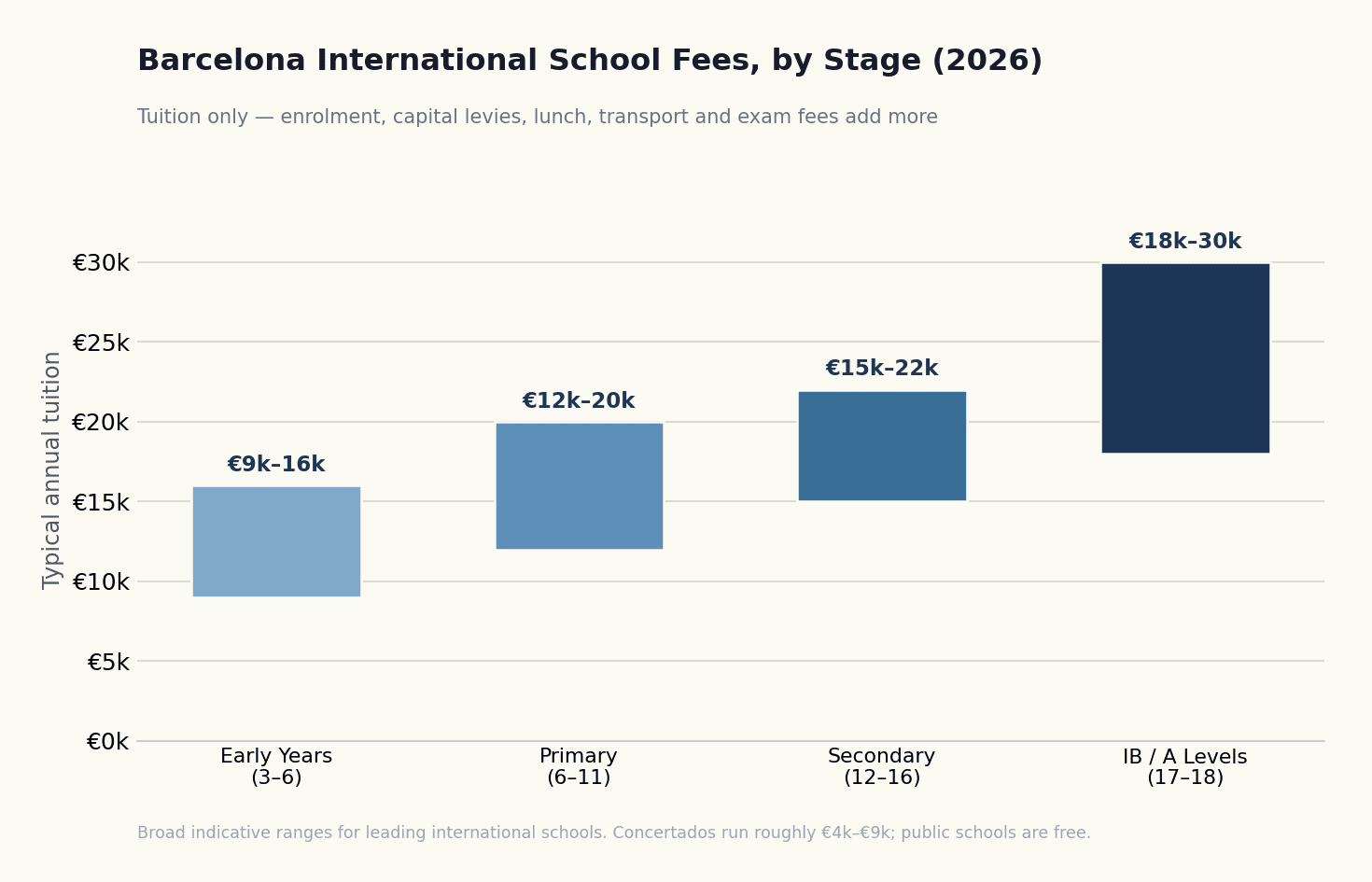
On top of tuition, budget for a one-off enrolment fee (often €1,500 to €3,000), annual materials or capital levies, lunch, uniforms, transport, optional extracurriculars, and separate exam fees for IGCSE, A Level, AP, or IB Diploma in the final years. Realistically, most families spend well above the headline tuition in the first year at a premium school once everything is counted.
A few ways to manage the bill: most schools offer sibling discounts, and a small discount is common for paying the full year upfront in September. Do not, however, budget on the assumption that you can offset school fees against tax. This is worth stating plainly because the opposite is widely repeated: Madrid and Andalusia do allow regional IRPF deductions for schooling costs, but Catalonia does not. The Agencia Tributaria’s official list of Catalan regional deductions runs to birth or adoption, widowhood, certain donations, angel investment, having more than one employer, rent for victims of gender violence, and cooperatives. Schooling is not on it, and neither is school transport, lunch, or materials.
The one education-related relief Catalonia does offer, listed by the Agència Tributària de Catalunya, is a deduction for interest on master’s and doctorate study loans granted through AGAUR, which is no help at all with a primary school bill. If you are choosing between Spanish regions and school fees are a major line in your budget, that gap is worth modelling before you commit: our guide to IRPF for foreign residents explains how the state and regional halves of the scale combine. Schools typically announce the following year’s fees around January for the September intake.
The Residential Areas
Where you live in Barcelona for family life is largely a question of the upper districts and a few well-connected suburbs. Here are the areas that consistently attract international families.
Sarrià-Sant Gervasi — the “Zona Alta”
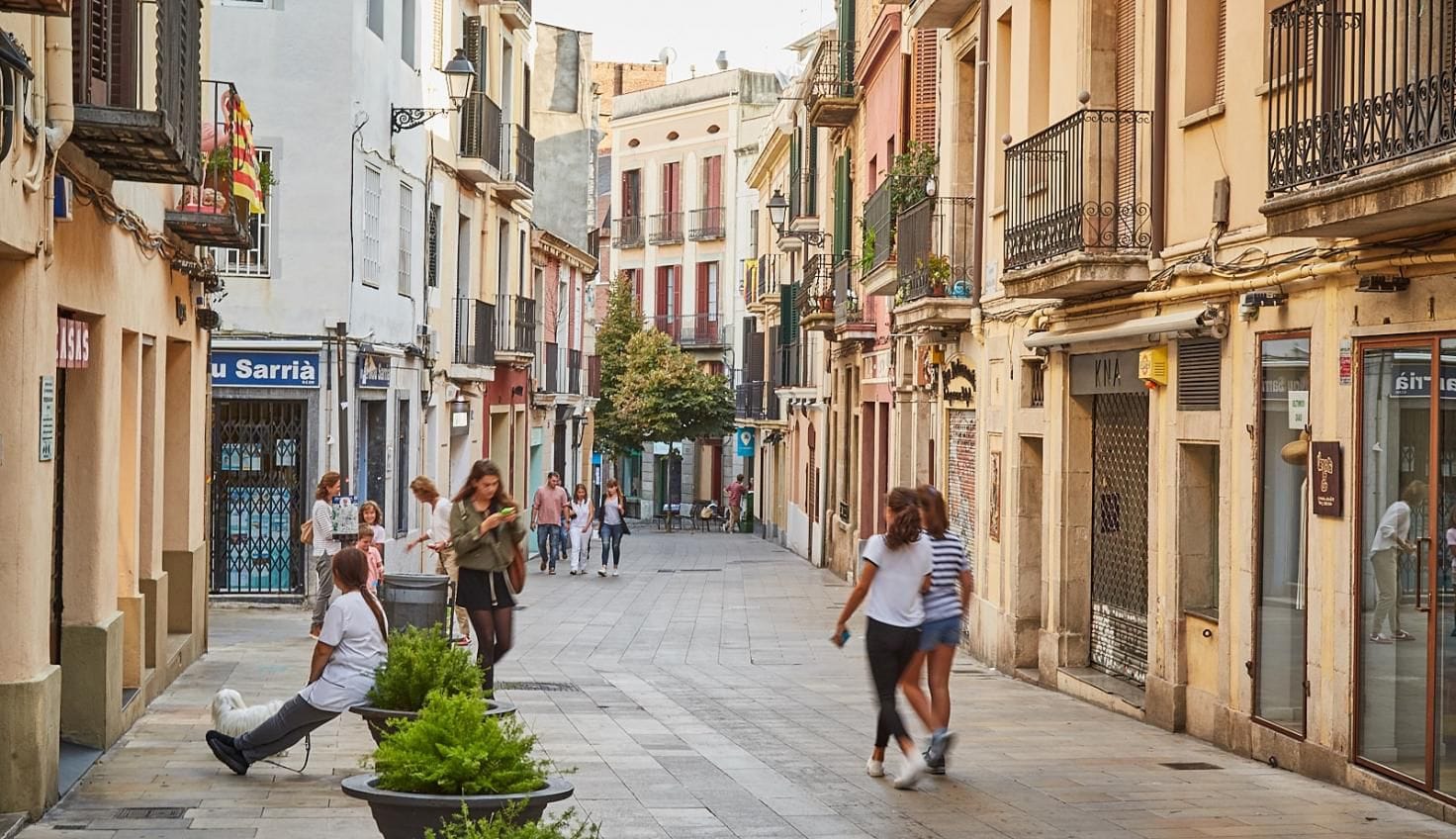
This is Barcelona’s most exclusive district and the first choice for many expat families with resources. Set against the green backdrop of Collserola and Tibidabo, it combines elegance, safety, and the city’s best concentration of international schools and private clinics. It is leafy, quiet, and largely free of tourist crowds, with a village feel around Plaça de Sarrià. Sub-areas each have their own character: Sarrià itself (charming, with good shops), Tres Torres (very quiet, generous parking), Sant Gervasi (more central and slightly more affordable), and Bonanova and Putxet. Purchase prices are among the city’s highest, and the FGC railway puts the centre 15 to 20 minutes away.
Pedralbes — ultra-premium
Within the Les Corts district, Pedralbes is widely regarded as Barcelona’s single most prestigious address. Expect wide avenues, large apartments with swimming pools, door attendants and garages, and, in the upper section, substantial villas with private gardens alongside embassy and consulate residences. Green spaces include the gardens of the Palau de Pedralbes and Parc de Cervantes, with the scenic Carretera de les Aigües trail along the ridge for running and cycling. It suits families with high budgets seeking maximum space and privacy.
Les Corts — upmarket and practical
Les Corts offers similar prestige and safety to its neighbours at generally lower rents (outside Pedralbes), plus an astonishing concentration of international schools and easy access to the business district along Diagonal and the Fira convention centre. The L’Illa shopping centre and proximity to Camp Nou add to its appeal. It is primarily residential, mixing apartment blocks, townhouses, and houses with gardens, and is a well-rounded choice for parents who also work in the business zone.
Sant Cugat del Vallès — suburban family life
For families who want space, gardens, and a quieter pace, Sant Cugat, just behind Collserola and around 20 to 30 minutes from the centre by FGC, is the standout. It offers detached houses with gardens and pools, cleaner air, golf and sports clubs, a lively cultural scene, and top international schools, with several schools running dedicated bus services to the area. It is consistently rated very safe and family-friendly, with a quality of life many find higher than in the city proper.
Esplugues de Llobregat and Sant Just Desvern
These inner suburbs to the northwest are spacious and green, with tennis and even horse-riding facilities, and are home to the American School of Barcelona in Esplugues. They appeal to families who want room to breathe while staying close to the city and key schools.
The coastal option: Castelldefels, Gavà, and Sitges
Families drawn to the British School of Barcelona and other southern campuses often base themselves in the beach towns of Castelldefels, Gavà, or Sitges. These offer a beach lifestyle, larger homes, and a short school run to coastal campuses, at the cost of a longer commute into central Barcelona.
The Smart Approach: Match the School First
The single most useful piece of advice for relocating families is to choose the school before the home, not the other way around. School places are competitive, waiting lists at the most sought-after schools are real, and curriculum fit is harder to change than an address. Once you have secured or shortlisted a school, choose a neighbourhood that keeps the daily commute sensible, whether that means walking distance in Sarrià, a short drive within Les Corts, or a stop on a school bus route from Sant Cugat or the coast. Many schools publish their bus routes, which can dramatically widen your housing options.
The one important exception is the public route: because places there are allocated largely on your registered address, families aiming at public schooling need to reverse the order and secure the right address first.
Practical Tips for a Smooth Move
A few points consistently make the difference. Applications for the September intake typically open in the late autumn, with offers in the following months, and most schools hold open days in October and February, so plan a scouting trip around those dates. Build in time for waiting lists at the top schools, and apply to more than one.
On housing, Barcelona’s long-term rental market is competitive and often unfurnished, and landlords usually require solid documentation such as proof of income or a work contract. Note too that parts of Barcelona have been declared stressed rental market areas, which caps what can be charged on new contracts, so the asking price is not always the price a landlord is entitled to set; our guide to renting a home in Spain as a foreigner covers deposits, contract types, and the clauses to watch for, including the one point that matters most here: your contract must allow you to register on the padrón, since school enrolment depends on it.
Temporary furnished rentals are a flexible bridge for your first months, and given how much rides on getting both school and neighbourhood right, many families use a specialist education or relocation adviser to navigate admissions, contracts, and the local rental market. You will also want healthcare arranged from day one; our guide to public healthcare versus private insurance sets out which route applies to your family.
Barcelona rewards families who plan. With its blend of multilingual schools and secure residential districts, it remains one of the best places in Europe to give children an international education and a genuinely high quality of life, provided you line up the school and the neighbourhood together, and start early. For how family costs compare across Spain’s main cities, see our comparison of the real cost of living in Madrid, Barcelona, Valencia, and Málaga, and for the wider move, our overview of how to move to Spain in 2026.
Verified August 2026 against the Generalitat de Catalunya’s published place-assignment criteria for the 2026-27 intake and the Consorci d’Educació de Barcelona; the Agencia Tributaria’s official list of Catalan regional IRPF deductions and the Agència Tributària de Catalunya; the UK Department for Education’s British Schools Overseas inspection scheme; and the International Baccalaureate’s school directory. Admission criteria, point weightings, and fees are set annually and school places change constantly, so confirm the current year’s rules with the linked sources and tuition directly with each school.
This article is for general informational purposes only. School fees, admissions timelines, available places, and property prices change frequently and vary by school, year group, and individual circumstances; the figures cited are indicative ranges rather than quotations. Always confirm current tuition, additional costs, and availability directly with each school, and verify rental or purchase terms with a qualified local professional before making any commitment.