When people compare the cost of living in Spain, they usually quote a one-bedroom rent and a coffee price. That is useful as far as it goes, but it misses most of what actually determines your annual outgoings: property, schooling if you have children, healthcare, and, for anyone with meaningful income or assets, the tax wedge that varies enormously between regions. Two cities can advertise a similar lifestyle yet leave a household thousands, or tens of thousands, of euros apart each year once everything is counted.
This 2026 guide compares Madrid, Barcelona, Valencia, and Málaga across every layer of the cost equation, so you can see not just where life looks appealing, but where it is genuinely most cost-effective for your circumstances.
Four Very Different Markets
Before the numbers, it helps to understand the positioning of each city.
Madrid is the capital and financial engine, home to the most expensive property in Spain but also one of the most favourable regional tax regimes. Barcelona offers the Mediterranean-cosmopolitan combination of beach and world-class culture, but pairs high property prices with Spain’s heaviest regional taxes. Valencia is the value play: a genuinely livable big city at far lower property prices, though its regional taxes sit above Madrid’s. Málaga, gateway to the Costa del Sol, blends coastal living and a fast-rising property market with Andalusia’s light regional tax touch.
1. Property: Where Your Money Goes Furthest

Property is the single largest expense in any relocation budget, and the gap between these cities is dramatic. The official benchmark is the Valor Tasado de la Vivienda statistic published by Spain’s Ministerio de Vivienda y Agenda Urbana, compiled from the valuations used in mortgage transactions. In the first quarter of 2026 it put the national average at €2,315.7 per square metre, a record since the series began in 1995, and placed our four provinces in a clear order: Madrid at €4,047.5, the only province in Spain above €4,000; Barcelona at €3,207.7; Málaga at €2,988, by a wide margin the most expensive province in Andalusia; and the Valencian Community at €1,898, also an all-time high.
Two caveats before you lean on those numbers. They are averages across the entire housing stock of each province, so the sought-after central districts listed below sit well above them. And the gap is widening rather than closing: the INE’s Índice de Precios de Vivienda recorded a 12.9% annual rise in the first quarter of 2026, with resale property up 13.5% and new build up 9.1%. Every autonomous community posted a double-digit increase, the Basque Country lowest at 10.3% and Catalonia just above it at 10.5%. Treat all of this as a way of understanding the relative gap between cities rather than as a valuation for any particular street.
| City | Sought-after districts | Average €/m², Q1 2026 (Ministerio de Vivienda) | Relative rent level |
|---|---|---|---|
| Madrid | Salamanca, Chamberí | €4,047.5 — the only province in Spain above €4,000; prime pockets far higher again | Highest |
| Barcelona | Sarrià-Sant Gervasi, Eixample | €3,207.7 — clear second among the four | High |
| Málaga | El Limonar; Marbella (province) | €2,988 — highest in Andalusia; Marbella and the Golden Mile sit far above the provincial average | Strong, markedly seasonal |
| Valencia | El Pla del Remei, L’Eixample | €1,898 across the Valencian Community — 47% of Madrid, 59% of Barcelona | Lowest of the four |
Madrid is in a league of its own at the top, and pulling away: its provincial average rose 16.4% year on year, the steepest of the four. Barcelona is the clear second city for central urban property, though Catalonia recorded one of the mildest regional price rises in Spain. Málaga is the interesting case: at €2,988 the province sits below Barcelona, yet its coastline competes at the very top, with Marbella and the Golden Mile among the most expensive stretches in the country, and it posted the sharpest rise in Andalusia at 14.2%.
Valencia is the standout value option, but the shorthand you will read everywhere, that it costs half of the big two, is only half right. At €1,898 against Madrid’s €4,047.5 it is 47%, so the claim holds there. Against Barcelona’s €3,207.7 it is 59%, which is a meaningful discount but not a halving. Rents, on the other hand, are genuinely the lowest of the four by a clear margin.
Whichever city you choose, budget the transaction costs alongside the price: our guide to property purchase taxes in Spain sets out ITP, IVA, AJD, and notary fees region by region, and these differ meaningfully between the four communities. Our guide to the annual taxes of owning property covers the recurring IBI and related charges. If you plan to rent first, which most newcomers sensibly do, our guide to renting a home in Spain as a foreigner explains deposits, contract types, and the stressed-market rules that can cap rents in parts of these cities.
2. The Tax Wedge: The Hidden Multiplier
This is where the real money is for anyone with substantial income or assets, and it is the factor most cost-of-living guides ignore entirely. Under Ley 22/2009, the law governing how Spain’s regions are financed, each autonomous community receives half the income tax collected in its territory and sets its own scale for the general tax base. The Agencia Tributaria’s own guidance on the regional component of IRPF confirms that every community has approved a scale of its own, which is why an identical salary produces a different bill in Madrid and Barcelona. Add near-total regional control over wealth tax, and where you establish tax residency (the 183-day rule) can move your annual outgoings by more than any rent difference.
The contrast is stark. Madrid has effectively eliminated its regional wealth tax and applies among the lowest regional income-tax rates in the country. Andalusia (Málaga) mirrors this with an effectively neutralised regional wealth tax and very generous inheritance-tax relief for close family. Catalonia (Barcelona), by contrast, levies among the highest income-tax rates in Spain, with a top combined marginal rate around 50%, and applies its own wealth tax with a low exempt threshold. Valencia also sits at the higher end for income tax and retains its wealth tax, though it raised the exempt minimum to €1 million.
Two important qualifications. First, the regional advantage narrows sharply at the top. Ley 38/2022 created the Solidarity Tax on Large Fortunes, which reaches net wealth above €3 million (in practice closer to €3.7 million once the standard allowance applies) regardless of region. Its harmonising purpose is stated openly in the law’s own preamble: the burden on taxpayers living in communities that have wholly or partly abolished wealth tax should not differ substantially from the burden elsewhere. Because you are only charged on the portion your own community has not already taxed, the low-tax regions lose most of their advantage above that threshold. Our guide to Spain’s wealth tax and the Solidarity Tax sets out the mechanics. Second, income tax bites everyone, not just the wealthy: the regional half of the scale applies at every bracket, so a salaried professional also pays measurably different amounts in Madrid and Barcelona on identical earnings. Our guide to IRPF for foreign residents explains how the two halves of the scale combine.
For a household with a substantial portfolio, the annual tax difference between living in Madrid or Málaga versus Barcelona can dwarf any difference in rent or school fees. That said, tax residency follows where you genuinely live: buying in a low-tax region while actually residing elsewhere does not work, and the authorities check utility bills, school records, and banking patterns.
3. Education
Spain’s public schools are free and generally good, and many foreign families use them successfully, particularly with younger children who pick up the language quickly. In Catalonia and Valencia, note that public education is conducted substantially in the co-official regional language, which is a genuine consideration for a family arriving mid-schooling.
For families choosing international schooling, Madrid and Barcelona host the deepest markets. At the upper tier, annual tuition commonly runs from around €9,000 in Early Years to roughly €18,000–€30,000 at the IB Diploma or A-Level stage, before enrolment fees (often €1,500–€3,000), capital levies, transport, and exam fees. A realistic first-year budget for a top-tier school is therefore meaningfully higher than the headline tuition figure.
Valencia and Málaga offer strong international schools at generally lower fees, with mid-range English-medium options a good deal cheaper, which is a significant draw for families wanting international education without Madrid or Barcelona price tags. Sibling discounts are common across all four cities. Our guide to international schools and residential areas in Barcelona looks at how school choice and neighbourhood interact for relocating families.
4. Healthcare
Many foreign residents layer private healthcare on top of, or instead of, the public system. Visa-compliant private insurance with no copayments runs broadly €50–€150 per month depending on age, with comprehensive policies higher; our guide to health insurance for Spanish visas explains what a compliant policy must contain.
All four cities have excellent private hospitals. Madrid and Barcelona have the widest networks and the strongest concentration of English-speaking specialists, while Málaga and Valencia are well served and often somewhat cheaper. If you are eligible for the public system, whether through employment, an S1 form, or the convenio especial, the cost picture changes entirely. One condition catches new arrivals out: the Ministerio de Sanidad requires anyone subscribing to the convenio especial to prove effective residence in Spain for a continuous year immediately before applying, though time spent in the EU, the EEA, Switzerland or the United Kingdom counts towards that year. It is not, therefore, a route you can use on arrival, and budgeting for private cover in the first twelve months is unavoidable for most people who lack another entitlement. Our guide to public healthcare versus private insurance sets out who qualifies for which route.
5. Daily Life
This is where Spain delivers extraordinary value relative to London, New York, or Zurich. Dining out and weekly groceries both cost markedly less, so a lifestyle that would feel indulgent elsewhere feels unremarkable here. The reference point for how those everyday costs are actually moving is the INE’s Índice de Precios de Consumo, published monthly, and it is worth a look before you commit to a budget built on figures from a guide written a year ago.
Madrid and Barcelona have the richest dining and cultural scenes, with deep rosters of acclaimed restaurants, galleries, and music. Málaga and the Costa del Sol punch above their weight on dining, beach clubs, and golf, while Valencia’s gastronomic scene is smaller but growing fast and excellent value. Gym memberships run in the region of €30–€60 a month across the board, with boutique studios costing more.
Running a car adds a few hundred euros a month once fuel, insurance, and parking are counted, and note that motor insurance is legally compulsory in Spain for as long as a vehicle is registered, even if it never moves; our guide to compulsory car insurance explains that obligation and the penalties. In Madrid and central Barcelona, many residents rely on excellent public transport and skip the car entirely, which is itself a meaningful saving.
6. The Part You Can’t Put on a Spreadsheet
Some of the “cost” of living somewhere is really about what you get for the money, and here the cities diverge by character rather than price. Málaga and Valencia offer abundant sunshine, beaches, and a noticeably more relaxed pace, the lifestyle dividend that draws so many relocators south and east. Madrid trades the coast for being Spain’s cultural and business capital, with unmatched connectivity, dining, and a dry continental climate that is genuinely cold in winter and very hot in summer. Barcelona uniquely combines beach, mountains, and a global cultural brand, though it also contends with tourism pressure and tightening short-term-rental rules that affect central neighbourhoods.
Putting It Together
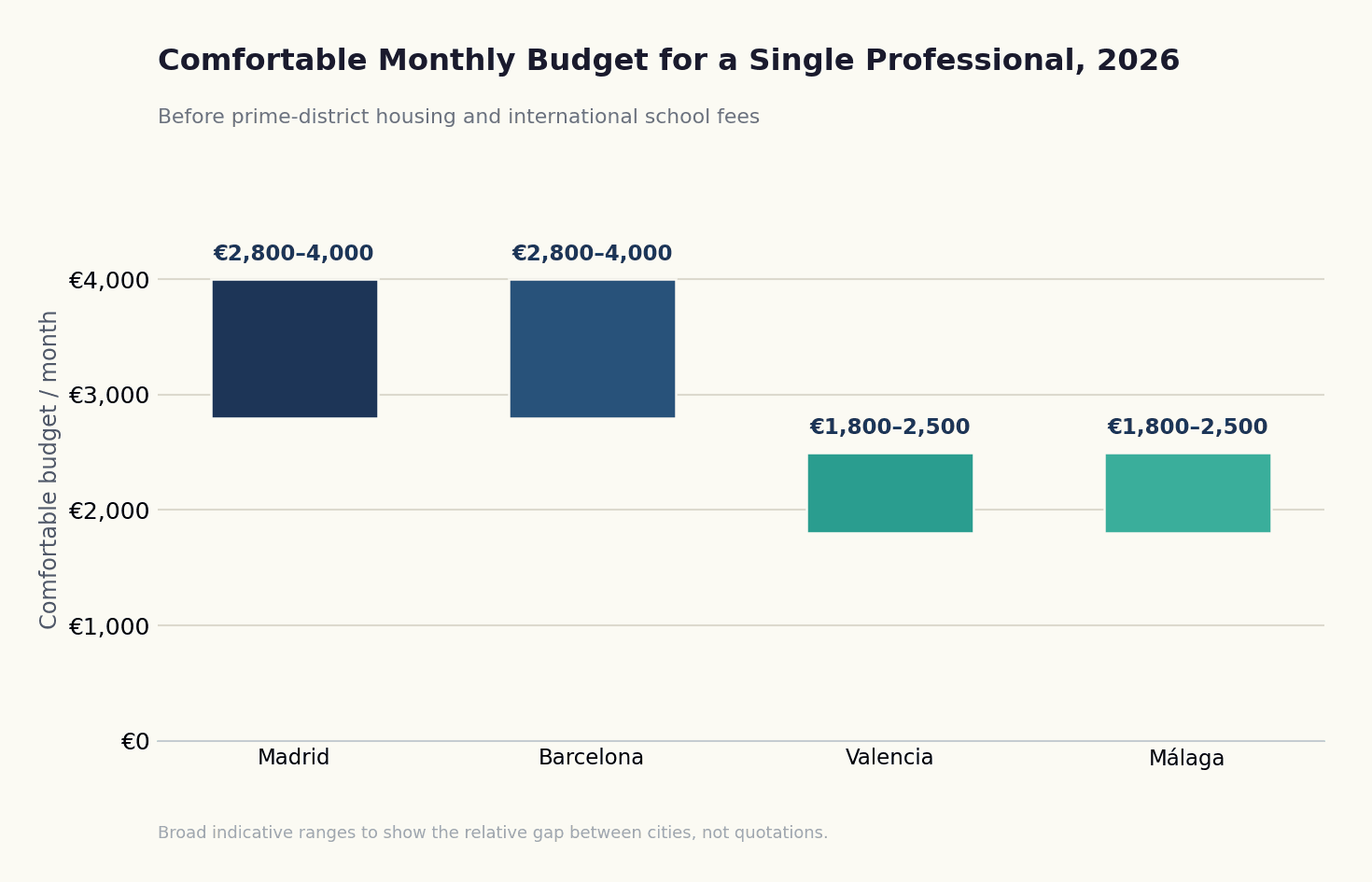
Headline budgets tell the story at a glance. A comfortable, not extravagant, single professional needs roughly €2,800–€4,000 a month in Madrid or Barcelona, versus around €1,800–€2,500 in Valencia or Málaga, before the additional layers of private schooling and prime-district housing. For a household weighing all the layers, the picture broadly looks like this:
| Cost layer | Madrid | Barcelona | Valencia | Málaga |
|---|---|---|---|---|
| Property | Highest | High | Lowest | High on the coast |
| Income & wealth tax | Lowest | Highest | High | Low |
| International schooling | Deepest, priciest | Deepest, priciest | Moderate | Moderate |
| Daily living | High, world-class | High, world-class | Lower, great value | Moderate |
| Climate / beach | Inland, continental | Beach and city | Beach and value | Best beach lifestyle |
The pattern is revealing. On pure outgoings, Valencia and Málaga are markedly cheaper than Madrid and Barcelona. But once the tax wedge enters the calculation, the ranking can flip for higher earners: Madrid’s high property prices may be offset by its low regional taxes, while Barcelona’s high property prices are compounded by high ones. Málaga is unusual in combining a relatively affordable city, a glamorous coast, and Andalusia’s light tax touch.
Which City Fits Which Household?
Madrid suits those who prioritise career connectivity, cultural depth, and tax efficiency on larger incomes and portfolios. You pay the most for property, but the favourable regional tax regime can more than compensate at higher income and wealth levels.
Barcelona is for those who want the complete Mediterranean-cosmopolitan package, beach, mountains, design, and global culture, and are willing to pay for it twice over, in both property and the country’s heaviest regional taxes.
Valencia is the smart value choice: a real, livable city with central property at roughly half the price of Madrid or Barcelona and an excellent quality of life, with the caveat of higher regional taxes than Madrid for affluent residents.
Málaga offers perhaps the most distinctive blend: coastal living, a fast-appreciating property market, and Andalusia’s investor-friendly tax stance, though prime coastal prices now rival the big cities and the market is competitive. Our detailed comparison of buying property in Málaga versus Valencia goes deeper on those two markets specifically.
There is no single “cheapest” city, because cost is not one number. It is the sum of property, tax, education, healthcare, and daily life, weighted by what your household actually values and how your income and assets are structured. The person who models all of those layers together, rather than comparing rents alone, is the one who ends up paying the right price for the right life. For the wider sequence of the move, see our overview of how to move to Spain in 2026.
Verified August 2026 against the Ministerio de Vivienda y Agenda Urbana’s Valor Tasado de la Vivienda statistic and the INE’s Índice de Precios de Vivienda, both for the first quarter of 2026; Ley 38/2022 as published in the Boletín Oficial del Estado; Agencia Tributaria guidance on the regional component of IRPF; and Ministerio de Sanidad guidance on the convenio especial. Property statistics are published quarterly and the figures above will be superseded; check the linked sources for the current quarter before relying on them.
This article is for general informational purposes only and does not constitute financial, tax, legal, or investment advice. Property prices, rents, tax rates, school fees, and living costs change frequently and vary by neighbourhood, provider, and individual circumstances; the figures cited are broad indicative ranges intended to show the relative gap between cities, not current valuations or quotations. Before relocating or making major financial commitments, verify current figures directly and consult a qualified Spanish tax adviser and relevant local professionals about your specific situation.