
You arrive in Spain with three months of your regular medication in a carry-on bag, feeling prepared. Then, as the supply nears its end, you walk into a Spanish pharmacy with your original US or UK prescription, hand it to the pharmacist, and they look at you with polite confusion. No, they cannot dispense based on a foreign prescription. No, they will not call your doctor back home. You will need to see a Spanish doctor, explain your condition, and receive a Spanish prescription. Welcome to the reality of healthcare across borders. This guide explains how prescriptions in Spain work for expats: how to bring what you have, what you must arrange before you fly if your medication is controlled, what to do when the supply runs out, and how to find equivalents if your usual medication is not sold here.
The Core Rule: Spanish Pharmacies Do Not Accept Foreign Prescriptions
This is the single most important fact. Spanish pharmacies cannot and will not dispense medication based on a prescription written by a US, Canadian, or Australian doctor, even if the prescription is valid, recent, and clearly written. This is not a quirk or a shortcut available to those with connections; it is the law. Each country controls its own drug supply, licensing, and safety standards, and Spain recognises prescriptions only from physicians licensed within its own or a recognised system.
The solution is not to fight this rule but to work within it. Before arriving in Spain, obtain a substantial supply of your regular medications from your home pharmacy, ideally with a formal letter from your doctor on official letterhead detailing your diagnosis, the generic (not brand) name of each medication, dosage, frequency, and the reason for your travel. This letter, paired with your original prescription, serves as documentation if customs questions you.
Bringing Medications Into Spain: What Is Legal
Spanish pharmaceutical law, consolidated in Royal Legislative Decree 1/2015 (which replaced the earlier 2006 medicines act), permits you to bring medications for personal, ongoing medical treatment into Spain. The three-month figure everyone quotes is real and comes from the AEMPS: the quantity you carry must match your prescribed treatment and must not be large enough to suggest trafficking, which in practice means no more than three months’ supply. The AEMPS also states that larger quantities can be accepted exceptionally where properly justified, so a longer supply is a matter of documentation rather than a hard prohibition, as long as the medicine is not a controlled substance.
Key requirements:
Original packaging. All medications must be in their original containers with the pharmacy label showing your name, the drug name, dosage, and dispensing date. Do not transfer pills to pillboxes or unmarked containers for international travel; doing so makes it nearly impossible to verify what you are carrying.
Carry them in hand luggage. Never mail medications to Spain. Spanish customs will return or destroy mailed packages of prescription drugs, and neither your embassy nor Spanish authorities will intervene. Hand-carry everything.
Have documentation. Travel with your original prescription and a doctor’s letter on official letterhead. Neither document legally requires a certified Spanish translation, but having one can smooth the process at customs. At minimum, ensure your letter states:
- Your full name and date of birth
- Your diagnosis
- The generic name (not brand) of each medication
- Dosage and frequency
- The reason for travel (for example, relocation or ongoing medical treatment)
- Your doctor’s contact details
Controlled medicines need advance permission, not just a letter. This is the part most relocation guides get wrong, and getting it wrong is the difference between a formality and a customs problem. Spain uses its own categories rather than your home country’s scheduling: medicines classified as estupefacientes (narcotics, including strong opioids) or psicótropos (psychotropics, including many stimulants and benzodiazepines) are treated separately at the border.
If you are arriving from outside the Schengen area, which includes the United States, Canada, Australia and the United Kingdom, and you carry a medicine containing an internationally controlled substance, article 74 of Royal Legislative Decree 1/2015 requires you to apply for an entry permit before you travel. It is not discretionary and it is not something you sort out on arrival. The application goes to the AEMPS, either directly by email to its Área de Estupefacientes y Psicótropos or through a Spanish embassy or consulate in your country, and only medication already prescribed as part of a medical treatment qualifies.
Two limits catch people out. The permit is normally issued for a treatment period of up to thirty days, extended only for psychotropics used as anticonvulsants or where the destination country’s rules allow longer, and the certificate itself is valid for a maximum of three months. So the reassuring “bring three months’ supply” advice does not apply to controlled medicines in the way it applies to everything else. If your treatment is long-term, plan on seeing a Spanish doctor early rather than importing a long supply. Medicines that do not contain controlled substances need no prior permission at all, though ordinary customs rules still apply and travelling with the prescription is sensible.
Watch for time limits. Prescriptions for controlled medicines are typically valid only for a limited period after issue. Make sure yours is recent enough to be accepted.
EU and UK Prescriptions: A Different Story
If you are moving from an EU country, the situation is simpler. Under EU cross-border healthcare rules, a prescription issued in Germany, France, Italy, or elsewhere in the Union can in principle be dispensed in Spain, provided it is written in the standard cross-border format with the generic drug name rather than a national brand. In practice, availability of the exact product still governs what you walk out with, and Spain will expect you to transition to a Spanish prescription once you are resident, both for continuity of care and because prescribing data feeds into the Spanish health system.
British readers should not assume the same applies automatically after Brexit. Ask your UK surgery specifically whether it can issue a prescription in a format intended for dispensing abroad, and plan on the basis that you will need a Spanish prescription reasonably soon after arriving rather than relying on a UK one indefinitely.
The Transition: Getting a Spanish Prescription
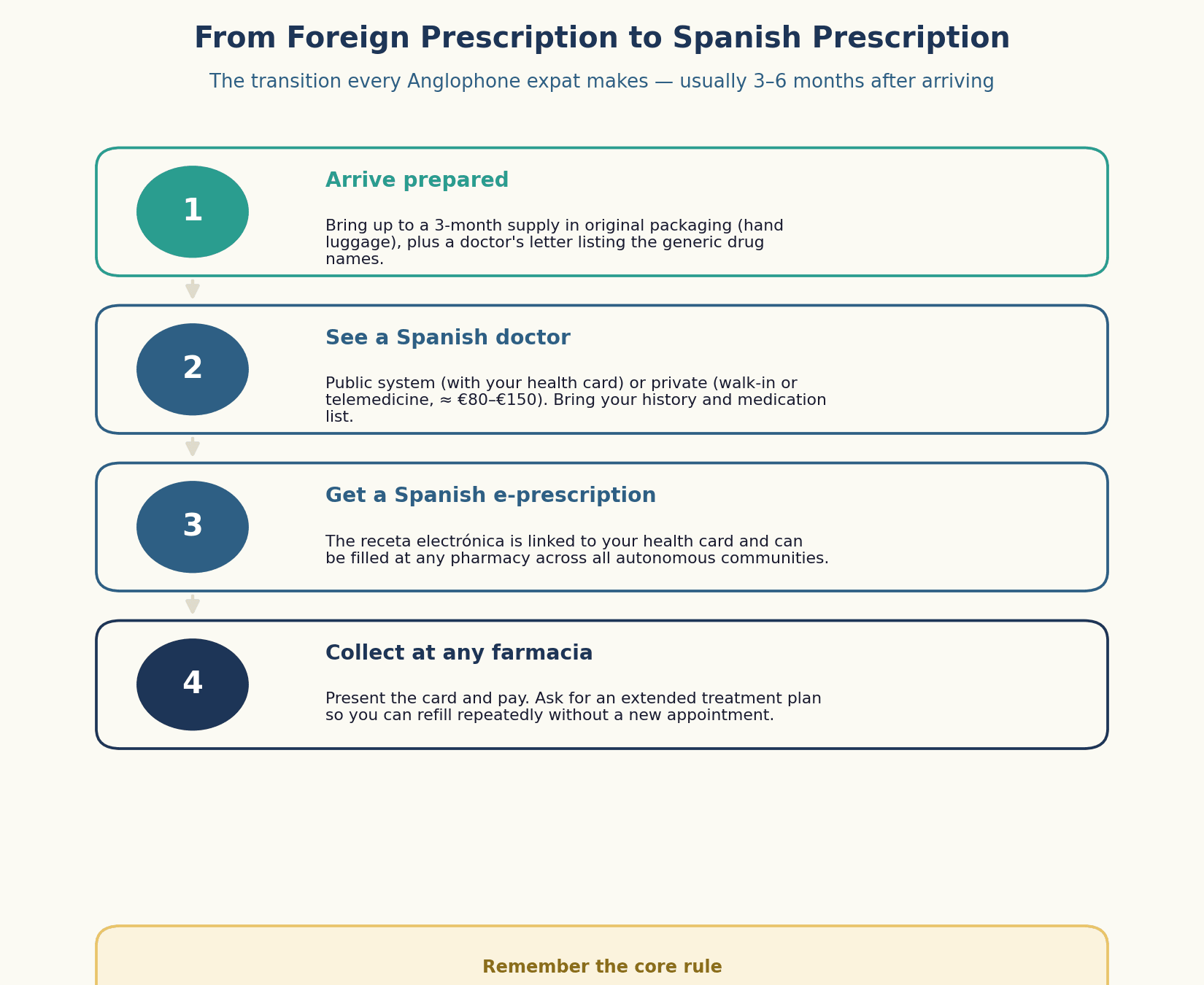
Once your initial supply runs out, typically three to six months into your move, you will need to see a Spanish doctor to obtain a local prescription.
Private vs. public healthcare
Spain’s public healthcare system is excellent, and since the 2018 universal access reform the right to it is tied to establishing residence rather than to having contributed to Social Security. In practice, however, several groups of newly arrived foreigners still fall outside it, most commonly those on visas that require private insurance as a condition of the permit, and regional implementation varies. Our guide to public healthcare versus private insurance explains which route applies to whom.
One point from that guide matters enormously here: the convenio especial, the mechanism that lets economically inactive residents buy into the public system, does not include outpatient prescription medication. Subscribers pay the full pharmacy price. By contrast, someone covered through Social Security contributions or a Spanish pension pays only a subsidised share. If you rely on regular medication, that difference should feed directly into which healthcare route you pursue.
Most newly arrived expats rely on private health insurance, broadly in the region of €50 to €150 a month depending on age and cover, with comprehensive policies higher. Choosing a compliant policy matters for your visa too; see our guide to health insurance for Spain’s Digital Nomad Visa. A private doctor visit typically costs somewhere around €80 to €150 and does not require prior authorisation: you can walk in, book ahead, or use telemedicine. Many private clinics in cities and coastal areas employ English speakers.
The doctor’s appointment
When you visit a Spanish doctor, bring your complete medical history, any test results, a list of your current medications (generic and brand names), and your foreign prescription or doctor’s letter. Explain that you are transitioning your care from abroad.
The doctor will typically review your condition and medication, check whether the same drug is available in Spain (often under a different brand name), and either issue a Spanish prescription or propose a clinically equivalent alternative. Many common medications, including antidepressants, antihistamines, blood pressure drugs, and statins, are widely available in Spain as generics at a fraction of US prices.
How Spanish prescriptions actually work now
This is where guidance written even a few years ago is misleading. Spain has moved substantially to electronic prescribing (receta electrónica). In the public system, your prescription is linked to your health card rather than handed to you on paper: the doctor enters it into the system, and you collect at any pharmacy by presenting the card, often across several months of a treatment plan without returning to the surgery. The system is genuinely interoperable between autonomous communities through the Ministry of Health’s RESNS service, so medication prescribed in one region can be dispensed from a pharmacy in another on production of your health card alone. Two practical details are worth knowing before you need them. Tell the pharmacist which region issued the prescription, because they need it to look your treatment up. And be aware that when you collect outside your own community, the annual caps on what you contribute towards medication costs are not applied at the counter: you pay your normal percentage, and if that takes you over your cap you have to keep the receipts and claim the difference back on returning home. Pensioners, who have the lowest caps, are the ones this bites.
Private healthcare increasingly uses electronic prescribing too, though paper prescriptions still circulate in some private practice. Either way, the practical upshot is the same as the old paper system in one respect: Spanish doctors do not “call in” refills the way US practices do. What they do instead is issue a treatment plan covering an extended period, so for a chronic condition you can collect repeatedly without a new appointment each time. Ask your doctor explicitly to set the prescription up this way if you are on long-term medication.
Finding Your Medication: Brand Names and Equivalents
A significant challenge is that the same drug is often sold under different brand names in different countries. Methylphenidate, sold as Ritalin in much of the English-speaking world, appears in Spain under names including Rubifen and Concerta. Escitalopram may be dispensed as a generic or under a different brand. Atorvastatin is typically generic.

To ease this transition:
Use generic names. Before you move, learn the generic (chemical) name of every medication you take. That is the name that travels across borders; brand names do not.
Look them up yourself before you move. You do not have to rely on anyone’s recollection for this. The AEMPS runs CIMA, a free public database of every medicine authorised in Spain, searchable by active substance. Search the generic name and you get every product sold here containing it, the brand names, the presentations and pack sizes, the patient leaflet, whether it requires a prescription, and, usefully, whether the product currently has supply problems. Do this before you move rather than after, because discovering that your medication is simply not marketed in Spain is much easier to solve while you still have your home doctor.
Consult a Spanish pharmacist. Once you arrive, visit a pharmacy and ask the farmacéutico whether your medication is available and under what name. Spanish pharmacists are highly trained, frequently speak English in urban and coastal areas, and are thoroughly used to expats. They can suggest direct equivalents or discuss alternatives with your doctor.
Be prepared for substitution. Some medications you rely on may not be available in Spain, or your Spanish doctor may propose a slightly different but clinically equivalent drug. If your condition is complex or you are sensitive to formulation changes, discuss alternatives with your home doctor before moving, not after.
Medications That May Be Unavailable or Restricted
Some medications available in the US or UK are restricted, unavailable, or branded differently in Spain.
Stimulant ADHD medication. Amphetamine-based products common in the United States are far more tightly restricted in Spain, and Spanish practice leans toward methylphenidate or non-stimulant alternatives. If you rely on one, raise it with a Spanish doctor early, since you may need to switch or navigate a more involved authorisation process.
Certain painkillers. Some opioids and combination products sold in the US are restricted or simply not marketed in Spain. Non-prescription NSAIDs such as ibuprofen are widely available.
Specific supplement brands. Particular US supplement brands may not be imported. If you depend on one, bring a supply and plan a substitution.
Biologics and specialty medications. Injectable biologics for conditions such as rheumatoid arthritis or psoriasis vary in availability and often require specific authorisation. Discuss these with both your Spanish doctor and your insurer well in advance, since they are also among the most expensive to fund privately.
Pharmacies in Spain: How to Use Them
Spanish pharmacies (farmacias) are identified by a green cross and are everywhere; nearly every neighbourhood has one. Hours vary, but many stay open into the evening, and every area operates a rota of farmacias de guardia for nights, Sundays, and holidays, published locally and online.
Filling a prescription: present your health card (for electronic prescriptions) or your paper receta, and pay at the counter. The pharmacist may offer a generic in place of a brand; generics are equivalent and cheaper.
Language: English is commonly spoken in pharmacies in Madrid, Barcelona, Valencia, and coastal areas, less so in smaller inland towns. Carrying your medication list with generic names solves most of the problem.
Over-the-counter availability: a number of medications requiring a prescription in the US are sold over the counter in Spain, including common painkillers and antihistamines, though the pharmacist may ask questions before dispensing. One important correction to a persistent myth: antibiotics always require a valid prescription in Spain and cannot legally be sold over the counter. Spain has actively tightened enforcement on this as part of antimicrobial resistance policy.
Costs: A Pleasant Surprise
Medication in Spain is markedly cheaper than in the United States. A generic month’s supply of a common statin, antidepressant, or diabetes medication typically costs single-digit to low double-digit euros, and even branded products are cheaper than US equivalents because Spain applies price controls to reimbursed medicines.
What you personally pay, though, depends on your healthcare route. Someone covered through Social Security contributions pays a percentage set by income; someone on a convenio especial, or paying privately, pays the full price. That gap is worth modelling honestly if you take several medications daily.
If you are inside the public system, the rules changed very recently and in a way that favours people on long-term treatment. Real Decreto-ley 11/2026, in force since May 2026, replaced the old three income bands for working-age patients with six, and introduced monthly caps where previously there were none for incomes below €35,000. Working-age contributions now run from 40% at the lowest bands up to 60% for incomes of €100,000 or more, with monthly ceilings of €8.23, €18.52 and €61.75 applying to the lower brackets. Pensioners keep a 10% general rate with their own set of caps by income. The stated purpose of the reform is to stop the cost of chronic treatment becoming a reason to abandon it, so if you are on several long-term medicines it is worth checking which band you fall into rather than assuming the older figures still circulating online.
Telemedicine and Long-Term Strategy
Many private clinics in Spain offer telemedicine consultations, which are convenient for routine reviews and renewals once you have an established relationship with a doctor. Some international insurance plans cover these at reduced rates.
The smoothest long-term path is to establish relationships with a doctor and a local pharmacy who know your history. For chronic conditions, ask specifically for an extended treatment plan so you can collect repeatedly without a new appointment each time. And keep copies of all prescriptions, doctor letters, and medication lists in both English and Spanish, which makes any future transition, whether within Spain or on to another country, far less painful.
Cautions
Do not buy medications from unlicensed sources. Spain has a dense network of regulated pharmacies staffed by trained professionals; there is no reason to look elsewhere, and online sellers shipping prescription drugs into Spain are frequently operating illegally.
Do not assume medications are identical to those at home. Even where the active ingredient matches, formulations, doses, and excipients can differ. Confirm with your pharmacist rather than assuming.
Report side effects, and know that you can do it yourself. If a medication prescribed in Spain causes problems, tell your doctor promptly. Beyond that, patients in Spain can report a suspected adverse reaction directly, without going through a health professional, using the AEMPS’s NotificaRAM form. Reports feed the national pharmacovigilance database and from there the European one, and you do not need to be certain the medicine caused the problem; a suspicion is what the system is designed to collect. This matters more than it sounds for someone who has just switched to an unfamiliar formulation of a familiar drug.
Getting your paperwork in place makes all of this easier, since your health card and doctor registration depend on it; our guide to the NIE, TIE, and empadronamiento explains the order to obtain them in. For the wider picture of settling in, see our overview of how to move to Spain in 2026.
Verified August 2026 against the AEMPS on medicines carried by travellers, including the entry permit required under article 74 of Royal Legislative Decree 1/2015 for controlled substances, its CIMA database of authorised medicines, and the NotificaRAM adverse-reaction reporting system; the Ministerio de Sanidad on the interoperable electronic prescription service of the National Health System; and Real Decreto-ley 11/2026 as published in the Boletín Oficial del Estado for the pharmaceutical contribution bands in force since May 2026. Rules on controlled substances, permit durations and pharmaceutical contribution rates change, and healthcare implementation varies by autonomous community, so confirm your own position with the AEMPS and a Spanish physician before travelling.
This article is for general informational purposes only and does not constitute medical or legal advice. Medication availability, prescription requirements, controlled-substance rules, and healthcare regulations in Spain change and vary by autonomous community. Always consult a qualified Spanish physician, and check current import rules with the AEMPS and your home country’s health authorities, before travelling with prescription medication. Seek professional medical advice for any question about your specific medicines or conditions.