You bought Bitcoin five years ago at €2,000 and held it while it appreciated. Or you are staking Ethereum through a liquid staking protocol, earning yield in a DeFi lending pool, holding governance tokens in a DAO, and collecting royalties from an NFT collection you minted two years ago. Either way, once you are a Spanish tax resident, the Agencia Tributaria has a position on all of it, and that position is often not the one investors arriving from the US or UK expect.
Every crypto-to-crypto swap, every coffee paid for in Bitcoin, every staking reward is a potential taxable event, reported to authorities automatically through European data-sharing rules and penalised if declared incorrectly. This guide covers the whole picture for 2026: the foundations of how Spain taxes digital assets, and then the more complex Web3 territory, staking, DeFi, NFTs, and DAOs, where foreign investors make the most expensive mistakes.
The Fundamental Rule: Spain Taxes Crypto as an Asset, Not a Currency
The Agencia Tributaria classifies cryptocurrency as a digital asset, equivalent to stocks, bonds, or real estate, not as currency. This distinction is the root of nearly everything else: each time you dispose of crypto, whether by selling it, swapping it for another coin, or using it to buy goods, you trigger a taxable event. Simply holding Bitcoin is not taxable. Converting it into euros, exchanging it for Ethereum, or paying for a meal with it is.
For Spanish tax residents, the rule is worldwide taxation. If you spend more than 183 days a year in Spain or your centre of vital interests sits there, Spain taxes all your cryptocurrency income and gains regardless of where the crypto is held, where the transaction takes place, or which exchange you use. Your Coinbase account in the US, your hardware wallet holding Ethereum, your mining rigs abroad, all fall within scope. If you are unsure whether you have crossed the residency line, our guide to IRPF for foreign residents explains the test in detail.
What Triggers Taxation
The following activities are treated as taxable events under Spanish IRPF:
- Selling crypto for fiat currency. The gain is the difference between your acquisition cost and the sale price, both valued in euros.
- Swapping one cryptocurrency for another. Trading Bitcoin for Cardano, exchanging tokens on a decentralised exchange, or swapping stablecoins. The Agencia Tributaria has confirmed in binding consultations that these are taxable disposals: you are deemed to have converted your initial crypto to euros at fair market value, then purchased the new crypto with those theoretical euros.
- Using crypto to purchase goods or services. The gain is the difference between your cost basis and the asset’s value on the day of purchase.
- Receiving crypto as income. Mining, staking rewards, yield farming returns, airdrops, or salary paid in crypto, all taxable at fair market value on the day you gain control of the asset.
- Receiving crypto by inheritance or gift. This falls under Spain’s Inheritance and Gift Tax (ISD), which operates separately from income tax.
Two activities do not trigger immediate taxation. Simply holding crypto incurs no tax however much it appreciates; tax arises only on disposal. Transferring crypto between your own wallets is not a taxable event either, provided both wallets are yours and you keep documentation proving it. Without that proof, the tax authority may treat the transfer as a disposal.
The Tax Rates: Two Separate Scales
Spanish income tax splits into two pools, and crypto income lands in different ones depending on its nature. This is the distinction that determines whether you pay roughly 20% or roughly 45%.
Capital gains and most investment-type crypto income fall into the savings base (base del ahorro), taxed on this national scale, which is the same across all of Spain:
| Savings base | Rate |
|---|---|
| Up to €6,000 | 19% |
| €6,000 – €50,000 | 21% |
| €50,000 – €200,000 | 23% |
| €200,000 – €300,000 | 27% |
| Over €300,000 | 30% |
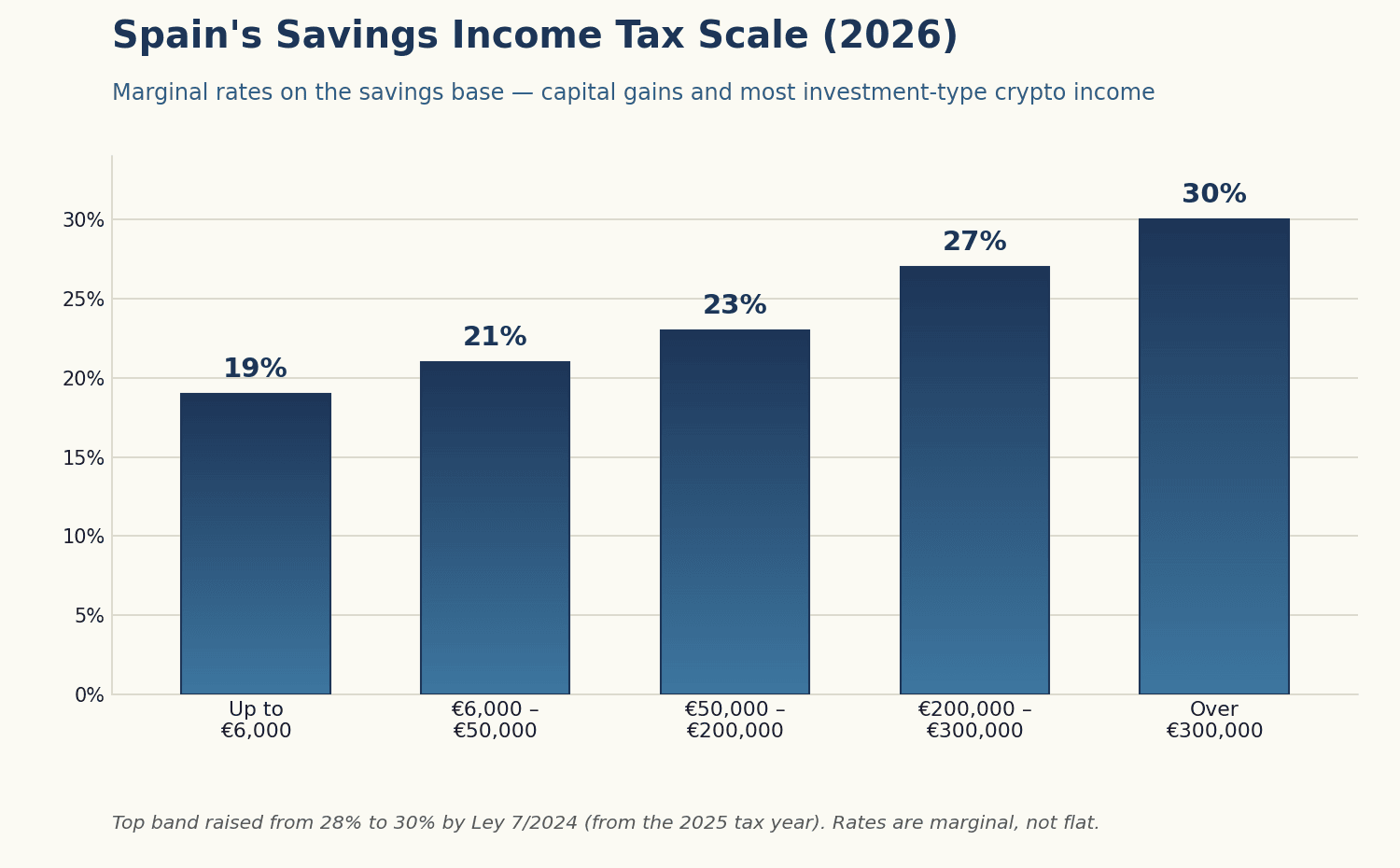
The top band was raised from 28% to 30% by Ley 7/2024, with effect from the 2025 tax year, and the old top band was split so that €200,000–€300,000 remains at 27%. Note these are marginal rates: a €60,000 gain does not attract 23% throughout. You pay 19% on the first €6,000, 21% on the next €44,000, and 23% on the remaining €10,000.
Crypto treated as general income, notably mining and any activity reclassified as a professional economic activity, is taxed instead on the general progressive scale, which combines a state portion with your autonomous community’s own scale and reaches roughly 47% at the top. Because the autonomic half varies by region, two people with identical crypto income can owe noticeably different amounts depending on where they live.
Non-residents are taxed at a flat rate on Spanish-source capital gains under the separate IRNR regime, which can work out more or less favourably than the resident scale depending on the size of the gain.
FIFO: Working Out Which Coins You Sold
Spain mandates the FIFO (First-In-First-Out) method. If you bought Bitcoin in three separate transactions and later sold some, you are deemed to have sold the oldest purchase first.
Worked example: you buy 1 BTC at €3,000 in 2020, another at €30,000 in 2023, and another at €40,000 in 2024. You then sell 2 BTC at €45,000 each. Under FIFO you have sold the 2020 coin (gain €42,000) and the 2023 coin (gain €15,000), for a combined €57,000 gain. The 2024 purchase is untouched. This matters because FIFO forces you to realise your oldest, cheapest holdings first, which typically maximises the taxable gain.
Your cost basis includes not just the purchase price but all acquisition and disposal costs: exchange fees, network fees, transaction charges. These reduce your taxable gain, and forgetting them means overpaying.
Staking: The Classification That Changes Everything
The single most consequential question in Spain’s digital asset regime is whether your staking counts as casual investment income or a professional economic activity. The gap between the two outcomes is enormous.

Casual staking, the typical case for individual investors delegating tokens to a validator, using an exchange’s staking product, or participating in liquid staking without running infrastructure, is taxed as savings income (rendimientos del capital mobiliario) on the 19%–30% scale above.
Professional or business-like staking is reclassified entirely. If you operate your own validator nodes, stake at meaningful scale, or engage with the frequency, organisation, and purpose characteristic of a business, the Agencia Tributaria can recharacterise your rewards as economic activity income. That pushes them onto the general progressive scale reaching roughly 47%, and brings registration, social security, and reporting obligations with it. If you are heading in that direction, our guide to registering as an autónomo or setting up an SL covers what formalising the activity actually involves.
There is no bright-line threshold. The tax authority weighs scale, frequency, and underlying purpose. Someone staking €5,000 of Ethereum through a major exchange is almost certainly casual. Someone running multiple validator nodes, actively managing infrastructure, and treating staking as a primary income source is at real risk of reclassification. If your activity is growing, take advice before you scale, not after: the difference between 19–30% and up to 47% justifies the consultation fee many times over.
The Two-Layer Mechanic Most Investors Miss
Whatever the classification, the core mechanic is the same: staking rewards are taxed as income at fair market value the moment you gain control of them, not when you eventually sell.
Receive 0.5 ETH when Ethereum trades at €3,000 and you have €1,500 of taxable income at that instant, whether you sell, hold, or restake it. This creates a genuine cash-flow trap: you can owe tax on rewards you never converted to cash, and if the asset later falls in value you cannot retroactively reduce that income recognition.
Then, when you eventually dispose of those rewards, a second taxable event occurs: a capital gain or loss measured from the value at receipt (your cost basis) to the value at disposal. This two-layer system, income on receipt plus capital gains on disposal, is the most misunderstood feature of Spanish crypto taxation among investors used to jurisdictions that tax only at final sale.
DeFi: Lending, Liquidity Pools, Wrappers, and Bridges
Decentralised finance introduces complications that general crypto tax guidance tends to skip over.
Lending and liquidity pools. Yield earned from depositing into a lending protocol or liquidity pool is generally treated like staking: income at fair market value on receipt. But the deposit itself can constitute a taxable disposal where it involves exchanging your original token for a pool-representative LP token, since the Agencia Tributaria’s general position treats crypto-to-crypto swaps as disposals.
Liquid staking tokens. Where you receive a tradeable derivative token representing your staked position, a genuinely unsettled question arises: does receiving that derivative itself trigger a taxable swap, separate from the yield that accrues afterwards? Spanish guidance here is less developed than for straightforward staking. Conservative practice treats the initial conversion as a disposal and the ongoing yield as separate income, but this is an area where the interpretation is still evolving and professional advice earns its keep.
Wrappers and bridges. Wrapping a token (ETH to wETH, for instance) or bridging assets across chains technically exchanges one asset for a different one, which can trigger disposal treatment under a strict reading of the rules even though the economic substance is unchanged. This is widely regarded as one of the harsher technicalities of the current framework, and it demands careful documentation of the euro value at each step.
NFTs, DAOs, Airdrops, and Tokenized Assets
NFTs are taxed as digital assets on broadly the same framework as cryptocurrencies: buying, selling, or exchanging one triggers capital gains treatment. If you mint and sell NFTs as a creator with any regularity, however, the income may be classified as economic activity income and taxed on the higher general scale instead. Royalties from secondary sales are ordinary income at the point of receipt.
DAO governance tokens sit in one of the least-resolved corners of Spanish practice. Tokens received through an airdrop or as compensation for contributing to a protocol are generally taxed as income on receipt; tokens bought are treated as a standard asset acquisition. Voting with them triggers nothing, but redemption, sale, or any token-for-token exchange follows the usual disposal rules.
Airdrops are taxed as ordinary income at fair market value on the date you gain control of the tokens, whether or not you did anything to receive them.
Mining is taxed as general income at the market value of the coins on the day you receive them. Mine 0.1 BTC worth €4,000 and that €4,000 is immediately taxable; a later sale at €5,000 produces a separate €1,000 capital gain. Where you mine as a registered professional autónomo, costs such as electricity can be set against the revenue.
Tokenized real-world assets, such as tokenized equities, real estate, or commodities, follow the same acquisition and disposal rules as conventional crypto, meaning the familiar FIFO and capital gains framework applies to these newer categories too.
Reporting: Modelo 100, Modelo 721, and Modelo 714
Modelo 100 (annual IRPF return). All crypto gains, staking income, DeFi yield, NFT gains, and airdrop income go into your annual return, filed through Modelo 100, with capital gains reported in Section D (Ganancias y Pérdidas Patrimoniales). With many transactions you may be able to submit summarised figures rather than listing every trade, but the total net result is mandatory. Deadline: 30 June of the year following the tax year.
Modelo 721 (foreign-held crypto). If you hold crypto on foreign platforms worth more than €50,000 on 31 December, you must file Modelo 721, an informative return. Deadline: 31 March of the following year.

A distinction that matters here: Modelo 721 targets assets custodied by third-party platforms located outside Spain. Genuine self-custody wallets, where you hold the private keys, are generally outside its scope, unless the wallet interface is itself provided by a foreign custodial service. Self-custodied assets nonetheless count fully toward your net wealth for Wealth Tax purposes, so falling outside Modelo 721 is not the same as being invisible.
Modelo 721 carries no bespoke penalty scale. Failing to file, or filing incompletely, falls under the general regime for informative returns in the Ley General Tributaria: €20 per omitted or incorrect data point, with a minimum of €300 (reduced to €150 where you file late but voluntarily, before the Agencia Tributaria requests it) and a maximum of €20,000. This is considerably milder than the flat per-asset penalties under the old Modelo 720 foreign-asset regime, which the Court of Justice of the European Union ruled disproportionate in 2022.
Modelo 714 (Wealth Tax). If your total worldwide net wealth exceeds your region’s threshold, your crypto holdings at 31 December are includible assets, declared at market value through the Impuesto sobre el Patrimonio. Thresholds and rates vary substantially by autonomous community, and a separate Solidarity Tax on Large Fortunes applies to very high net worth. Our guide to Spain’s Wealth Tax and Solidarity Tax sets out how the two interact. Both apply on the basis of what you hold, even in a year with no sales and no income.
DAC8: Why the Data Now Reaches Spain Automatically
The European Union’s DAC8 directive requires crypto exchanges, custodians, and wallet providers to report customer holdings and transactions automatically to tax authorities. Spain’s AEAT now receives data from major platforms, and this sits alongside Modelos 172 and 173, reporting obligations imposed directly on exchanges and custodians operating in Spain.
The practical consequence is that the AEAT cross-checks your declared figures against what the exchanges report. Declare €10,000 of gains where the exchange reports €50,000 of sales and the mismatch is flagged automatically. Automatic reporting is still more limited for genuinely decentralised, non-custodial DeFi activity, but the gap is narrowing, and treating on-chain activity as invisible because no centralised exchange was involved is an increasingly poor bet.
Offsetting Losses, and the Cap That Catches People Out
You can offset crypto losses against crypto capital gains in the same year: a €20,000 Bitcoin gain against a €5,000 Ethereum loss nets to €15,000. Unused losses carry forward four years against future capital gains.
Two limits matter. First, capital losses cannot offset general income: a €50,000 trading loss does nothing against a €100,000 salary or against mining income. Second, and less well known, where your net trading result remains negative after offsetting gains, you can apply the residual loss against income from movable capital such as staking or DeFi yield, but only up to 25% of that category’s positive balance for the year. An active investor with heavy trading losses therefore cannot simply erase their staking tax liability; real tax can remain due even in a net-loss year.
A Practical Compliance Checklist
- Keep detailed records of every purchase and sale: date, euro value, and fees.
- Track FIFO ordering so you know which lots you actually disposed of.
- For every staking reward, airdrop, and DeFi payment, record both the value at receipt and the value at eventual sale. You need the two separately.
- Log every wrap, bridge, and LP deposit as a potential taxable event, with the euro value at each step, even when the economic substance feels unchanged.
- Classify your staking honestly, and take advice before scaling toward validator operation rather than after.
- Distinguish self-custodied from custodial holdings when assessing Modelo 721, but count both toward Wealth Tax.
- File Modelo 721 by 31 March if foreign-platform holdings exceeded €50,000 at year end, and Modelo 100 by 30 June.
Getting Your Crypto Reporting Right
Spain’s crypto tax regime is mature, automated, and enforced. The AEAT has the data, the authority, and growing sophistication in identifying undeclared activity, and penalties on unpaid tax itself run steeply under the general tax-penalty rules, plus interest. Ignoring these obligations is not a risk so much as a delayed certainty.
The manageable version is not complicated in principle: keep proper records, understand which pool each type of income falls into, and get help where the activity goes beyond buy-and-hold. Specialised crypto tax software with explicit Spanish IRPF and Modelo 721/714 support handles the tracking far better than a general gestoría unfamiliar with on-chain transaction tracing, liquidity pools, or non-custodial wallets. For anything involving DeFi, bridges, or liquid staking positions, an adviser with genuine Web3 experience is worth seeking out specifically; traditional firms frequently lack the technical background to audit these correctly.
If you hold assets or income in more than one country, read this alongside our guide to the US-Spain and UK-Spain double taxation treaties. And if you are still planning the move itself, the wider picture is in our overview of how to move to Spain in 2026.
Paying the tax is only half of it. Holdings on exchanges or in wallets outside Spain also trigger a separate informative declaration, filed on its own form and on its own calendar: see our guide to Modelo 720 and Modelo 721 for foreign assets and crypto.
Verified August 2026 against Agencia Tributaria guidance on virtual currencies and the taxation of capital gains and investment income. This article is for general informational purposes only and does not constitute tax, legal, or investment advice. Spanish digital asset taxation is complex, subject to regional variation, and evolving rapidly, particularly regarding staking, DeFi, and Web3 activity, where significant interpretive questions remain unresolved. Rates, thresholds, and reporting requirements change; the figures cited are indicative for the 2025 tax year filed in 2026. Interacting with blockchain assets carries inherent financial risk. Before acting, verify current rules with the Agencia Tributaria and consult a qualified Spanish tax professional with specific cryptocurrency and Web3 experience.