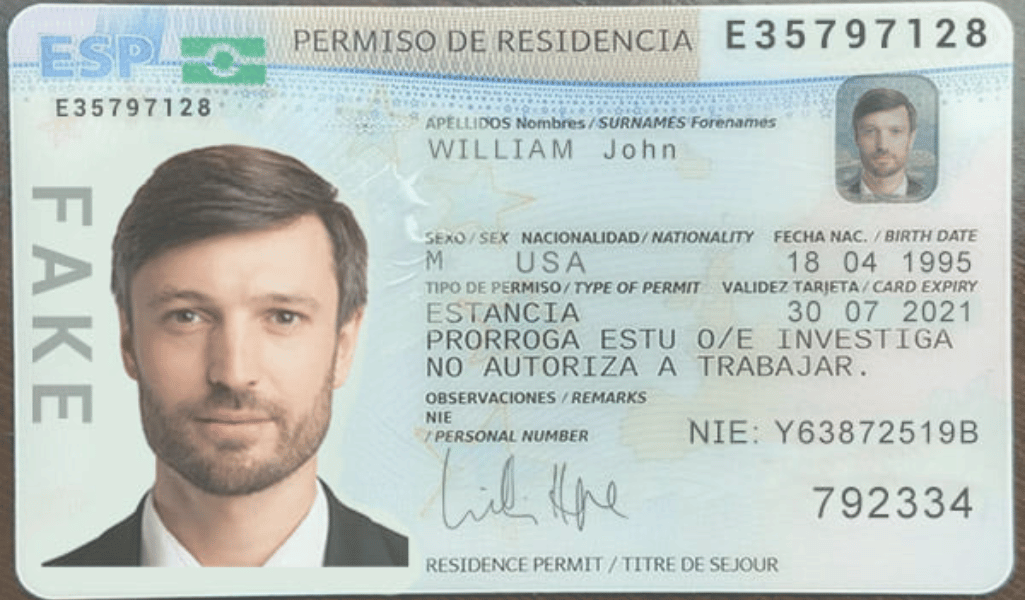
Almost every foreigner who moves to Spain trips over the same three words in their first weeks: NIE, TIE, and empadronamiento. They sound interchangeable, they are constantly confused, and getting them in the wrong order can stall everything else, your bank account, your residency card, your healthcare, even enrolling your children in school. The good news is that once you understand what each one actually is and the sequence in which they fit together, the process becomes far less intimidating. This guide explains all three clearly for 2026, who needs which, and the order that saves you the most time.
The One-Line Summary That Clears Up the Confusion
Before the detail, hold on to this simple distinction, because it resolves 90% of the confusion:
- The NIE is a number. It is your foreigner’s identification number for any dealing with the Spanish administration. It is not a card and not a residence permit.
- The TIE is a card. It is the physical biometric residence card that non-EU nationals carry; it contains your NIE and proves you hold a valid residence authorisation.
- The empadronamiento is a registration. It is your entry on the local town-hall census (the padrón), confirming the address where you live. It is not an immigration status at all.
Put simply: the NIE is “the number”, the TIE is “the card”, and the padrón is “the proof of where you live”. Everyone who deals with Spain needs an NIE; only non-EU residents need a TIE; and almost everyone living in Spain should be on the padrón, because so many other procedures depend on it.
The NIE: Your Spanish Administrative Identity
The Número de Identidad de Extranjero is a unique alphanumeric code (a letter, seven digits, and a final letter, for example Y1234567K) assigned by the National Police. It is the identifier Spain uses to track you for tax, property, employment, and virtually every official transaction. You need it to buy a home, open a bank account, sign before a notary, start a job, or pay taxes. Crucially, the NIE by itself does not grant residency or the right to work; it simply identifies you.
There are two main routes to obtain it. You can apply before you move, through the Spanish consulate in your home country, which is often the smoothest path, especially for buyers and investors who need the number before arriving. Or you can apply from within Spain at a National Police station or Foreigners’ Office (Oficina de Extranjería), using form EX-15 and paying the associated fee via the Modelo 790 (código 012). Non-EU applicants applying in Spain generally need to show an economic, professional, or social reason for requesting it. The official requirements are set out on the Ministry of the Interior’s NIE page.
The single biggest practical obstacle in 2026 is not the paperwork but the appointment (cita previa). In high-demand cities such as Madrid, Barcelona, Valencia, and Málaga, slots on the electronic booking system can disappear within minutes of being released. Checking early in the morning and late at night, when new slots are often loaded, and looking at police stations in smaller nearby municipalities, are the strategies that most reliably work.
The Empadronamiento: The Foundation Almost Everything Rests On
The empadronamiento (registering on the padrón municipal) is the administrative registration of where you live, managed by your local town hall and coordinated nationally through the statistics institute (INE). It does not grant or regularise immigration status, but it unlocks a remarkable amount: registering for public healthcare and getting your health card, enrolling children in school, later stages of residency and card renewals, exchanging a driving licence, and, importantly, building the dated residence history that is later used to prove how long you have lived in Spain.

Registering is free, and anyone charging you a fee simply to empadronar is a red flag. You typically need an identity document (passport, NIE, or national ID) and proof of your address, usually your rental contract or property deed, plus a recent utility bill in some municipalities. In larger cities such as Madrid and Valencia the process can often be done online with a digital certificate or Cl@ve; in smaller towns it is usually in person by appointment. Children are registered together with their parents.
Two practical points catch people out. First, the volante de empadronamiento (the simple proof of registration) does not technically expire, but most authorities, including the police for your NIE or TIE appointment, will only accept one issued within the last three months, so you often need a fresh one. Second, non-EU residents without long-term residence generally must confirm or renew their padrón registration every couple of years, or the town hall can remove them, breaking the continuous history that matters for later procedures.
A reassuring note for anyone worried: you can and should register on the padrón regardless of your immigration situation. Registering does not report you to immigration, and the length of padrón history is precisely what later enables certain regularisation routes.
The TIE: The Card Non-EU Residents Carry
The Tarjeta de Identidad de Extranjero is the physical, biometric residence card for non-EU nationals who hold an authorisation to live in Spain for more than six months, whether on a Non-Lucrative Visa, Digital Nomad Visa, work permit, or family route. Since Brexit, this includes UK nationals, alongside Americans, Canadians, Australians, and other third-country citizens. The card contains your NIE, your photograph, and the type and validity of your residence authorisation, and it serves as your identity document within Spain. It expires and must be renewed in line with your underlying permit. The official conditions for who must obtain it are published on the Ministry of the Interior’s TIE page.
The process is separate from, and comes after, obtaining your visa. In broad terms, once you are in Spain with a valid visa and a favourable residence resolution, you apply for the TIE, generally within one month of entry or of the resolution. The typical file includes form EX-17, proof of the fee paid via Modelo 790 (código 012), your empadronamiento certificate, your passport and visa, photographs, and attendance at a fingerprinting (toma de huellas) appointment at a police station. The physical card is usually ready to collect around a month later, at a second appointment. Note that the empadronamiento certificate is almost always required at the fingerprinting stage, which is exactly why the padrón usually needs to come first.
One reason the card matters more than it used to: the EU’s Entry/Exit System (EES), which registers third-country nationals crossing external Schengen borders, does not apply to those who hold a residence permit in a member state. For a UK, US, or other non-EU national living in Spain, carrying a valid TIE is what evidences that status at the border and keeps you outside the short-stay counting system. Travelling on your passport alone, without the card, is the situation to avoid.
EU/EEA citizens do not get a TIE, and are not subject to the EES at all, since it applies only to third-country nationals. Instead, EU citizens staying more than three months register at the Foreigners’ Office and receive the green Certificado de Registro de Ciudadano de la Unión (the “green certificate”), an A4 paper document that confirms their residence right and carries their NIE. It is not an identity document and will not replace your passport or national ID card when travelling; keep it for administrative use in Spain and travel on your national documents.
The Order That Saves You Time
Because each document tends to depend on the previous one, sequence matters more than anything else. While details vary by nationality and personal situation, the logic below reflects how the pieces usually fit together for a non-EU resident.
- Get your visa first (non-EU). Your residence visa is arranged through the Spanish consulate in your home country before you move; the TIE later gives physical form to that authorisation.
- Consider getting your NIE early. Applying for the NIE at the consulate before departure means you arrive with the number already in hand, which smooths the bank account and other steps. (For non-EU residents, the NIE will in any case appear on your TIE.)
- Empadronar as soon as you have an address. Once you have somewhere to live and its rental contract or deed, register on the padrón. This is frequently the first thing to do on arrival, because the certificate feeds into almost everything after it.
- Apply for the TIE. With your visa, favourable resolution, and a recent empadronamiento certificate, book the fingerprinting appointment, submit form EX-17 and the paid Modelo 790, and collect the card about a month later.
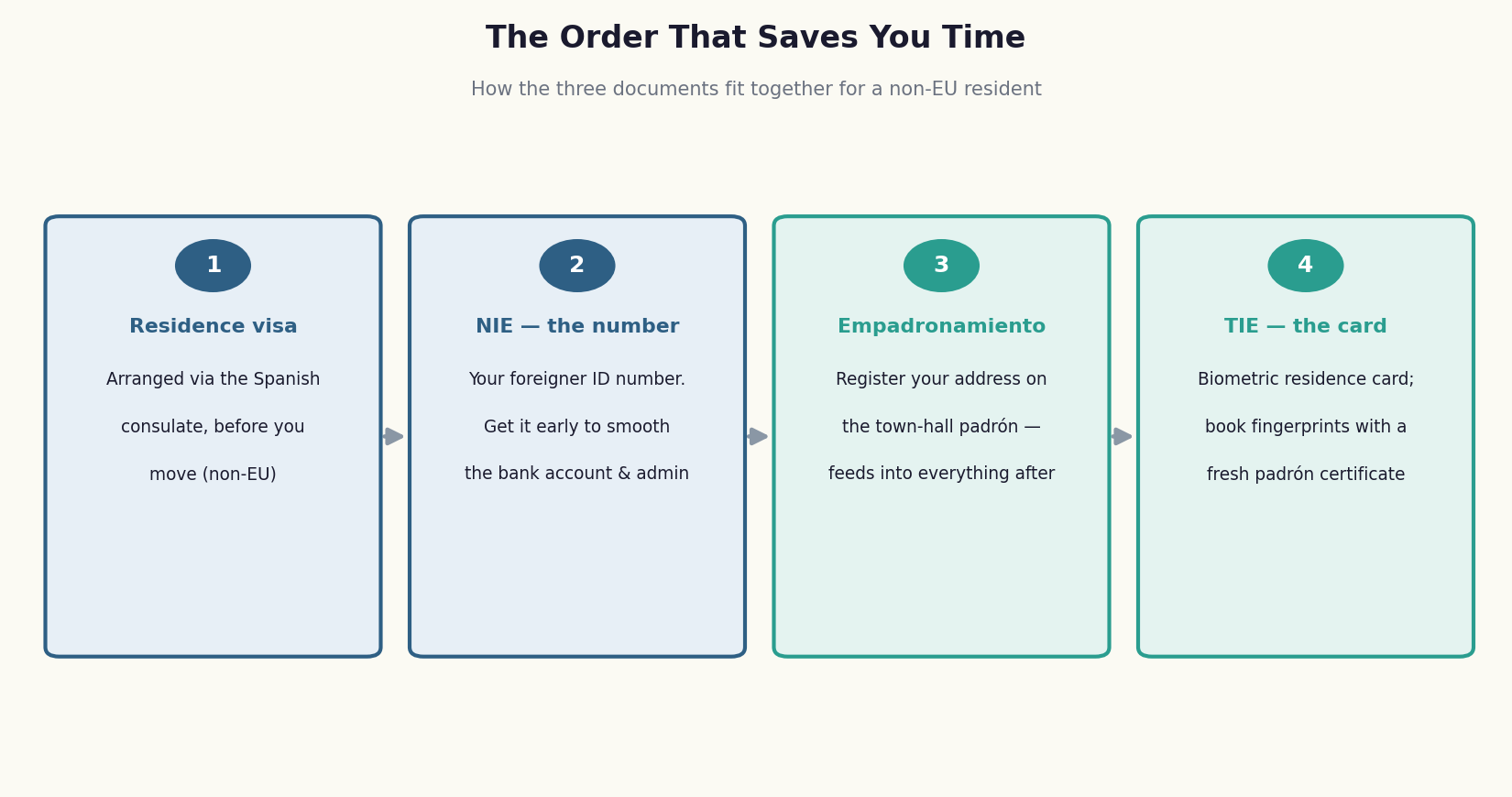
The recurring theme is that the empadronamiento often has to come before the residence card, and that securing appointments is usually the slowest link in the chain, so start the whole sequence early rather than close to any deadline.
What the Padrón Is in Law, and Why the Details Matter
Almost everything written in English about the empadronamiento describes it as a helpful piece of admin you should probably get round to. The law is blunter than that. Article 15 of Law 7/1985 on the Bases of Local Government states that everyone living in Spain is obliged to register on the padrón of the municipality where they habitually reside, and that if you live in several municipalities you register only in the one where you spend most of the year. Registration is not a favour the town hall grants you; it is a duty you owe, and the status of vecino is acquired at the exact moment the entry is made. Understanding the handful of rules that follow from that will save you more time at a counter than any appointment-booking trick.
Volante or certificado: they are not the same document
This is the single most common confusion, and it costs people repeat trips. Article 16.1 of the same law gives padrón data the status of proof of residence and habitual domicile, and says that the certifications issued from those data carry the character of a public and authoritative document for all administrative purposes. The technical instructions issued jointly by the INE and the Directorate-General for Regional and Local Cooperation, published in the BOE, then draw the practical line: the certificación must be signed by the town clerk and countersigned by the mayor, or issued under an official electronic seal with a secure verification code, while the volante is a purely informative document that requires no signature from any official at all.
In everyday life the volante is enough. It becomes insufficient only where a certificate is specifically demanded, because the certificate is the one document that authoritatively proves your residence and habitual domicile for administrative purposes. Ask for the volante first and the certificate only when the counter has told you it needs one.
The three-month rule that everyone repeats is also worth understanding properly, because it is not what it appears. The instructions say neither certificates nor volantes need carry any expiry clause. What they do require is that town halls keep a means of verifying the authenticity of what they issue for a minimum of three months from the date of issue. Beyond that window, a receiving office cannot necessarily confirm that your document is genuine, which is why so many of them refuse anything older. The document has not expired in law. It has simply passed the point where it can be checked, and that is a practical distinction worth knowing when someone tells you your two-month-old volante is out of date.
What the town hall may ask you for, and when it must stop
The town hall may require documents proving your identity and your address, and the instructions list what counts: a title of ownership, or a current residential tenancy agreement accompanied by the most recent rent receipt. It may accept other evidence at its discretion, such as utility bills, and it may verify by other means entirely, including a local police report or an inspection by its own staff.
There is a limit written into the same text, and it is unusually explicit. The power to demand documents exists for the sole purpose of confirming that the declared data are true. As soon as the municipal officer is satisfied that they are, the town hall ceases to be empowered to ask for further supporting documents. The instructions also state plainly that a request for the title legitimising your occupation of the home gives the town hall no authority to rule on questions of ownership or tenancy; it serves only as evidence that you actually live at the address you have given. If you are being asked for a fourth document to prove something the first three already established, that is worth citing.
Where other people are already registered at the address, the rule changes. Instead of a title of your own, you need the written authorisation of an adult already registered there, who must themselves hold a document evidencing effective possession of the property. That is the mechanism behind the landlord authorisation described earlier, and it is why a cooperative existing tenant or owner matters so much.
One recent change is worth flagging because it is not yet reflected in most guidance: since the reform of Article 16.2 by Royal Decree-Law 6/2023, the compulsory data in a padrón entry include the habitual address with its cadastral reference, where the property has one. Expect to be asked for it.
If the town hall does not answer, you are registered anyway
Where the town hall has doubts and opens a verification procedure rather than registering you on the spot, it has three months to notify a decision. If it does not, positive administrative silence applies and you are considered registered for all purposes from the date of your application. This is one of the few situations in Spanish administration where delay works entirely in your favour, and it is worth knowing before you resign yourself to waiting indefinitely.
The two-year renewal, and the hearing you do not get
Article 16.1 requires periodic renewal every two years for the padrón entries of non-EU nationals who do not hold long-term residence authorisation. The mechanics matter. The Directorate-General of Police reports monthly to the INE on who has been granted or has lost long-term residence; the INE works out by exclusion who falls into the renewal category, and tells the relevant town hall three months before an entry is due to lapse. At that point the town hall may send a warning. It is not obliged to.
Renewal is not automatic and not a formality. The instructions describe it as requiring an express act by which you declare that you still live in the municipality and at the registered address, and that you wish to renew. And here is the part that catches people: where two years pass from the date of registration or the last express renewal without that act, the lapse may be declared without any prior hearing. Unlike a removal on the town hall’s own initiative, which requires notice and a chance to respond, this one can simply happen. Since padrón history is what later evidences how long you have lived in Spain, a lapse you never noticed can undo years of accumulated record.
EU citizens, holders of long-term residence, and family members holding EU-scheme residence cards are outside this obligation, but not outside all checking. Their residence is verified periodically where their last padrón entry is more than two years old, or more than five if they are registered in the Central Register of Foreigners. Those checks cannot involve treatment that would be discriminatory compared with Spanish nationals.
Registering proves where you live, not that you live there legally
The two halves of this point are both in the legislation, and holding them together resolves most of the anxiety around the subject. Article 18.2 states that registering a foreign national on the padrón does not constitute proof of legal residence in Spain and confers no right that the law does not otherwise grant. It is a record of a fact, not an immigration status.
Facing the other way, the INE instructions are equally direct: the purpose of requiring identity documents is solely to confirm that the identifying data are correct, regardless of the foreign national’s legal situation in Spain, and it is not for the town hall to exercise any control over whether a resident’s presence in Spanish territory is lawful. That is why the padrón can be, and is, the foundation of later regularisation routes, and why registering is the right thing to do whatever your paperwork looks like today.
Frequently Asked Questions
Is the NIE the same as being a resident?
No. The NIE is only an identification number; plenty of non-residents hold one purely to buy property or open a bank account. Legal residence is a separate authorisation, evidenced for non-EU nationals by the TIE and for EU nationals by the green registration certificate.
Can I empadronar without a formal rental contract?
Often yes, though it is harder. Many town halls will register you with the written authorisation of the property owner (accompanied by their ID and proof of ownership), or through an in-person check by the town hall. A cooperative landlord is the key; note that a clause forbidding you from registering on the padrón is a warning sign in any rental, and one of several red flags covered in our guide to renting a home in Spain as a foreigner.
Do EU citizens need any of this?
EU/EEA citizens need an NIE and should empadronar, but they do not get a TIE. Instead they obtain the green EU registration certificate (with their NIE) if staying beyond three months. The empadronamiento matters just as much for EU citizens, since healthcare and school enrolment depend on it.
How does this connect to healthcare, driving, and buying a home?
Your empadronamiento is typically required to register with the public health system and to exchange a foreign driving licence, and your NIE is essential for a property purchase and the taxes that follow it. For healthcare, see our guide to public healthcare vs. private insurance in Spain; for buying, our guide to property purchase taxes in Spain explains where the NIE fits into the process.
These three documents are the administrative backbone of settling in Spain. For the wider picture of visas, residency, and logistics, see our overview of how to move to Spain in 2026.
Once these three are in place, the piece that unlocks almost everything else is a digital identity: without one, most of the forms that follow can only be filed in person. Our guide to the certificado digital and Cl@ve explains which of the two you need and why one of the usual routes is closed to most foreigners.
Verified August 2026 against Ministerio del Interior guidance on foreigners’ documentation. The padrón sections were verified in August 2026 against the consolidated text of Law 7/1985 on the Bases of Local Government, articles 15 to 18, and against the technical instructions to town halls on management of the municipal padrón issued by the INE and the Directorate-General for Regional and Local Cooperation, both as published by the Boletín Oficial del Estado. This article is for general informational purposes only and does not constitute legal or immigration advice. Procedures, forms, fees, and appointment systems for the NIE, TIE, and empadronamiento change periodically and vary by nationality, region, and individual circumstances. Before starting any procedure, confirm the current requirements with the official Spanish authorities (the National Police / Oficina de Extranjería and your local town hall) or a qualified immigration professional regarding your specific situation.