
If you have built your working life across more than one country, one worry tends to surface as retirement approaches: will the years you paid into a foreign system simply vanish, leaving you short of the minimum needed to draw a pension anywhere? For most people who have worked in the EU or in a country with a bilateral agreement with Spain, the reassuring answer is no. A mechanism called the totalización (aggregation) of contribution periods is designed precisely so that a career split across borders counts as a whole. This guide explains how it works in 2026, who it applies to, how each country ends up paying its share, and the practical steps to claim what you are owed.
The Core Problem Totalization Solves
Spain, like most countries, requires a minimum contribution history before it will pay a contributory retirement pension: generally at least 15 years of contributions, of which at least 2 must fall within the 15 years immediately before retirement. Someone who worked 10 years in Spain and 12 years in Germany could, under each country’s rules taken in isolation, fail to reach the 15-year threshold in Spain and potentially fall short elsewhere too, losing the value of contributions they genuinely made.
Totalization prevents this. To check whether you meet the minimum qualifying period, the competent institution adds together (totalizes) the periods you contributed in all the countries covered by the applicable rules. In the example above, 10 years in Spain plus 12 in Germany totals 22, comfortably clearing Spain’s 15-year gate. Crucially, totalization is used only to establish your right to a pension; it does not transfer money between systems or inflate the contribution base Spain uses to calculate the amount it pays.
Spain’s Own Retirement Rules in 2026
Before looking at how countries combine, it helps to know what Spain itself now requires, because the thresholds have been moving every year under a long transition that runs to 2027.
In 2026, the ordinary retirement age is 66 years and 10 months for anyone with less than 38 years and 3 months of contributions, or 65 years for anyone who reaches that longer contribution record. From 2027 the table becomes final: 67 years, or 65 with 38 years and 6 months contributed. Both figures come from the phased table the Seguridad Social publishes with its ordinary retirement requirements, which sets out every year from 2013 to 2027 and is the authoritative version to check your own year against. One exception sits outside that table: anyone to whom the legislation in force before 1 January 2013 still applies keeps the flat age of 65.
The amount depends on your contribution record as well. The 15-year minimum earns exactly 50% of your regulatory base, and the climb from there is measured in months rather than in years. The official scale published by the Seguridad Social adds 0.21% for each of the first 49 additional contribution months and 0.19% for every month beyond that, never exceeding 100% unless you retire later than your applicable age. Running that arithmetic is worth doing, because it produces the figure everyone quotes without ever showing where it comes from: 49 months at 0.21% covers 10.29 percentage points, the remaining 39.71 points need a further 209 months at 0.19%, and 258 additional months is 21 years and 6 months. On top of the 15-year floor, that puts a full 100% at 36 years and 6 months of contributions in 2026. From 2027 the increments drop to 0.19% and 0.18%, and the same calculation moves the threshold to 37 years. Note also that the 2023 pension reform began phasing in from 2026 an extended calculation period, moving from 25 years toward 29 years with the two worst discarded; during 2026 the transitional version takes the 302 highest contribution bases from the preceding 304 months and divides by 352.33, applied alongside the existing method so that whichever is more favourable to the pensioner is used. If your Spanish career is long enough for this to matter, ask the INSS to confirm which basis applies to you rather than assuming.
How Spain Actually Counts Your Years
The fifteen-year gate sounds like a round number, but Spain does not work in years when it checks it. The minimum is expressed as 5,475 days, and the conversion rules that produce that figure decide every borderline case. For this purpose a year is fixed at exactly 365 days and a month at exactly 30.41666 days, whatever the calendar actually did in the years you worked. Every countable day is added up first, then converted into whole years and months, and fractions are discarded rather than rounded. Someone who lands eleven months and twenty-nine days past a threshold is credited with eleven months, not with a year.
Two exclusions apply to that count. Only contributions actually paid, or those the law expressly deems equivalent, are counted at all. And the proportional share attributable to the pagas extraordinarias, the extra payments built into most Spanish salaries, is stripped out before the total is struck, which is why a naive reading of your payslips will overstate your position.
Some days count without having been worked, and these are easy to overlook. Periods of unpaid leave taken to care for a child or dependent relative are treated as effectively contributed under Article 237 of the General Social Security Act. Periods credited for childcare benefits count under its fourteenth transitional provision. And assimilated contribution periods for childbirth are credited under Article 235. These are Spanish periods, which means they are counted before any foreign period needs to be brought in at all, and for someone hovering just under the threshold they can remove the need to totalize anything.
Part-time and seasonal work is treated far more generously than most people expect, which matters because a large share of foreign residents in Spain arrive into hospitality, agriculture, or tourism. Where you worked part time, every period spent on a part-time contract counts toward the qualifying period in full, regardless of how short the working day was. Fijos discontinuos, the permanent seasonal contracts common in coastal and agricultural regions, do better still: the entire span of the contract is counted and then multiplied by a coefficient of 1.5, capped only so that the days credited in a year cannot exceed the calendar days in it.
None of this changes the totalization mechanism described below, but it changes the number that goes into it. Establish what your Spanish record is actually worth in days first, and only then work out how much your foreign periods need to cover.
Two Different Legal Frameworks
Which rules apply to you depends entirely on where you worked, and they fall into two broad regimes.
1. The EU coordination rules
If your career spans Spain and one or more EU member states, plus the European Economic Area (Iceland, Liechtenstein, Norway) and Switzerland, coordination is governed by Regulation (EC) No 883/2004 and its implementing Regulation (EC) No 987/2009. These are directly and uniformly applicable across all member states. They do not create a single “European pension”; instead, each country keeps its own system, but the regulations knit them together so that periods count everywhere and each state pays a proportionate share.
2. Bilateral social security agreements
For work in non-EU countries, totalization depends on whether Spain has a bilateral social security agreement with that country. Spain has signed many, including with the United States, Argentina, Canada, Mexico, Chile, Brazil, Morocco, Japan, Australia, South Korea, and others. Each agreement is a separate treaty with its own precise terms, so the details vary, but the underlying logic mirrors the EU system: recognise foreign periods to establish entitlement, and have each country pay proportionally. In Latin America, an additional instrument, the Ibero-American Multilateral Social Security Agreement, coordinates entitlements across participating countries in the region. Where a bilateral agreement offers a more favourable outcome than the general rules, Spanish case law has generally allowed the more beneficial treatment to apply.
If you worked in a country with which Spain has no agreement at all, those periods generally cannot be totalized with your Spanish ones; you would instead pursue whatever pension right the foreign country’s own law grants for the contributions made there.
The United Kingdom: a category of its own since Brexit
Britons are a large share of Spain’s foreign population, and the UK no longer fits neatly into either box. Since Brexit, Spain-UK coordination runs primarily through two instruments rather than a conventional bilateral treaty: the Withdrawal Agreement, which protects people who were already in a cross-border situation before the end of the transition period, and the Protocol on Social Security Coordination attached to the EU-UK Trade and Cooperation Agreement, which governs situations arising afterwards. The practical outcome is broadly similar to the EU rules, periods aggregate and each country pays its proportional share, but which instrument applies to you depends on your dates, and that can matter at the margins.
UK State Pension age is a separate calendar from Spain’s, currently 66 and rising toward 67 over the coming years, so a British-Spanish career will very often produce two pensions starting at different times. British readers should also know that voluntary National Insurance contributions can often be paid to fill gaps in a UK record, which is sometimes a cheap way to secure a materially larger UK pension. Check your UK record directly with HMRC before assuming a gap is permanent.
How Each Country Calculates Its Share: The Prorrata Temporis
Once your right to a pension is established through totalization, the amount each country pays is worked out through a method called prorrata temporis (proportional apportionment). Under the EU rules, the competent institution in each country performs a double calculation and pays whichever is higher.
- The national pension. The country calculates the pension you would be entitled to under its own law using only the periods actually contributed there, as if no foreign periods existed. If you independently meet its minimum, this figure is available.
- The pro-rata (totalized) pension. The country first calculates a “theoretical pension”, the amount you would receive if all your contribution periods, home and foreign, had been completed under its own legislation. It then pays only the fraction of that theoretical pension corresponding to the periods actually completed in its territory, relative to your total career.
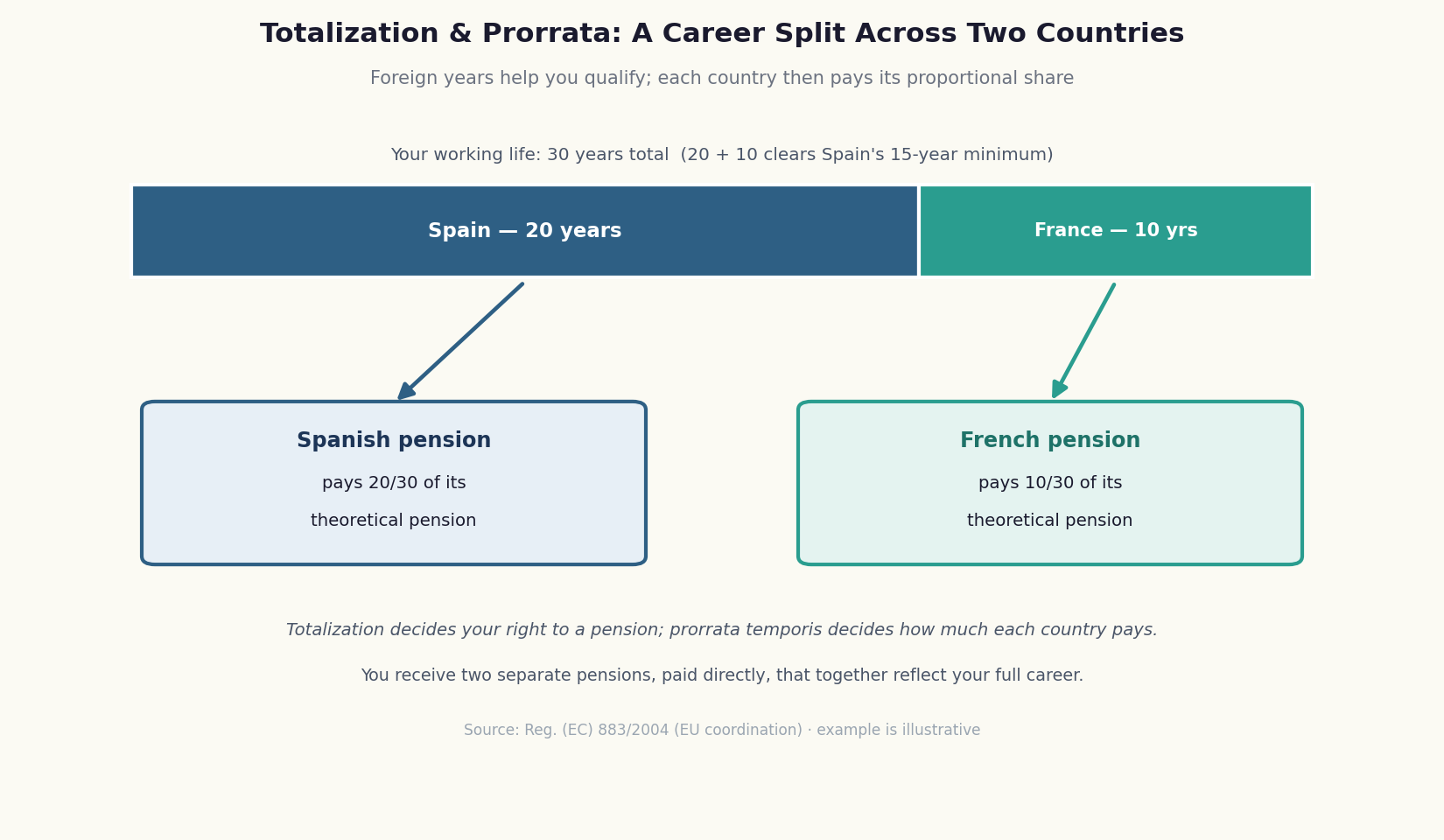
A simplified example makes this concrete. Suppose you contributed 20 years in Spain and 10 years in France, 30 years in total. Spain calculates a theoretical pension as though all 30 years had been Spanish, then pays 20/30 (two-thirds) of that theoretical amount as its pro-rata share. France performs the equivalent calculation and pays its 10/30 share. You end up with two separate pensions, one from each country, each paid directly to you, which together reflect your full international career.
Two important nuances follow from this structure. First, Spain calculates the amount it pays based only on the contribution bases actually recorded in Spain, so foreign years help you qualify and can raise the applicable percentage of your Spanish regulatory base, but they do not add foreign salaries into Spain’s calculation. Second, because each country applies its own retirement age and rules, your various pensions may start on different dates, so it is entirely normal to draw one pension before another becomes payable.
Key Principles Worth Knowing
Beyond the mechanics, a few governing principles shape how these cross-border pensions behave in practice.
- Exportability. A pension recognised by one country can generally be paid to you while you live in another. You could draw your Spanish pension while residing in the US, or your Argentine pension while living in Spain, subject to each agreement’s conditions. Your contributions are not stranded by where you choose to retire.
- No refund of contributions. These systems do not refund the contributions you paid abroad; instead, they convert them into pension entitlement. There is no mechanism to “cash out” foreign contributions on return.
- Interaction with Spain’s minimum-pension top-up. If you receive several small pensions from different countries, all of them are counted together when Spain assesses whether you qualify for its complemento por mínimos (minimum pension supplement). Spain only tops your pension up to the minimum if the combined total of all your pensions and other income falls below the annually set income limits.
- Gaps can sometimes be filled. If you fall short of a minimum, a Spanish convenio especial with the Seguridad Social lets you keep contributing voluntarily, and several other countries offer an equivalent. It is worth checking before concluding that a shortfall is final.
How to Claim: The Practical Process
The coordination system is designed so that you do not have to file separate claims in every country you ever worked in. In practice, you generally submit a single application in your country of residence, and the institutions communicate with each other.
- Apply through the institution where you live. If you reside in Spain, you file your retirement claim with Spain’s Instituto Nacional de la Seguridad Social (INSS), which acts as the liaison and forwards your details to the other countries’ institutions. If you live abroad, you apply through your country of residence, which contacts Spain.
- Declare your full working history. List every country you contributed in and the approximate periods. The institutions use standardised forms and electronic exchange to confirm the actual periods recorded in each system, but an accurate declaration from you speeds everything up.
- Gather documentation. Keep any social security numbers, employment records, and contribution statements from each country. Foreign work records can take time to verify, so starting early, months before your intended retirement date, is strongly advisable.
- Check your Spanish record first. Request your informe de vida laboral from the Seguridad Social and read it carefully. Missing periods (old jobs, unemployment, leave) are common and can usually be reclaimed and added, which occasionally changes the outcome entirely.
- Expect separate decisions. Each country issues its own resolution granting (or refusing) its share and states the amount and start date. You may receive these at different times, which is normal given differing retirement ages and processing speeds.
The Tax Side: A Separate Question
Coordinating your contributions decides entitlement; it does not decide how the resulting pensions are taxed. If you are a Spanish tax resident, you are generally taxed on your worldwide income, which includes foreign pensions, and how each pension is taxed depends on the double taxation treaty between Spain and the paying country. Government-service pensions, private pensions, and state social security pensions can each be treated differently, and the UK State Pension in particular becomes taxable in Spain rather than the UK once you are Spanish resident, which surprises many retirees.
Because the pension and tax rules run on entirely separate tracks, plan both together. Our guide to the US-Spain and UK-Spain double taxation treaties explains how pensions are allocated between countries, our guide to IRPF for foreign residents covers the Spanish rates that will apply, and our broader guide to retiring in Spain and protecting your pensions covers the wider financial picture. Healthcare access is a further separate question, addressed in our guide to public healthcare and the convenio especial.
Frequently Asked Questions
Do my foreign years increase the amount Spain pays me?
They help you qualify and can raise the percentage applied to your Spanish regulatory base, but Spain calculates the monetary amount using only the contribution bases actually recorded in Spain. Foreign salaries are not added into Spain’s own calculation; instead, the foreign country pays its own proportional share separately.
Will I receive one pension or several?
Typically several, one from each country where you contributed enough (whether directly or via totalization). These are compatible with each other and can be paid whether you live in Spain or abroad. Together they reflect your full career; individually, each is proportional to the time spent contributing in that country.
What if I contributed in a country with no agreement with Spain?
Those periods generally cannot be totalized with your Spanish contributions. You would pursue any pension right directly under that country’s own legislation for the contributions you made there, separately from your Spanish or EU-coordinated pension.
I only worked a few years in Spain. Is it even worth claiming?
Often yes. Even if you fall short of Spain’s 15-year minimum on Spanish contributions alone, totalizing your foreign periods may open the door to a proportional Spanish pension you would otherwise lose entirely. It is worth applying and letting the INSS run the calculation rather than assuming a short Spanish career is worthless.
Does the 2026 retirement age apply to me if most of my career was abroad?
Each country applies its own retirement age to its own share. Spain will apply the Spanish table to the Spanish portion of your pension, while the other country applies its own. Whether you qualify for Spain’s lower age of 65 depends on your total contribution record as assessed under Spanish rules, so this is worth confirming directly with the INSS rather than estimating.
Still planning the move itself? Our overview of how to move to Spain in 2026 sets out the residency and healthcare steps that typically accompany retirement planning.
If your pension comes from the United Kingdom or another EU country, your healthcare in Spain may be paid for by that country rather than by the Spanish system, through a separate document that has nothing to do with your pension claim itself. Our guide to the S1 form explains how the two interact.
Verified August 2026 against Seguridad Social guidance on the totalisation of contribution periods across countries, against the Seguridad Social published requirements for ordinary retirement for the 2026 age and contribution thresholds and the rules on counting contribution periods, against the Seguridad Social published rules on the pension amount for the 2026 and 2027 percentage scales and the transitional calculation of the regulatory base, and against Regulation (EC) No 883/2004 as published by the European Union for the coordination framework. This article is for general informational purposes only and does not constitute legal, tax, or financial advice. Social security coordination rules, bilateral agreements, retirement ages, qualifying periods, and calculation methods are complex, are revised annually during Spain’s ongoing pension transition, and depend on your specific countries of work, career history, and individual circumstances. Before making retirement decisions, confirm your position with Spain’s Instituto Nacional de la Seguridad Social (INSS) or the competent institution in your country of residence, and consider consulting a specialist in international social security.