The renderings are stunning: floor-to-ceiling windows, an infinity pool overlooking the Mediterranean, finishes you can still customize. The price is 15–20% below comparable completed properties. The developer’s sales team is warm, professional, and eager to have you sign today. This is the market for off-plan property in Spain, and for international buyers it represents one of the country’s most genuinely attractive real estate opportunities, provided you understand exactly how Spanish law protects you, and exactly where that protection can fail if you skip the right legal steps. This guide explains the legal framework, the deadlines that matter, and the due diligence that separates a safe off-plan purchase from a financial disaster.
Why International Buyers Are Drawn to Off-Plan
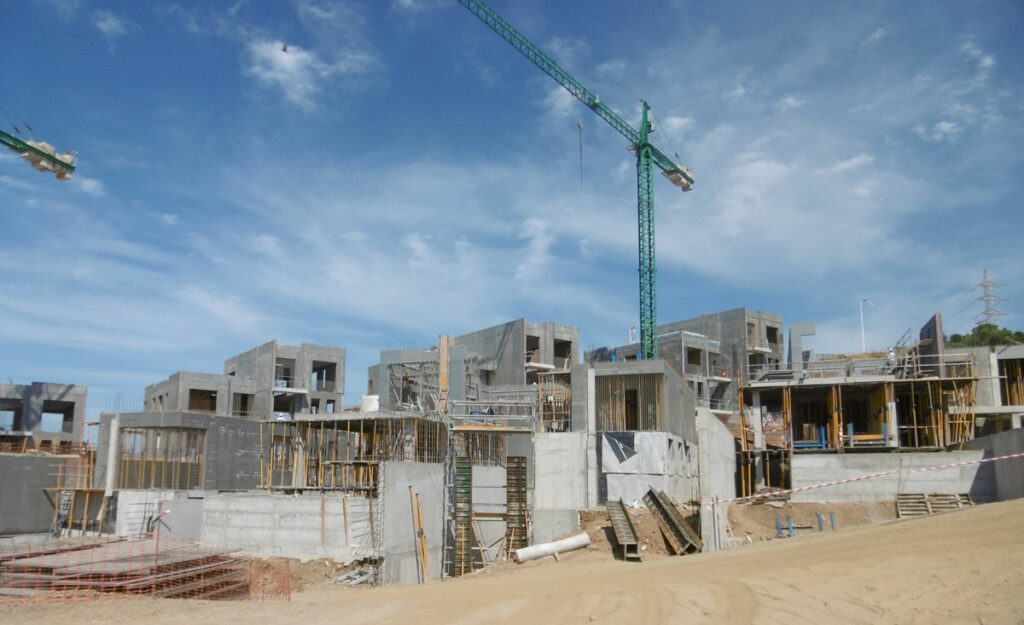
Buying “sobre plano” (literally, “on the plan”) means purchasing a property before or during construction, paying in stages rather than the full price upfront. For international buyers the appeal is substantial: prices set at the start of a project are typically 15–20% below completed market value; buyers can often customize floor plans, materials, and finishes; new builds must comply with the Código Técnico de la Edificación, the national building code that sets minimum standards for structural safety, fire safety, noise protection and energy performance, so a new build generally means lower utility bills and better thermal comfort than an older resale, and the standard is tightening again as Spain transposes the 2024 EU energy performance directive; and the staged payment structure is considerably easier on cash flow than paying the full price of a resale property immediately.
The risk, historically, has been real. During the 2008 financial crisis, thousands of foreign buyers, particularly along the Costa Blanca and Costa del Sol, lost deposits and stage payments when developers collapsed mid-construction. Legal battles to recover that money dragged on for over a decade in some cases. The lessons from that crisis directly shaped the legal protections that now govern the Spanish off-plan market, protections that are genuinely strong today, but only when properly applied.
The Legal Framework: LOE and the Bank Guarantee
The cornerstone of off-plan buyer protection in Spain is the Ley de Ordenación de la Edificación (LOE, Law 38/1999), reworked significantly by Law 20/2015, which repealed the older 1968 legislation and moved the buyer-protection regime into the LOE itself. Together, these establish several non-negotiable requirements.
Mandatory payment guarantees. Every developer receiving advance payments from buyers before completion must guarantee those funds through either a bank guarantee (aval bancario) or an equivalent insurance policy. This is, without exaggeration, the single most important protective document in an off-plan transaction.
Segregated escrow accounts. All payments made before completion must be deposited into a special, ring-fenced account used exclusively for the construction costs of that specific project. Developers cannot legally divert these funds to other developments or unrelated business activities.
The right to a full refund with interest. If the developer fails to complete by the contractually agreed delivery date, or becomes insolvent before finishing, buyers are legally entitled to reclaim their protected payments plus statutory interest, from the developer directly or from the bank or insurer that issued the guarantee. The Banco de España’s consumer guidance is precise about the scope: the guarantee must be issued and kept in force for the entire amount advanced, taxes included, plus statutory interest from the date each payment was made until the agreed delivery date. Taxes included matters: on a new build you are paying 10% VAT alongside the instalments, and that VAT is covered too.
Joint bank liability. Spanish courts, including the Supreme Court, have consistently ruled that banks accepting off-plan deposits into accounts without confirming a valid guarantee was in place share liability with the developer. In practice, this means that even years after a failed purchase, buyers may still be able to pursue a claim directly against the bank if it allowed unprotected deposits to be paid into its accounts.
A critical limitation to understand. The obligation to guarantee advance payments runs from the point the developer has obtained the building license (licencia de obra mayor). Any amount a buyer pays before that license exists sits outside the statutory protection. This is a frequently overlooked detail with serious consequences: paying a deposit early, even with warm assurances from the developer or estate agent, can leave that specific payment unprotected. It is, in effect, the one gap the 2015 reform left open, and it is precisely where careless buyers still get hurt.
If It Goes Wrong: How to Actually Claim, and the Two-Year Trap
Most guidance stops at “you are protected.” Knowing how to enforce that protection matters just as much, because the 2015 reform introduced a deadline that did not exist under the old law and that quietly destroys claims.
The sequence is specific. If construction does not start or does not finish in the agreed period, you must first formally demand the money back from the developer. Only if the developer fails to pay within thirty days can you go against the guarantor. You may go straight to the bank or insurer where a prior demand on the developer is not possible, typically because it has already collapsed.
Then the trap. The guarantee itself expires two years after the developer’s breach if in that window you have not formally required the developer to rescind the contract and return the money. Note what the clock measures: not the date you eventually sue, but the date you made a formal demand. A buyer who spends two years accepting reassurances that the project is only a little behind can find the aval has lapsed before ever instructing a lawyer. If a delivery date passes and the explanations start, put the demand in writing immediately and by a means that leaves proof, such as burofax. It costs almost nothing and it preserves everything.
What Your Lawyer Must Verify Before You Pay Anything
Never transfer money to a developer, beyond a small, refundable reservation fee, without an independent Spanish real estate lawyer first confirming the following:
Building license status. The licencia de obra mayor must already be granted by the local municipality, not merely “in process” or “expected shortly.” Payments made before this license exists fall outside LOE protection.
Plot ownership and encumbrances. The developer must demonstrably own the land, free of mortgages, embargoes, or other charges that could complicate or jeopardize the project. A nota simple from the Land Registry is the starting point: it identifies the property, its registered owners, and the extent, nature and limitations of their rights, including any charges. You can request one yourself through the registrars’ own electronic office, and it is worth knowing that the service offers an official English translation of the nota simple prepared by legal translators, which removes a common excuse for relying on the seller’s summary. Bear in mind it is informative only and does not itself constitute proof of title, so it complements your lawyer’s checks rather than replacing them.
Valid bank guarantee or insurance certificate. This must be issued specifically in your name (or the name of the purchasing entity) and cover the exact payment amounts and schedule in your contract. A generic assurance that “guarantees exist for the development” is not sufficient; you need a specific certificate tied to your payments.
Escrow account details. Confirm the specific account into which your payments will be deposited, and that it is the legally mandated segregated account, not the developer’s general operating account.
Complete technical specifications (memoria de calidades). A detailed, binding list of materials, fixtures, and finishes included in the base price. Developments frequently quote an attractive base price while treating items buyers assume are included, fitted kitchens, air conditioning, parking, storage, landscaping, as costly extras. Get everything in writing.
Delivery date and penalty clauses. The contract must specify a firm completion date and clear financial penalties if the developer misses it.
Developer track record. Review the developer’s financial stability and history of completing previous projects on schedule. A developer with multiple delayed or abandoned projects is a significant warning sign, regardless of how polished their current sales presentation appears.
Coastal status, if the project is near the sea. Developments on or close to the shoreline can be affected by Spain’s Coastal Law, which restricts what may be built within the protection easement. Our guide to the Ley de Costas and beachfront property explains what to check, including obtaining the current deslinde.
The Payment Structure: What to Expect
While exact terms vary by developer and region, off-plan purchases in Spain typically follow a recognizable staged structure:

Reservation fee: 1–2% of the purchase price, paid to take the property off the market temporarily while initial legal checks and contract preparation occur. This should be clearly refundable if due diligence reveals a problem.
Private purchase contract and main deposit: Upon signing the contrato de arras or equivalent private contract, buyers typically pay 10–13% of the purchase price. This is the point at which your lawyer must have already confirmed the bank guarantee is in place.
Stage payments during construction: An additional 20–30% (sometimes structured as several smaller installments) is paid as specific construction milestones are reached, typically over 12–24 months, depending on the project’s scale and timeline.
Final balance and completion: The remaining 60–70% is paid upon completion, at the same time the public title deed (escritura pública) is signed before a Spanish notary and the keys are formally handed over. Do not sign that deed before the licencia de primera ocupación has been granted by the town hall, or the equivalent declaración responsable where a region uses one. That licence is what certifies the building was executed according to the approved project; without it the utility companies will not give you definitive contracts, in several regions the notary will not authorise the deed, and the final tranche of a Spanish mortgage is typically released against it. It is also the document that formally cancels the developer’s guarantee obligation, which is precisely why its absence should keep your money where it is. Many international buyers finance this final payment through a Spanish mortgage; non-residents can typically secure somewhere around 60–70% loan-to-value, with tax residents sometimes qualifying for more, though lending criteria vary considerably by bank and profile.
Statutory Warranty Periods After Completion
Articles 17 and 19 of the LOE establish mandatory warranty periods covering different categories of defect. Two mechanics matter before the list itself. The clock runs from the date of the acta de recepción, the formal handover of the finished works, not from the day you personally get the keys. And liability among the parties involved, developer, architect, technical director and builder, is joint and several, which means you can claim against any of them without first proving which one caused the defect. That is a considerable advantage for a buyer facing a wall of mutual blame.
- 1 year for finishing defects: paintwork, minor fittings, and similar cosmetic issues.
- 3 years for habitability defects: insulation failures, plumbing problems, waterproofing issues, and similar functional defects.
- 10 years for structural damage originating in or affecting the foundations, supports, beams, floor slabs, load-bearing walls or other structural elements, where it directly compromises the building’s mechanical resistance and stability.
A common misunderstanding is worth clearing up: only the ten-year tier is backed by compulsory insurance. The seguro decenal required of developers on new residential building covers structural damage alone, not the three-year habitability tier or the one-year finishes tier, which are legal warranties you enforce against the parties themselves. The compulsory nature of that policy has real teeth, though. Article 20 of the LOE prevents a notary from authorising, and a registrar from recording, the declaration of new works unless the guarantee is evidenced, so a development that never arranged it cannot be registered and therefore cannot properly be sold on.
Before formally accepting the completed property, arrange a thorough snagging inspection (repaso de obra), ideally with an independent professional surveyor, to document any defects before final completion and keys are handed over. Defects identified and documented at this stage are far easier to enforce than issues raised after you have already accepted the property without reservation.
Taxes, Residency, and Other Buyer Realities
New builds are taxed differently from resales. A new-build purchase from a developer attracts VAT (IVA) rather than the transfer tax that applies to resale property, plus Actos Jurídicos Documentados (AJD), a stamp duty typically ranging from around 0.75% to 1.5% of the price depending on the autonomous community. That combination generally makes a new build more expensive in transaction taxes than an equivalent resale. Our guide to property purchase taxes in Spain sets out the rates region by region, and our guide to the annual taxes of owning property covers the recurring costs that begin once you hold the keys.
Residency no longer flows from the purchase itself. This is a critical 2026 update that catches many buyers out: Spain’s real-estate Golden Visa closed to new applicants in April 2025, so buying property, off-plan or completed, no longer grants any residency right on its own. Foreign nationals retain full property rights and can still buy freely, but if you also intend to live in Spain you must qualify separately under one of the remaining visa routes. See our guide to the alternatives to the Golden Visa for the current pathways, and confirm any residency strategy with an immigration specialist before relying on it.
Cryptocurrency-funded purchases. A growing number of international buyers seek to fund off-plan purchases using cryptocurrency. In practice, the vast majority of Spanish developers cannot and do not hold cryptocurrency directly due to corporate accounting and anti-money-laundering requirements; any “crypto-accepting” developer is, in reality, working with a third-party processor that immediately converts your crypto to euros. If you plan to fund a purchase this way, convert to euros before initiating payments to the developer, so your bank guarantee protects a specific, clearly defined euro amount rather than a volatile crypto position. Be aware too that liquidating crypto to fund the purchase is itself a disposal that can trigger capital gains tax depending on your residency status and timing.
Red Flags That Should Stop You
Pressure to sign or pay quickly, particularly with “discounts” offered for immediate payment before your lawyer has completed due diligence.
Reluctance to provide a specific bank guarantee certificate in your name, or vague assurances that guarantees “exist for the project” without documentary proof.
A building license described as “imminent” rather than already granted, especially if you are asked to make payments beyond a small reservation fee before that license is confirmed in force.
Reliance on the developer’s own lawyer or the selling agent for your legal review. Their incentives are not aligned with yours; always retain independent legal representation.
Being told which notary you will be signing with. Developers routinely present their notary as a given, and buyers assume it is part of the package. It is not. The Consejo General del Notariado is explicit that where one party is a consumer and the other a large operator, a developer, a bank, a business, the right to choose the notary belongs to the consumer regardless of who pays the fee, and that this right cannot be waived. Since notary fees are fixed by a state tariff, choosing your own costs you nothing and gives you an independent public official who has no ongoing commercial relationship with the developer.
Significant gaps or vague language in the technical specifications, leaving room for the developer to substitute materials or finishes after you have committed funds.
What Actually Protects an Off-Plan Buyer
Spain’s legal framework for off-plan property purchases is genuinely robust, a direct response to the painful lessons of the 2008 crisis, and when properly applied it offers international buyers strong, enforceable protection. The risk in 2026 is not primarily that the law is inadequate; it is that buyers, dazzled by attractive renderings and competitive pricing, skip the specific verification steps the law requires before money changes hands. An independent Spanish lawyer, a confirmed bank guarantee tied specifically to your payments, and a building license already in force before you pay anything beyond a small reservation fee remain the three non-negotiable safeguards that separate a secure off-plan investment from a costly legal battle years down the line. If you are also planning the move itself, see our overview of how to move to Spain in 2026.
Verified August 2026 against the Ley de Ordenación de la Edificación as published in the Boletín Oficial del Estado, in the wording given to its first additional provision by Ley 20/2015; the Banco de España’s Cliente Bancario guidance on guarantees for advance payments, including the two-year expiry of the aval and the thirty-day demand on the developer; the official Código Técnico de la Edificación; the Colegio de Registradores on the nota simple; and the Consejo General del Notariado on the consumer’s right to choose the notary. Off-plan contracts and guarantees vary by developer and the applicable regime depends on when your contract was signed, so have an independent lawyer confirm the position for your specific purchase.
This article is for general informational purposes only and does not constitute legal, tax, or financial advice. Spanish property law, including off-plan buyer protections, is subject to regional variation and periodic legislative change. Before making any off-plan property purchase in Spain, engage an independent, qualified Spanish real estate lawyer to verify all legal guarantees, licenses, and contractual terms specific to your transaction.