Spain closed its Golden Visa programme on 3 April 2025, ending more than a decade in which non-EU nationals could secure residency by investing €500,000 or more in Spanish real estate. If buying a property to secure residency was your plan, you now need a different strategy, and the encouraging news is that several strong alternatives remain available to investors in 2026.
The Golden Visa was always just one route into Spain, and the country remains one of Europe’s most appealing destinations for international investors and relocating families. Several legal pathways to Spanish residency are still open, each leading to the same long-term destination: permanent residency after five years and, eventually, citizenship. This guide breaks down the most relevant alternatives, what each one requires, and how to decide which fits your situation.
What Happened to Spain’s Golden Visa
Spain’s investor visa was introduced in 2013 (Law 14/2013) during the depths of the financial crisis as a way to attract foreign capital. Over its run, it drew tens of thousands of investors, the large majority through property purchases.
In January 2025, the government published Organic Law 1/2025, which repealed the articles governing the Golden Visa. The programme officially stopped accepting new applications on 3 April 2025. The stated reason was housing affordability: officials argued that foreign investment concentrated in major cities and coastal areas was pushing property prices beyond the reach of local residents.
Two points matter for anyone affected:
- Existing holders are protected. Applications submitted before the deadline are still processed under the old rules, and current Golden Visa holders can renew their permits as long as they keep meeting the original conditions.
- Buying property is still legal. Foreign nationals retain full property rights in Spain. What changed is that a purchase no longer grants residency on its own.
The Main Alternatives in 2026
For investors and people with means, three pathways now do most of the work the Golden Visa used to. None lets you simply “buy in,” but each can lead to permanent residency and citizenship over time.
1. The Entrepreneur Visa: the most investment-oriented option
If your goal is to put capital to work in Spain, the Entrepreneur Visa is the closest thing to a modern investor route. It grants residency to non-EU nationals who launch an innovative business considered to be of special economic interest to Spain.
How it works in practice:
- You submit a business plan to ENISA, Spain’s national innovation agency, which evaluates the project on innovation and scalability. Traditional brick-and-mortar concepts rarely qualify; the programme favours tech-enabled, high-growth, or impact-driven models that create local jobs.
- With a favourable ENISA report, you apply for the residence permit through the Large Companies and Strategic Groups Unit (UGE-CE), where processing is comparatively fast.
- The route operates as a dual pathway: a consular visa for initial entry, or a three-year residence permit for those already legally in Spain, renewable for subsequent periods while you continue to meet the conditions.
- There is no minimum investment threshold. Eligibility rests on the quality and innovation of the business plan, though you must show sufficient personal means to support yourself.
This route was not affected by the Golden Visa closure because it falls under different provisions of the same 2013 law.
2. The Non-Lucrative Visa: for passive income and retirees
The Non-Lucrative Visa (NLV) is designed for people who can support themselves without working in Spain, making it a natural fit for retirees, investors living off portfolio income, or anyone with substantial savings.
- Proof of sufficient passive income, generally around €2,400 per month for a single applicant, calculated as 400% of Spain’s IPREM indicator, plus roughly 100% of IPREM (about €600 per month) for each additional family member. Unlike the Digital Nomad Visa threshold, this figure is tied to IPREM rather than the minimum wage, so it did not move with the 2026 minimum wage increase.
- No employment in Spain is permitted, and this includes remote work for foreign employers. Working remotely on an NLV breaches its conditions and can jeopardise renewal.
- You must genuinely live in Spain, spending at least 183 days per year in the country. This is enforced at renewal, generally makes you a Spanish tax resident, and rules out using the NLV as a permit held while living mostly elsewhere.
In practice, consulates frequently apply stricter informal standards than the published minimum, particularly for working-age applicants without pension income. They look at stability, documented source of funds, and continuity of income over time, so meeting the threshold on paper is not the same as submitting a strong application.
3. The Digital Nomad Visa: for remote workers and business owners
Launched under Spain’s Startup Act (Ley 28/2022), the Digital Nomad Visa (DNV) suits investors who run a business or work remotely for companies based outside Spain. It is now one of the most accessible residency paths for self-sufficient professionals.
- A minimum income of €2,849 per month for the main applicant in 2026, calculated as 200% of the minimum wage set for that year. Add roughly €1,069 per month for the first accompanying family member and about €356 per month for each additional one. Because the threshold is pegged to the minimum wage, it rises whenever the government raises it, so always check the figure for the year you apply.
- Income must be recurring and documented: recent payslips and an employer certificate if you are employed, or contracts, invoices, and matching bank statements if you are freelance. A one-off bank balance is not enough.
- A permit valid for one year if applied for through a consulate, or up to three years if applied for from inside Spain, renewable to a total of five years.
- No more than 20% of your income may come from Spanish clients or companies.
- A university degree or at least three years of relevant experience, and proof that the company you work with has operated for at least a year.
One point that older guides get wrong: the DNV is not a low-presence permit. Authorities are now applying strict checks on the minimum six-month physical stay in Spain, so treat it as a residence permit that requires you to actually reside here.
A major draw is the Beckham Law tax regime, which can let qualifying newcomers pay a flat 24% rate on Spanish-source employment income up to €600,000, rather than progressive rates reaching roughly 47%. It is a separate election with its own six-month deadline, and not every DNV holder qualifies; we cover the conditions in our guide to digital nomad taxes in 2026. Many DNV holders also register as autónomo, which our guide to registering as an autónomo or setting up an SL explains.
Where the 2026 Figures Come From, and Why Other Sites Get Them Wrong
Both income thresholds above are derived rather than published, which is why English-language guides disagree with each other so often. It is worth setting out the arithmetic, because a figure that is too low will get an application refused and a figure that is too high will make you think you do not qualify when you do.
The Digital Nomad Visa threshold is 200% of the minimum wage. The minimum wage for 2026 was fixed by Royal Decree 126/2026 of 18 February, published in the BOE the following day, at 1,221 euros a month and 40.70 euros a day, a rise of 3.1% over 2025, with effect from 1 January 2026. The decree also states the annual figure directly: for the purposes of annual comparison the minimum wage may not be treated as less than 17,094 euros.
That annual figure is the one that matters, because the calculation runs on the year divided by twelve rather than on the headline monthly wage. The Spanish minimum wage is paid in fourteen instalments, so 17,094 euros over twelve months gives 1,424.50 euros, and 200% of that is 2,849 euros a month. The common error is to double the 1,221 euro headline instead, which produces 2,442 euros. That is roughly 400 euros a month short of the real requirement, and an applicant who budgets to it will fall below the threshold. On the same basis, 75% gives about 1,069 euros for the first family member and 25% gives about 356 euros for each one after that.
The Non-Lucrative Visa works from a different index entirely. IPREM is a benefits benchmark rather than a wage, and it is set in the annual state budget. Because the 2023 budget has been rolled over again, IPREM has not moved: it remains 600 euros a month and 7,200 euros over twelve payments. Four times the monthly figure is where the 2,400 euros comes from, and one times it is the roughly 600 euros for each additional family member.
There is a consequence worth planning around. The minimum wage has risen every year since 2023 while IPREM has been frozen throughout, so the Digital Nomad threshold climbs annually and the Non-Lucrative one does not. The gap between the two requirements has been widening for several years, and unless a new budget finally lifts IPREM it will keep widening. If you are choosing between the two routes and expect to apply a year or two from now, assume the DNV bar will be higher than it is today and the NLV bar will not.
Quick Comparison
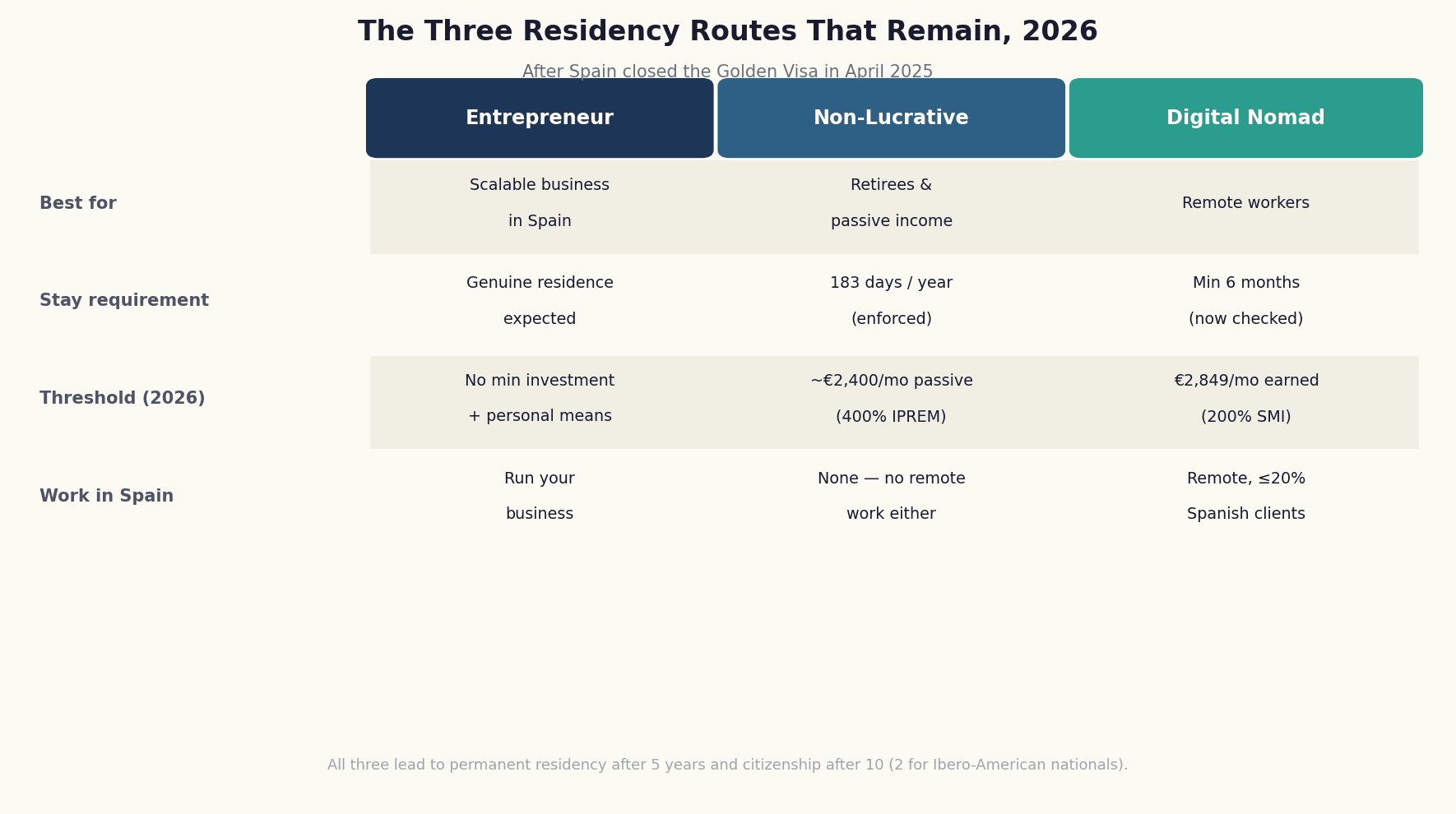
| Route | Best for | Stay requirement | Indicative financial threshold (2026) |
|---|---|---|---|
| Entrepreneur Visa | Building a scalable business in Spain | Genuine residence expected | No minimum investment; approved business plan plus personal means |
| Non-Lucrative Visa | Retirees and passive-income investors | 183 days/year, enforced at renewal | ~€2,400/month passive income (400% IPREM) |
| Digital Nomad Visa | Remote workers and online business owners | Minimum six months, now strictly checked | €2,849/month earned income (200% SMI) |
Buying Property Without a Visa
Property remains a sound investment for many, and you can still buy freely in Spain. You simply do it as an investment or a second home rather than as a residency route, and you can pair ownership with one of the visas above if you intend to live there. The purchase costs and the recurring charges are set out in our guides to property purchase taxes and annual property taxes for owners.

One development worth watching: the government has floated a proposal for a substantially increased tax on property purchases by non-EU, non-resident buyers, at one point discussed as a rate as high as 100%. Proposals of this kind have been announced, debated, and revised without necessarily becoming law, so confirm the current legislative status directly before committing to a purchase rather than relying on any article, including this one.
The Long-Term Path: Residency and Citizenship
All three routes lead to the same destination:
- Permanent residency after five years of continuous legal residence.
- Citizenship after ten years for most nationalities. The timeline drops to just two years for nationals of Ibero-American countries, the Philippines, Equatorial Guinea, Andorra, Portugal, and people of Sephardic origin. Naturalisation also requires demonstrating integration, typically an A2 Spanish language certificate and a test on constitutional and sociocultural knowledge.
Note that Spain does not generally permit dual citizenship except with those historically linked countries, so applicants from elsewhere would typically need to renounce their original nationality to naturalise. Many investors avoid this by holding a renewable residence permit indefinitely instead.
Tax Considerations Investors Should Not Overlook
Residency and taxation are linked but separate questions. Spending 183 days or more in Spain generally makes you a tax resident, which means taxation on worldwide income under IRPF and potential wealth tax exposure. Since both the NLV and the DNV now carry real presence requirements, tax residency is a consequence to plan for rather than a risk to avoid.
Americans face an extra layer: the United States taxes its citizens on worldwide income regardless of where they live, so US nationals must continue filing US returns and coordinate the two systems through tax treaties and credits, as our guide to the US-Spain and UK-Spain double taxation treaties explains. Because individual circumstances vary widely, this is an area where professional advice pays for itself.
Which Path Fits Which Investor?
- You want to deploy capital into a business: the Entrepreneur Visa is the natural successor to the old investor route.
- You live off investments or a pension and plan to settle in Spain: the Non-Lucrative Visa is built for you.
- You earn income remotely from outside Spain: the Digital Nomad Visa allows the work the NLV forbids, and opens the door to the Beckham regime.
- You only want property and do not need to live in Spain: buy as a non-resident, and revisit the residency routes if your plans change.
The end of Spain’s Golden Visa changed the entry ticket, not the destination. Investors can no longer write a single cheque and receive a residence permit, but those willing to build a business, relocate, or structure income properly still have clear, well-established routes to Spanish residency and, in time, an EU passport. The common thread across all of them in 2026 is that Spain now expects you to actually live here. For the wider sequence of the move, see our overview of how to move to Spain in 2026.
Of the three routes, the one most often chosen by people with savings or a pension rather than an income stream is also the one with the least understood tax consequence. Our guide to the Non-Lucrative Visa sets out the exact income requirement and the trap that follows it.
Verified August 2026 against residency and visa guidance published by the Ministerio de Inclusión, Seguridad Social y Migraciones, and against Real Decreto 126/2026 fixing the minimum wage for 2026, as published by the Boletín Oficial del Estado. The Digital Nomad income threshold was recalculated from the annual minimum wage set by that decree rather than taken from secondary sources, and the Non-Lucrative threshold was checked against the IPREM figure currently in force under the rolled-over state budget. This article is for general informational purposes only and does not constitute legal, immigration, or tax advice. Immigration rules, income thresholds, and tax regimes change frequently and can depend on your specific circumstances and nationality; income thresholds tied to the minimum wage or IPREM are revised annually, and the figures cited are those applicable in 2026. Before making any decision, verify the current requirements with the Spanish consulate or immigration authorities and consult a licensed immigration lawyer and tax adviser.