
You have a startup idea, a few months of runway, and a decision to make before you even think about visas: are you building a company that will operate in Spain, hire Spanish employees, and raise capital from Spanish or international investors backing a Spanish legal entity? Or are you continuing to run an existing business or serve clients based predominantly outside Spain, simply choosing to live there while you do it? These are fundamentally different activities, and Spain has built two fundamentally different visa pathways to match them. Choosing the wrong one is not a minor paperwork inconvenience; it can mean rejection, wasted months, or a residency status that actively restricts the business model you intend to pursue. This guide explains exactly how the Entrepreneur Visa in Spain differs from the Digital Nomad Visa, and which one fits a founder planning to raise capital and build an internationally scalable company in 2026.
The Core Distinction: What Each Visa Is Actually For
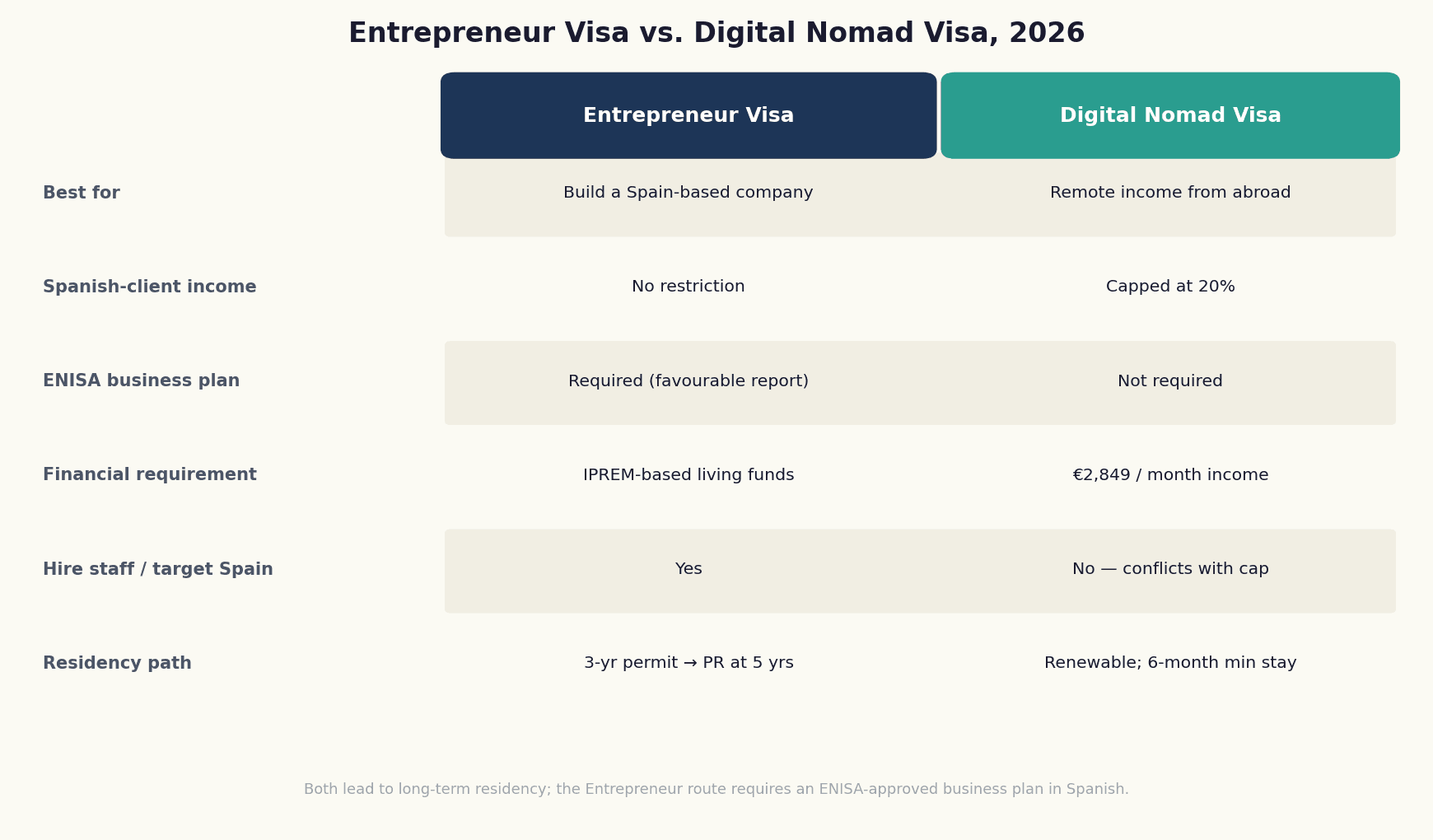
The Spain Digital Nomad Visa is built for remote workers, whether employees or contractors, whose income derives predominantly from companies or clients based outside Spain. It explicitly restricts income from Spanish clients to no more than 20% of total earnings. This visa assumes you are bringing existing remote income into Spain, not building a new, Spain-based business targeting the Spanish market.
The Spain Entrepreneur Visa (officially the Autorización de Residencia para Emprendedores, established by articles 69 and 70 of Ley 14/2013) is built for the opposite scenario: founders launching or developing a business that operates within Spain, targets Spanish customers, partners, or investors, and may hire Spanish employees and generate revenue entirely from within the Spanish market. Crucially, since the closure of Spain’s Golden Visa real estate route in April 2025, the Entrepreneur Visa has become the country’s primary active-business pathway for non-EU nationals seeking EU residency through building something, rather than simply buying property or working remotely. Our guide to the residency routes that remain after the Golden Visa sets out how both fit alongside the Non-Lucrative option.
For a founder specifically planning to raise capital and build an internationally scalable startup, potentially headquartered in Spain, with Spanish or international investors taking equity in a Spanish legal entity, the Entrepreneur Visa is almost always the structurally correct choice. The Digital Nomad Visa was never designed to accommodate a Spain-based company actively fundraising and building a local team; doing so on a Digital Nomad Visa risks breaching its core eligibility condition regarding the source of your income.
The Entrepreneur Visa: How It Actually Works
The gatekeeper for this entire pathway is a single agency: ENISA (Empresa Nacional de Innovación), a Ministry of Industry body that evaluates your business plan for innovation, scalability, and general economic interest to Spain, the concept the law itself uses. Without a favourable ENISA report (informe favorable), the immigration authority (UGE-CE, the Unidad de Grandes Empresas y Colectivos Estratégicos, Spain’s specialised fast-track unit for strategic profiles) cannot legally approve your residence permit. The report is requested through the Ministry of Industry’s own electronic procedure, which is the official channel and sets out the governing legislation and required documentation.
What ENISA looks for. This is not left to an assessor’s taste. ENISA evaluates against the criteria in articles 4.3 and 5.2 of Orden PCM/825/2023, the same standard used to certify startups under the Startup Law, and the UGE-CE publishes exactly what is weighed: your professional profile and degree of involvement in the project; the business plan, covering the project, the product or service, its financing and the investment required; and the added value the venture brings to the Spanish economy through innovation or investment opportunity. Where there are several partners, each one’s involvement is assessed, including partners who are not themselves applying for a visa. In practice this resolves to three things: innovation (technological novelty, proprietary product or business model), scalability (genuine potential for growth beyond a single local market), and market attractiveness (commercial viability and competitive positioning). Sectors that typically receive favourable reports include SaaS products, fintech, healthtech, edtech, agritech, export-oriented businesses, R&D-driven ventures, and any business that can credibly project hiring several employees in Spain. ENISA consistently rejects certain categories regardless of how the pitch is framed: traditional retail and hospitality (restaurants and cafes, even those claiming “innovative” ordering technology), franchise purchases (since a franchisee executes someone else’s existing operational manual rather than creating original intellectual property), pure consulting or real estate services relying solely on human capital without proprietary technology, and unlicensed crypto exchanges operating outside MiCA and CNMV compliance.
No minimum investment requirement. This is the single most important structural feature distinguishing the Entrepreneur Visa from Spain’s now-closed Golden Visa. Eligibility rests entirely on the demonstrated quality and innovation of the business idea, not on the size of any capital commitment. You do, however, need to demonstrate sufficient personal financial means to support yourself in Spain, calculated by reference to Spain’s IPREM indicator with additional amounts for accompanying family members. Because that indicator is revised periodically, confirm the current figure rather than relying on a number quoted in any guide; the point to hold on to is that this is a means-to-live requirement, not investment capital.
Processing timeline. Be careful with the short timelines quoted around this route, because they describe different stages and are often conflated. The UGE-CE decides the residence application itself quickly, within roughly 20 working days, and “positive administrative silence” applies: if it fails to decide within the statutory deadline, the application is legally deemed approved, a meaningful protection against bureaucratic delay. But that clock only starts once you hold the ENISA report, and ENISA’s own assessment is the slow part, taking up to three months. Build your timeline around the ENISA stage, not the immigration stage.
Permit structure and duration. The route operates as a dual pathway: either a consular visa for initial entry, or, for those already legally in Spain, a three-year in-country residence permit, renewable for subsequent periods while you continue to meet the conditions. The permit leads to eligibility for permanent residency after five years and naturalization after ten, though note that Spain does not generally permit dual citizenship except with a defined list of historically linked countries.
Family inclusion. Spouses or registered partners, dependent children, and dependent parents can apply for family reunification, either simultaneously with the principal applicant or subsequently, on a case-by-case basis.
The Business Plan: What Founders Often Get Wrong
The ENISA business plan is not a formality; it is the single document on which the entire application turns, and it must be submitted in Spanish, following a specific structure. It must include a detailed multi-year financial model (commonly three years), a thorough competitive landscape analysis, and a credible international market entry strategy, not merely a domestic Spanish business case.

Founders applying without professional guidance on ENISA’s specific evaluation framework frequently underestimate how rigorously the plan is assessed by independent technical experts. The single most common error is submitting a venture capital pitch deck in business-plan clothing: an investor deck is built to create excitement about upside, while an ENISA plan is built to evidence innovation, scalability, and economic interest to Spain against defined criteria. They are different documents with different evidentiary structures, and the second cannot be improvised from the first.
The Capital-Raising Advantage: Why This Matters for Startups
For a founder specifically planning to raise institutional or angel capital, the Entrepreneur Visa carries structural advantages directly relevant to fundraising that the Digital Nomad Visa simply does not offer.
Full domestic market engagement. The Entrepreneur Visa permits hiring Spanish employees and generating revenue entirely within the Spanish market, essential for any startup building a genuine local team or targeting Spanish customers as part of its growth strategy, something the Digital Nomad Visa’s 20% income cap would directly conflict with.
Access to public financing. ENISA itself, beyond its gatekeeping role for the visa, also administers public financing programmes for innovative companies. These are préstamos participativos rather than grants, an instrument governed by article 20 of Real Decreto-Ley 7/1996 that sits between a conventional loan and venture capital. ENISA lends in no other form. The founder-friendly part is real: no personal guarantees, no equity dilution, no company valuation required at entry or exit, interest that is tax-deductible, and a variable interest tranche tied to your actual profitability, so a year without profit costs you less. It also counts as net equity for commercial-law purposes, which strengthens your balance sheet rather than weakening it.
The condition founders miss is the matching requirement. ENISA’s published lending lines generally require the company’s own funds to be at least equal to the loan requested, and any loan above €300,000 obliges you to have the previous year’s financial statements externally audited. This is co-financing, not seed capital: it multiplies money you have already raised rather than replacing a round you have not. Beyond ENISA, formally building a Spain-based company opens access to the wider ecosystem of accelerators and regional programmes in ways a remote-income Digital Nomad Visa holder generally is not positioned to use.
Favourable tax treatment for startups specifically. Companies certified under the Ley de Startups (Ley 28/2022) can access a reduced corporate tax rate of 15% during their first four profitable years. Certification runs through ENISA under the same Orden PCM/825/2023 criteria as the visa report, so a founder pursuing both is assessed against one standard rather than two. It is worth being precise about what that saves you: Spain’s headline rate is 25%, but since the reform enacted by Ley 7/2024 a micro-enterprise with turnover below €1 million pays 19% on the first €50,000 of taxable base and 21% on the remainder, and reduced-dimension entities pay 23%. Most early-stage startups fall into those lower brackets anyway, so the real advantage of startup certification is narrower than the headline 15%-versus-25% comparison suggests, though still genuine. Our guide to choosing between autónomo and a Sociedad Limitada sets out the full rate structure.
Qualifying founders may separately elect the Beckham Law flat-rate personal income tax regime (24% on Spanish-source employment income up to €600,000), provided they have not been Spanish tax residents in the preceding five years and apply within six months of starting their activity. The Startup Law also improved the treatment of stock option compensation, raising the annual tax exemption and deferring taxation until a later triggering event, which is directly relevant when structuring employee equity to attract talent during early rounds. How these interact with your ordinary Spanish income tax position is covered in our guide to IRPF for foreign residents, and American founders should also read our guide on living in Spain with a US LLC, since a foreign holding structure interacts with Spanish corporate residency rules in ways that catch people out.
No restriction to a single autonomous region. Unlike some standard business immigration routes, which can restrict entrepreneurs to operating within a specific autonomous community, founders under the Entrepreneur Visa’s startup-specific framework face no such geographic restriction, important for a company planning multi-city operations or moving between Madrid, Barcelona, and Valencia’s distinct startup ecosystems as it scales.
When the Digital Nomad Visa Is Actually the Right Choice
None of this means the Digital Nomad Visa is the wrong choice categorically; it is the wrong choice specifically for a founder planning to build and fundraise around a Spain-based company. The Digital Nomad Visa remains the better fit if your income genuinely derives predominantly from clients or an employer based outside Spain, if you have no specific plan to raise capital into a Spanish entity or build a Spanish-based team, and if your priority is simply living in Spain while continuing existing remote work substantially unrelated to the Spanish market itself.
The 2026 income threshold sits at €2,849 per month for the main applicant, calculated as 200% of that year’s minimum wage, with roughly €1,069 per month more for the first accompanying family member and about €356 for each additional one. Those figures come from the 2026 SMI of €1,221 a month across fourteen payments, set by Real Decreto 126/2026, giving €34,188 a year for a single applicant. Because the threshold is pegged to the minimum wage it rises whenever the government raises it, so confirm the current amount for the year you apply rather than reusing last year’s number.
Two further points that catch applicants out. The permit is not a low-presence arrangement: authorities actively verify a minimum of 183 days per year in Spain, not six calendar months, and clearing that bar is precisely what makes you a Spanish tax resident under the 183-day rule, so the residence requirement and the tax consequence are the same threshold. Separately, the UGE has tightened its review of health insurance, rejecting policies with significant copayments or coverage gaps, so a cheap travel policy will not carry an application.
A useful practical distinction: if your pitch deck describes Spanish customers, a Spanish go-to-market strategy, or plans to hire a Spanish engineering or sales team funded by the capital you are raising, you are an Entrepreneur Visa candidate. If your pitch deck and client base remain centred outside Spain and you simply want Spain as your base of personal residence, the Digital Nomad Visa fits better, and notably carries no requirement for ENISA evaluation of a business plan at all.
The Fallback Path: What Happens If ENISA Rejects Your Plan
If your business plan does not receive a favourable ENISA report, you are not without options. Founders whose application is rejected can resubmit with an improved plan addressing the specific deficiencies cited, or pivot to an alternative route: registering as an autónomo (self-employed individual) if the activity does not require ENISA’s innovation threshold, or switching to the Digital Nomad Visa if the underlying work genuinely qualifies as remote employment or contracting for predominantly non-Spanish clients. This flexibility means an initial ENISA rejection, while a real setback in time and cost, is rarely an absolute dead end for a founder committed to building in Spain.
Choosing Between the Two Visas
For a founder specifically planning to raise capital and build an internationally scalable startup with any meaningful Spanish operational footprint, employees, market presence, or investor base tied to a Spanish legal entity, the Entrepreneur Visa is the structurally correct pathway, offering no minimum investment threshold, genuine startup-specific incentives, full domestic market access, and a clear route to long-term residency and citizenship. The Digital Nomad Visa remains the right tool for a different, equally legitimate situation: continuing existing remote income streams from outside Spain while choosing Spain as your personal base. Confusing the two, or choosing the Digital Nomad Visa simply because its process appears procedurally lighter, risks building your fundraising strategy on a residency status structurally unsuited to the business you are actually trying to build. For the wider sequence of relocating, see our overview of how to move to Spain in 2026.
Verified August 2026 against Ley 14/2013 as published in the Boletín Oficial del Estado; the UGE-CE’s published criteria for the entrepreneur authorisation; the Ministry of Industry’s electronic procedure for the ENISA entrepreneurial activity report, which applies the criteria of Orden PCM/825/2023; and the 2026 minimum wage set by Real Decreto 126/2026, from which the Digital Nomad Visa income thresholds are derived. Those thresholds are recalculated every time the minimum wage rises, and ENISA processing times vary, so confirm both before building a timeline.
This article is for general informational purposes only and does not constitute legal or immigration advice. Spanish immigration law, visa requirements, income and means thresholds, processing timelines, and associated tax incentives change periodically and are evaluated case by case; thresholds tied to the minimum wage or IPREM are revised annually. Before pursuing either visa pathway, consult a qualified Spanish immigration lawyer and, for the Entrepreneur Visa specifically, a professional experienced in preparing ENISA-compliant business plans.