
The fantasy is simple: work from a beach, get paid in dollars or pounds, and pay no tax to anyone. The reality is more interesting, and far more profitable for those who understand the rules. Digital nomads can legally and dramatically reduce their tax bill in 2026, but only by structuring residency correctly rather than by ignoring it.
This guide explains how digital nomad taxes in Spain and elsewhere actually work when you earn across borders: the specific 2026 numbers that matter for American and British remote workers, and where Spain fits for those considering it as a base.
The Three Tax Systems That Decide Your Bill
Every country fits into one of three models, and knowing which ones apply to you is the entire game.
- Residence-based taxation. You are taxed on your worldwide income wherever you are tax resident. This covers most of Europe, including Spain, plus the UK, Canada, and Australia. Tax residency is usually triggered after 183 days in a country within a year, though most nations apply additional tests based on your home, family, or economic ties.
- Territorial taxation. Only income earned inside the country is taxed; foreign-source income is exempt. Panama, Georgia, Paraguay, and Costa Rica broadly work this way. For a nomad earning from overseas clients, this can mean a 0% local rate.
- Citizenship-based taxation. You are taxed on worldwide income because of your nationality, no matter where you live. Only two countries do this: the United States and Eritrea.
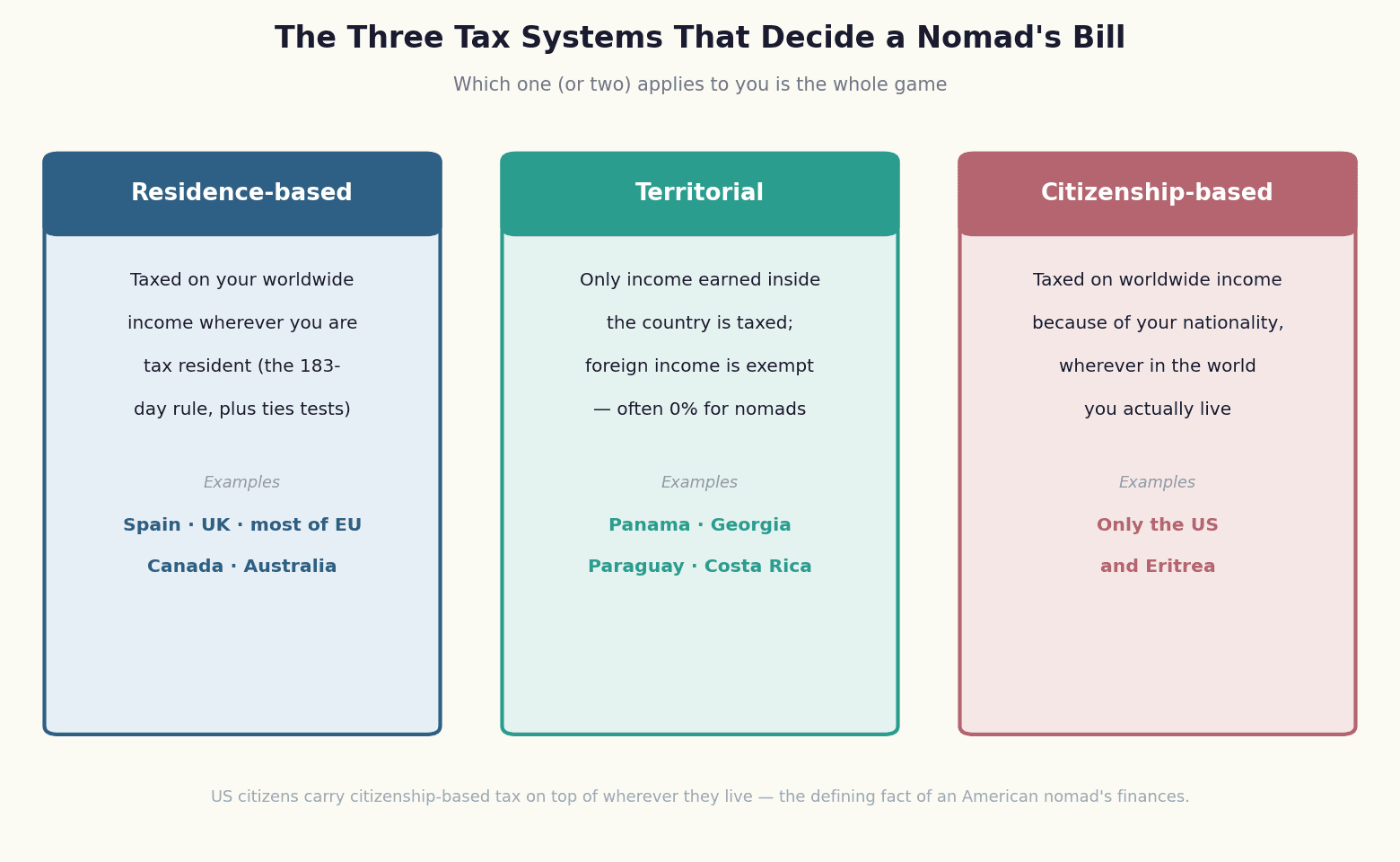
That last point is the defining fact of an American nomad’s financial life: moving abroad does not end your US tax obligations. You can manage them, but you cannot escape them by changing your location.
The American Reality: Filing Forever, but Often Paying Little
US citizens and green card holders must file a US return on worldwide income every year, regardless of residence. The good news is that the tax code provides powerful tools to bring the actual bill close to zero for many remote workers.
The Foreign Earned Income Exclusion (FEIE)
The FEIE lets qualifying Americans exclude a large slice of foreign earned income from US federal income tax. The exclusion is adjusted annually for inflation. The IRS set it at $132,900 per qualifying person for the 2026 tax year, up from $130,000 for 2025, in Revenue Procedure 2025-32. A married couple where both work abroad and both qualify each file their own Form 2555, for a combined maximum of $265,800.
Two mechanics decide whether you get the full amount. If you only qualify for part of the year, the cap is prorated by qualifying days rather than granted in full. And under the stacking rule the excluded income still sets your starting point on the rate table, so income above the exclusion is taxed at the rate it would have attracted had the exclusion not applied, not at the bottom bracket. Note also that revoking the election bars you from claiming it again for five years without IRS consent, which is why it should not be switched on and off opportunistically.
To claim it on Form 2555, you must have a foreign tax home and pass one of two tests: the Physical Presence Test (330 full days outside the US in any 12-month period) or the Bona Fide Residence Test (genuine residence in a foreign country for a full tax year). The 12-month window for the Physical Presence Test does not have to match the calendar year, which gives travellers flexibility to capture their highest-earning months.
There is also a separate Foreign Housing Exclusion for high housing costs, layered on top of the FEIE.
The Catch Every Freelancer Misses
The FEIE reduces income tax, but it does not reduce US self-employment tax, the 15.3% covering Social Security and Medicare. A self-employed American can zero out their income tax through the FEIE and still owe self-employment tax on their full net earnings. A totalization agreement between the US and the host country can change this result. Spain has had one with the United States since 1988, which is precisely why the interaction matters for Americans settling here. Note the direction of travel, because it is the opposite of what most guidance implies: a self-employed American actually resident in Spain generally contributes to the Spanish system and obtains a certificate from the Tesorería General de la Seguridad Social to prove exemption from US self-employment tax, rather than obtaining a certificate from the SSA to stay in the American system. That route is for employees posted temporarily by a US employer. Our guide to how totalization of social security contributions works explains the mechanics.
The Foreign Tax Credit (FTC)
If you live in a higher-tax country, the FTC is often the smarter choice. It gives a dollar-for-dollar credit for income tax paid abroad, and unlike the FEIE it can apply to passive income such as dividends and interest. Many high earners combine the two carefully, applying the FEIE first, then the FTC on income above the exclusion limit. You cannot use both on the same dollar of income.
The practical result for a remote worker earning well above the exclusion in a higher-tax European country is often a US bill at or near zero, with the real tax cost being what the host country charges. That is why the host country’s regime, not the US one, usually decides the outcome.
The British Reality: Leaving the UK Tax Net Properly
The UK taxes residents on worldwide income, so the key question for British nomads is whether you have actually broken UK tax residency. That is determined by the Statutory Residence Test, set out in HMRC’s RDR3 guidance. It runs in a fixed order: the automatic overseas tests first, then the automatic UK tests, then the sufficient ties test, which weighs days in Britain against connecting factors like available accommodation, work and family. Three things about it catch nomads out. Spend 183 days or more in the UK and you are resident full stop, with no further test to consider. Residence applies to the entire tax year rather than pro rata, so you are either in or out for all of it, subject to split-year treatment on arrival or departure. And a deeming rule can increase your counted days beyond those you actually spent there, so a day count that looks safe on a calendar may not be.
The UK also abolished its domicile-based non-dom system on 6 April 2025, replacing it with the Foreign Income and Gains (FIG) regime. This is widely misunderstood in nomad circles, so be clear about which direction it runs: FIG relieves foreign income and gains for the first four tax years of UK residence, and only for someone who was not UK resident in any of the ten preceding tax years. It is a regime for people arriving in Britain, not for people leaving it. If you are a Briton moving to Spain, FIG does nothing for you. Where it matters is on the return leg: a nomad who spends a decade abroad and then moves back can qualify, so breaking residence cleanly now has a value years later that most people never factor in. Note the trade-off if you ever claim it, since you give up the personal allowance and the capital gains annual exempt amount for each year you use it. The practical takeaway is the same as for Americans: getting the residency status right, and documenting it, is what unlocks the savings. If you are moving between the UK and Spain specifically, our guide to the US-Spain and UK-Spain double taxation treaties sets out how each category of income is allocated between the two countries.
Where Spain Fits
Spain is a residence-based system, so once you cross the 183-day line or your centre of vital interests moves here, you are taxed on worldwide income on the progressive scale. Our guide to IRPF for foreign residents covers the brackets in detail.

The exception that makes Spain competitive for remote workers is the special impatriate regime, widely known as the Beckham Law. Qualifying individuals who move to Spain to take up employment, and since the 2022 Startup Act certain founders and administrators, can elect a flat 24% on Spanish-source employment income up to €600,000, rather than the progressive scale reaching roughly 47%, and are treated broadly like non-residents for most foreign income for up to six tax years.
The conditions matter as much as the headline. You must not have been a Spanish tax resident in the preceding five years, counted in full calendar years, a threshold the Startup Act cut from ten and which now lets returning Spaniards qualify after a shorter absence. The burden of proof is yours: expect to produce tax residence certificates from the country you are leaving for each of those years. The election is made on Modelo 149 within six months of registering with Social Security, and this is where most failed claims die, because a late filing cannot be corrected and closes the door permanently. Supporting documentation must be uploaded through a separate procedure first, and the registration number that produces has to appear on the form itself.
Three further conditions catch specific profiles. Classic multi-client freelancers generally do not qualify. Company administrators are excluded where they hold more than 25% of a Spanish entity. And remote workers admitted under the Startup Act route must keep services rendered to Spanish companies below 20% of their activity. Once inside the regime you file annually on Modelo 151 rather than the ordinary Modelo 100, and if you breach a condition you must report it within one month.
For US citizens there is an added wrinkle: being treated as a non-resident for Spanish purposes can complicate the foreign-residency position their US filing relies on, so the two systems need modelling together rather than separately.
The regime also extends to wealth tax, where impatriates are taxed only on Spanish-situs assets rather than worldwide holdings, and because you are taxed as a non-resident the Modelo 720 foreign-asset declaration does not apply while the regime lasts. There is a less advertised counterpart, though, arising from the same logic: non-residents do not get the habitual-residence exemption, so an impatriate who buys a home in Spain is taxed on imputed income from it. On a €500,000 property that is roughly €10,000 of notional annual income, which can eat a visible share of the expected saving. Plan the exit too, since wealth tax, Modelo 720 and full worldwide IRPF all switch on at once when the sixth year ends. Our guide to Spain’s Wealth Tax and Solidarity Tax explains. For the visa side of the decision, see our comparison of the Entrepreneur Visa and the Digital Nomad Visa, and for Americans running a company, living in Spain with a US LLC.
A Note on Comparing Destinations
Nomad tax content ages badly, and rankings of “best tax countries” are among the least reliable material on the internet. Regimes close, thresholds move, and articles rarely get updated. Two examples worth knowing: Portugal’s NHR regime closed to new applicants on 1 January 2024, with a transitional window that has since expired, so any guide still recommending Portugal for tax-free foreign income is describing something you cannot join. Its replacement, the Tax Incentive for Scientific Research and Innovation (IFICI), is sometimes marketed as “NHR 2.0”, which is misleading: where NHR was open to almost anyone with high-value skills, plus retirees and passive investors, IFICI is restricted to defined professional categories in research, technology and higher education, and foreign pension income that NHR taxed at a flat 10% is now fully taxable. Arriving in Lisbon expecting the old deal and discovering you do not qualify leaves you on Portugal’s ordinary progressive scale. Separately, Thailand’s post-2024 remittance rules mean foreign income brought into the country may now be taxable where it previously was not.
Treat any headline rate you read anywhere, including here, as a starting point for verification rather than a fact to act on. Check the current position with the country’s own tax authority or a cross-border adviser before making a decision that depends on it.
The Mistakes That Turn “Tax-Free” Into a Bill With Penalties
The nomads who get into trouble almost always make one of these errors:
- Becoming a “tax nomad” of nowhere. Failing to establish tax residency anywhere does not mean you owe nothing. It often means your home country keeps you on its books, taxing you at full domestic rates.
- Not formally exiting the home system. Leaving accommodation available, keeping strong ties, or never deregistering can keep you tax resident where you started.
- Having no tax-residency certificate. Without official proof of where you are resident, you have nothing to defend yourself with if a tax authority comes asking.
- Assuming a digital nomad visa equals a tax break. Many visas exempt foreign income; many do not. Some, combined with a 183-day stay, trigger full local tax residency on your worldwide income. Spain’s own Digital Nomad Visa does not by itself confer the Beckham Law rate; that is a separate election with its own conditions.
- Missing the Beckham Law application window. Six months from starting your activity, and it cannot be claimed retroactively afterwards.
- Ignoring information sharing. Under FATCA and similar agreements, tax authorities increasingly match foreign bank inflows against what you report. A clear paper trail of your physical presence is essential.
A Practical Framework
If you want to optimise legally, three questions decide almost everything:
- Does my base country tax foreign-source remote income at all? Territorial systems and exemption-based nomad visas say no. Spain says yes, unless the impatriate regime applies.
- What does my move do to my home-country bill? Americans always file; the FEIE and FTC determine the result. Britons must break UK residency under the Statutory Residence Test.
- Can I prove it? Residency certificates, day-count records, and clean banking turn a good plan into a defensible one.
Get those right and the savings are substantial and entirely legal. Skip them, and the eventual reckoning tends to be expensive. If Spain is where you are heading, our overview of how to move to Spain in 2026 sets out the wider sequence.
Verified August 2026 against the IRS on the Foreign Earned Income Exclusion and the tax year 2026 inflation adjustments published in Revenue Procedure 2025-32; the US Social Security Administration on the US–Spain Totalization Agreement; HMRC’s RDR3 guidance on the Statutory Residence Test; and the Agencia Tributaria’s procedure page for Modelo 149, the election for the impatriate regime under article 93 of the IRPF law as amended by Ley 28/2022. The FEIE is re-indexed every year and the impatriate conditions are checked strictly, so confirm the current figures and your own eligibility before acting.
This article is for general informational purposes only and does not constitute legal, tax, accounting, or financial advice. Tax laws, thresholds, residency rules, and special regimes change frequently and depend on your nationality and personal circumstances; figures cited are indicative and inflation-adjusted amounts such as the FEIE change every year. Before making any decision, confirm the current rules with official sources such as the IRS, HMRC, or the Agencia Tributaria, and consult a qualified cross-border tax professional about your specific situation.