Málaga and Valencia are two of the most talked-about destinations for international property buyers in Spain right now, yet they offer almost opposite propositions. Málaga, anchored by the Costa del Sol and Marbella, is a prestige market at record-high prices. Valencia is a genuine, livable Mediterranean city that still trades at a substantial discount to its rivals while delivering some of the strongest rental yields in the country.
If you are weighing a purchase in 2026, the Málaga vs Valencia property decision comes down to what you actually want: a beachfront lifestyle and proven capital appreciation, or a culturally rich city base with more value per square metre and better income potential. This guide compares both markets across price, lifestyle, taxes, and investment fundamentals, with the honest pros and cons of each, and it uses the official statistics and the two regional tax authorities’ own published rates rather than agency estimates wherever those exist.
The Two Markets at a Glance
Both markets have been rising fast, but from very different starting points and with different ceilings. The official yardstick is the Valor Tasado de la Vivienda statistic from the Ministerio de Vivienda y Agenda Urbana, compiled from mortgage valuations. In the first quarter of 2026 it put Málaga province at €2,988 per square metre, comfortably the most expensive in Andalusia and the only one there above €2,000, against €1,898 across the Valencian Community. Both were all-time highs, and both sat above the national average of €2,315.7 in Málaga’s case and below it in Valencia’s.
Momentum differs too. Málaga posted the sharpest rise in Andalusia at 14.2% year on year, while the INE’s Índice de Precios de Vivienda recorded a 12.9% national increase over the same quarter, with resale stock up 13.5% and new build up 9.1%. Those are provincial and regional averages across the entire housing stock, so the prime addresses discussed below sit far above them. Prices move quickly and vary street by street, so verify anything you plan to act on.
In Málaga, homes in prime city neighbourhoods such as El Limonar, Cerrado de Calderón, Pedregalejo, and La Malagueta–Monte Sancha typically run from around €900,000 into the millions. Move into the province and the numbers climb sharply: Marbella and prime pockets along the Golden Mile and in Benahavís sit among the most expensive stretches in Spain. Foreign buyers make up an exceptionally high share of demand across Málaga province, one of the highest in the country.
Valencia tells a different story. The city average sits well below Málaga’s coastal figures, with the most prestigious addresses, El Pla del Remei, L’Eixample, and Ciutat Vella, commanding the premium. Annual growth has been strong, but because the base price is far lower than the Costa del Sol’s, the entry point remains substantially more accessible. Gross rental yields commonly land between roughly 4.5% and 6.5%, meaningfully above what prime coastal property typically returns.
| Factor | Málaga (Costa del Sol) | Valencia |
|---|---|---|
| Entry point | Higher; trophy coast assets | Lower; strong value per m² |
| Provincial average €/m², Q1 2026 | €2,988 — highest in Andalusia; the coast far above that | €1,898 across the Valencian Community |
| Typical gross yield | Lower in prime, strong in holiday lets | ~4.5–6.5% |
| Foreign-buyer presence | Very high across the province | High and growing |
| Resale transfer tax (ITP) | Flat 7% (Andalusia) | 9% up to €1M / 11% above (from 1 June 2026) |
| Stamp duty (AJD, new build) | Among the lower rates | 1.4% (from 1 June 2026) |
| Vibe | Beach-resort prestige | Year-round livable city |
Málaga: The Pros
Prestige and lifestyle. Málaga province is one of southern Europe’s best-known destinations. Between Marbella’s marinas, championship golf, beach clubs, and a growing cluster of branded residences, it offers a lifestyle and a brand that few markets in Spain can match. For buyers who want a recognizable address, this is the headline draw.

A mature international ecosystem. English is widely spoken, there is a deep bench of international schools, private healthcare, and services, and the expat and second-home community is large and established. For an international family relocating or buying a holiday base, the soft landing is easier here than almost anywhere else in Spain.
Connectivity. Málaga–Costa del Sol Airport is a major international gateway with extensive direct connections across Europe and growing North American links, which makes the region practical for owners who fly in regularly.
A genuine economic engine. Málaga has reinvented itself as a technology and business hub, which underpins demand beyond pure tourism and supports the case for long-term appreciation.
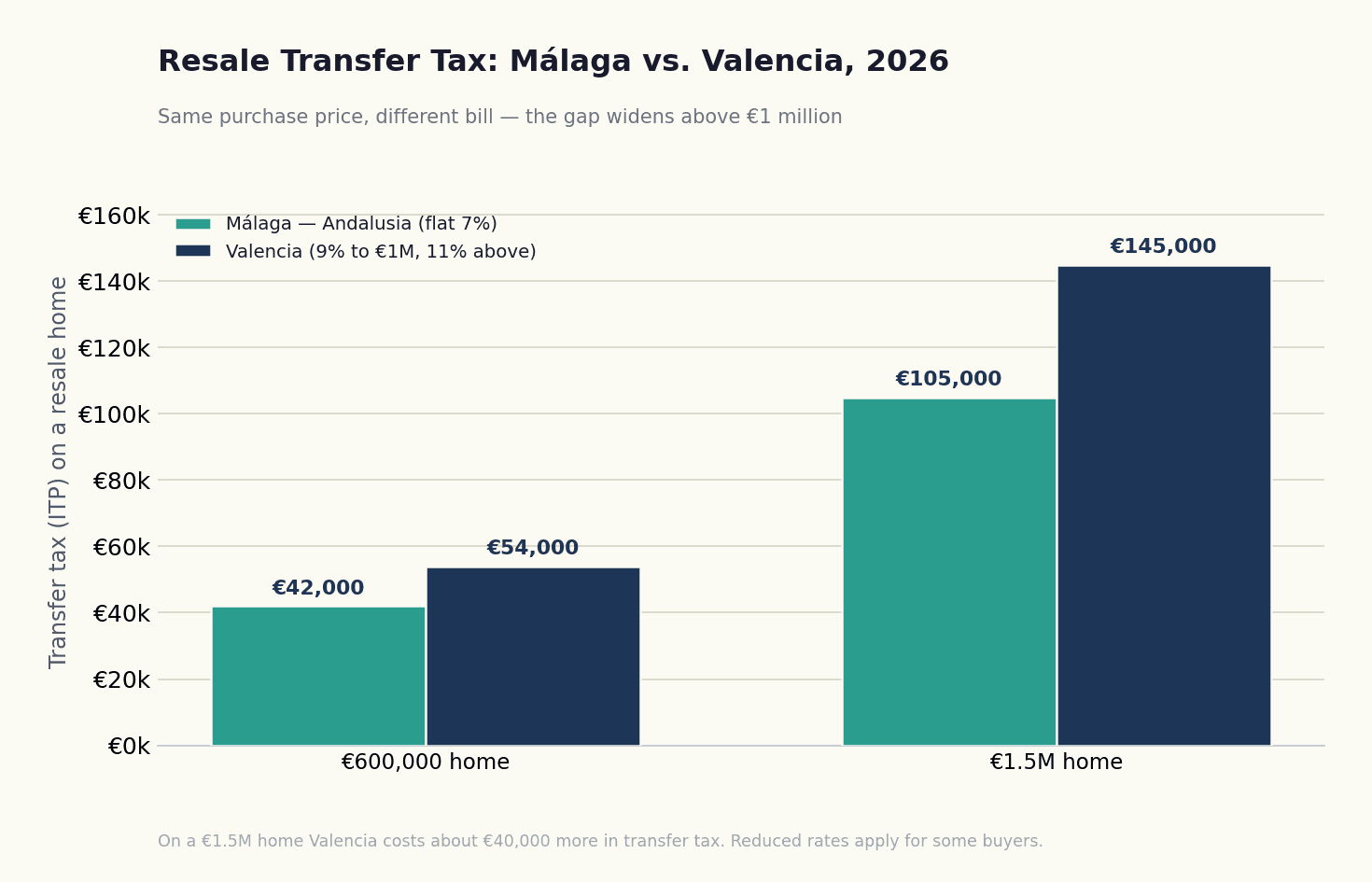
Lower transfer tax. Andalusia applies a flat 7% transfer tax (ITP) on resale homes, one of the most competitive rates in mainland Spain. On a high-value purchase, this is a meaningful saving versus several other regions, including Valencia.
Favourable wealth and inheritance treatment. Andalusia offers generous reliefs on inheritance and gift tax for direct family and has effectively neutralised its regional wealth tax, an important consideration for anyone structuring a long-term holding. Our guides to Spain’s Wealth Tax and Spain’s Gift Tax explain how the regional differences work.
Málaga: The Cons
Record prices and thin negotiation room. The flip side of a hot market is that you buy at the top of the cycle, with limited room to negotiate and stiff competition for the best homes. Buyers often have to move quickly and decisively.
Affordability and overheating concerns. Some neighbourhoods have seen extraordinary one-year jumps, and parts of the market look stretched. While analysts do not generally forecast a near-term decline, the easy double-digit gains of recent years are widely expected to moderate.
Limited quality supply. Move-in-ready, energy-efficient stock is scarce in the city itself, and many older properties carry poor energy ratings, pushing buyers toward renovation or pricier new builds further west. If you are considering a new development, our guide to buying off-plan property in Spain covers the bank guarantees and licence checks that protect your payments.
Tightening tourist-rental rules. Both the regional government and the Málaga city authorities have moved to restrict short-term tourist lets, which could cool investor demand in central areas and affect holiday-rental income strategies.
Seasonality and crowding. Parts of the Costa del Sol are intensely seasonal and tourist-heavy, which suits a holiday-home buyer but less so someone seeking an authentic, year-round city life.
Coastal legal restrictions for beachfront homes. If your Málaga search extends to first-line-of-beach property, Spain’s Ley de Costas imposes real restrictions on building, renovating, and expanding coastal homes, and can mean you are buying a concession rather than outright ownership. See our dedicated guide on buying beachfront property and the Ley de Costas before shortlisting anything directly on the sand.
Valencia: The Pros
Value for money. This is Valencia’s biggest advantage. Comparable property costs far less per square metre than on Málaga’s coast, so a given budget buys more space, or a better address, in Spain’s third-largest city. For buyers who balk at Costa del Sol pricing, Valencia is the obvious value play.

A real city, not a resort. Valencia delivers genuine year-round livability: world-class cuisine, the vast Turia gardens, a historic core, the City of Arts and Sciences, beaches within the city, and a relaxed but cosmopolitan rhythm. It is increasingly mentioned in the same breath as Madrid and Barcelona for quality of life, at a lower price.
Strong rental yields and income potential. With gross yields commonly in the 4.5%–6.5% range and long-term rental demand rising, Valencia is attractive to buyers who want their property to work financially, not just appreciate. Note that parts of the city may fall within a declared stressed rental market area, which caps what can be charged on new contracts; our guide to renting a home in Spain explains how those declarations work.
Appreciation from a lower base. Price growth has been strong, yet because entry prices are lower, there is arguably more runway than in an already record-priced coastal market.
Tight supply. A pronounced drop in available inventory in recent years supports prices and makes sharp corrections less likely in the near term.
Character architecture. Prime districts such as El Pla del Remei, L’Eixample, and Ruzafa offer elegant Modernista buildings with high ceilings, original tilework, and period detail, the kind of character stock that is hard to replicate.
Valencia: The Cons
Higher transfer tax at the top end. This is the key drawback for higher-value purchases. The Valencian Community reduced its general ITP rate from 10% to 9% with effect from 1 June 2026 under Ley 5/2025, but deliberately retained the 11% rate on the portion above €1 million. For a genuine luxury purchase, that is heavier than Andalusia’s flat 7% and it materially raises your acquisition cost.
A smaller true luxury segment. Valencia simply does not have the depth of ultra-prime and branded-residence inventory that Marbella and the Golden Mile offer. Buyers chasing trophy assets or a recognizable luxury brand will find fewer options.
Renovation is often part of the deal. Much of the prime central stock is older and needs work. Fully renovated, move-in-ready homes are in short supply and command a premium, so factor in time, budget, and project management.
Less mature international infrastructure. While Valencia’s expat scene is growing quickly, the established high-end services, international schools, and concierge ecosystem are still more developed on the Costa del Sol.
Short-term-rental restrictions. Licensing is tighter in historic and tourist-heavy zones, which can limit holiday-let strategies in exactly the central areas many buyers covet.
Flood-risk due diligence. Parts of the wider Valencia region are exposed to flooding, a point underscored by the severe floods that hit areas of the province in late 2024. It does not affect every neighbourhood, but checking the specific flood-risk classification of any property is essential before buying, and it can affect both insurance and resale.
Taxes and Buying Costs: The Numbers That Matter
Across Spain, budget roughly 10% to 13% of the purchase price for taxes and fees on top of the headline figure. The single biggest variable is the purchase tax, and this is where the two regions diverge sharply.
For resale homes you pay transfer tax (ITP), and both regions publish their own rates. The Junta de Andalucía applies a flat 7%, in force since April 2021 and consolidated in Ley 5/2021 on the region’s ceded taxes. It also sets 6% on a habitual home worth up to €150,000, and 3.5% for buyers under 35, buyers with a recognised disability of 33% or more, and members of a large family, on homes up to €250,000.
The Agència Tributària Valenciana charges 9% up to €1 million and 11% on the portion above it, both effective from 1 June 2026 under Ley 5/2025. Its protected rates work in pairs that split at €180,000: 6% or 8% for a first habitual home bought by someone under 35 on limited income, and 3% or 4% for large and single-parent families, buyers with a qualifying disability, and victims of gender violence. For new builds bought from a developer you instead pay 10% VAT (IVA) nationally plus regional stamp duty (AJD), which is lower in Andalusia than the 1.4% Valencia applies following the same reform. Check whether you qualify for a reduced rate before assuming the general one, because the gap between 9% and 3% on the same home is enormous.
Consider a €1.5 million resale purchase. In Málaga, the 7% ITP is about €105,000. In Valencia, applying 9% on the first million and 11% on the remaining €500,000 works out to roughly €145,000, around €40,000 more in tax for an equivalent price. On a €2.5 million home the gap widens further. For high-value transactions, that difference alone can tip the decision toward Andalusia. Below the million-euro threshold, however, the gap narrows considerably: the same purchase at €600,000 costs €42,000 in Andalusia against €54,000 in Valencia.
Our guide to property purchase taxes in Spain sets out the rates for every region alongside notary, registry, and gestoría costs.
Beyond the purchase, both regions levy ongoing costs to plan for: the annual IBI municipal property tax, and, for non-resident owners, an annual notional income tax filed via Modelo 210, with non-EU owners including post-Brexit Britons taxed at a higher rate than EU owners. Our guide to the annual taxes of owning property in Spain covers those recurring obligations, and our comparison of the real cost of living across Spain’s four main cities places both markets alongside Madrid and Barcelona.
One national wildcard hangs over both markets: the government has floated a substantially increased tax on property purchases by non-EU, non-resident buyers, discussed at one point as a rate as high as 100%. Proposals of this kind have been announced, debated, and revised without necessarily becoming law, so anyone in that category should confirm the current legislative status directly before committing rather than relying on any article.
Which One Should You Choose?
Choose Málaga if prestige and lifestyle top your list. It is the better fit for a beachfront or resort-style home, a buyer who values an established international community and easy connectivity, and anyone prioritizing capital appreciation in a proven market. The flat 7% transfer tax and Andalusia’s favourable wealth and inheritance treatment are real financial advantages at the high end, provided you are comfortable buying at record prices.
Choose Valencia if you want a real city to live in year-round, more value per square metre, and stronger rental income. It rewards buyers who appreciate culture, food, and architecture, who are comfortable taking on a renovation, and who want momentum from a lower price base. The main trade-off is the heavier transfer tax above €1 million and a shallower ultra-luxury market.
Due Diligence for Either City
Wherever you buy, the fundamentals are the same. Engage an independent lawyer (not just the agent), obtain your NIE, and verify the property’s valor de referencia, since tax is calculated on the higher of the price you pay or that official value. It is published by the Dirección General del Catastro and can be consulted, and certified, through the Sede Electrónica del Catastro using the property’s twenty-character cadastral reference. Do this before you agree a price, not after: if the figure you sign for comes in below the valor de referencia, the tax is assessed on the higher number regardless, unless you can positively demonstrate that market value is lower. Check for outstanding debts, that licences and permits are in order, the energy certificate, community fees, and any short-term-rental licensing limits. In Valencia, add flood-risk classification to that list; on the Málaga coast, add the coastal deslinde. Budget the full 10%–13% in costs from the outset so taxes and fees never catch you short at signing. If you do not yet have your paperwork in place, our guide to the NIE, TIE, and empadronamiento explains the order to obtain them in.
Both Málaga and Valencia are strong, internationally driven markets supported by chronic undersupply, so neither looks fragile heading deeper into 2026. The decision is less about which market is “better” and more about which lifestyle, and which cost structure, fits your goals. For the wider picture of relocating, see our overview of how to move to Spain in 2026.
Verified August 2026 against the Ministerio de Vivienda y Agenda Urbana’s Valor Tasado de la Vivienda and the INE’s Índice de Precios de Vivienda, both for the first quarter of 2026; the published ITP and AJD rates of the Junta de Andalucía and the Agència Tributària Valenciana; Ley 5/2021 of Andalusia as published in the BOE; and the Dirección General del Catastro on the valor de referencia. Property statistics are published quarterly and regional tax rates change with each budget, so confirm both with the linked sources before you commit to a purchase.
This article is for general informational purposes only and does not constitute legal, tax, financial, or investment advice. Property prices, tax rates, and regulations change frequently, vary by region and individual circumstances, and the figures cited are indicative. Before buying, verify current rates and rules with official sources and engage an independent Spanish lawyer and a qualified tax adviser regarding your specific situation.