
The appeal of retiring in Spain is easy to understand: a warm climate, excellent healthcare, a relaxed pace of life, and a cost of living that still undercuts much of northern Europe and North America. But the dream of a sun-soaked retirement comes with a serious financial reality check. The moment you become a Spanish tax resident, your worldwide income and, in many cases, your worldwide assets fall within reach of the Spanish tax authorities.
The good news is that with planning, most retirees can move their pensions and wealth to Spain efficiently and legally, and avoid the expensive surprises that catch the unprepared. This guide explains how Spain taxes foreign pensions and assets in 2026, the reporting rules you must follow, and the practical steps to transfer and protect what you have built.
The Rule That Changes Everything: Tax Residency
Everything starts with one question: are you a Spanish tax resident? You generally become one if you spend more than 183 days in Spain in a calendar year, or if your main centre of economic or vital interests is in Spain. Once that line is crossed, Spain taxes you on your worldwide income, not just income arising in Spain, subject to the double taxation treaty between Spain and the country where each income stream originates.
This is the single most important concept for any would-be retiree to internalise. The most expensive mistake is assuming that income already taxed abroad is safe from Spanish tax. Often it is not, and the detail of the relevant treaty decides exactly who taxes what.
How Spain Taxes Your Pension
Spain does not treat all pensions the same way. The treatment hinges on the type of pension and the wording of the applicable treaty, which typically distinguishes between government (public-sector) pensions and everything else.
| Pension type | Where it’s taxed | Examples |
|---|---|---|
| Government / public-sector pension | Generally only in the paying country (exemption with progression in Spain) | UK civil service, teachers, police, military; US federal/state government pensions |
| Private and state social security pension | Generally taxed in Spain as ordinary income once resident | UK private/workplace pensions, UK State Pension, US 401(k)/IRA, US Social Security |
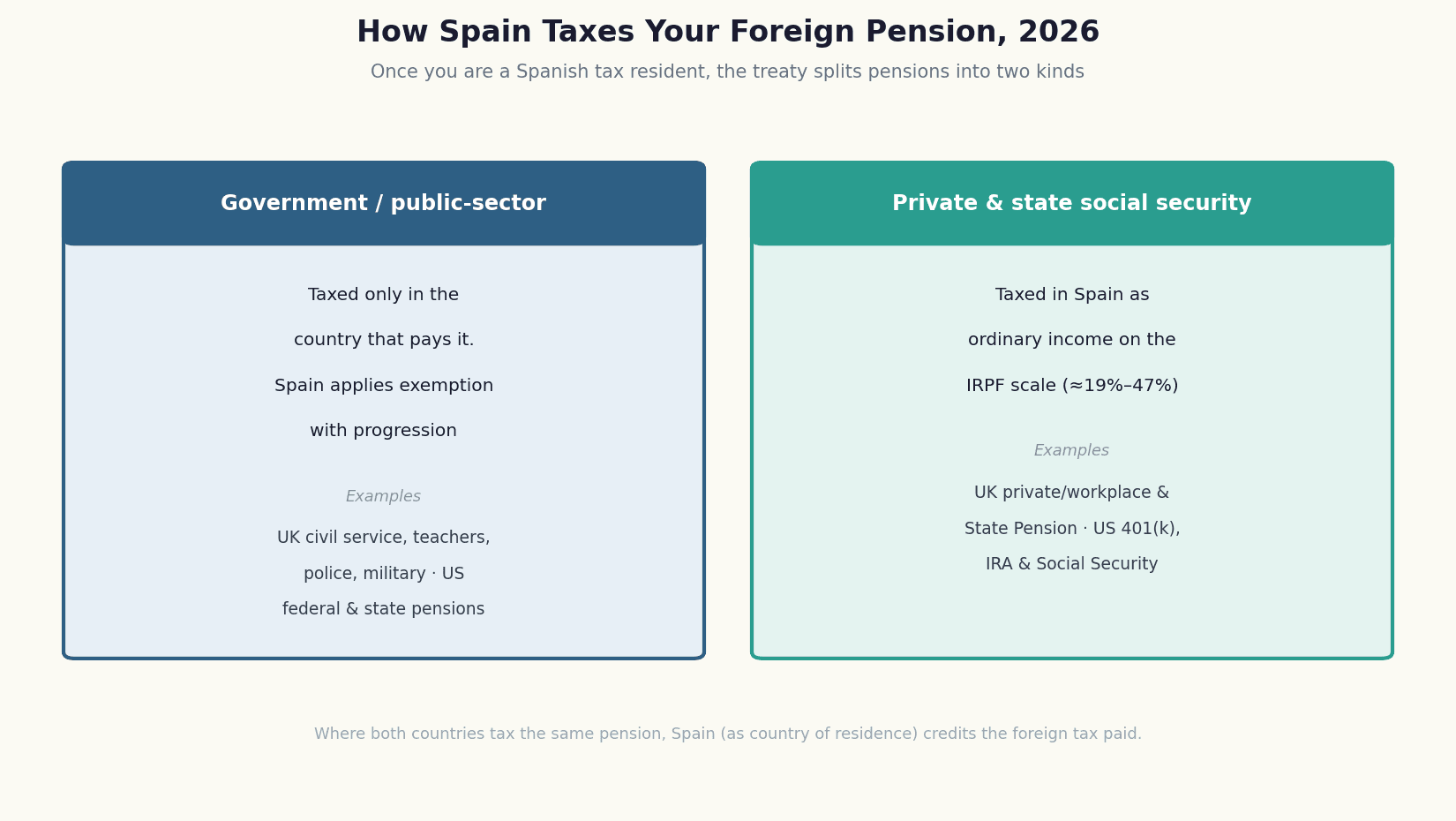
Government and public-sector pensions (for former service to the state, such as retired civil servants, teachers, police, military, and local authority staff) are generally taxable only in the country that pays them, under most treaties including those with the UK and the US. So a British or American government pension usually remains taxed at source and is not taxed again in Spain. However, Spain applies what is called “exemption with progression”: the exempt pension is still added to your other income to determine the tax rate applied to that other income.
Private pensions behave differently. Workplace and personal pensions, drawdown from schemes such as UK private pensions, and US accounts like 401(k)s and IRAs, along with state social security retirement benefits (including the UK State Pension and US Social Security), are generally taxable in Spain as ordinary income once you are resident. They are taxed under Spain’s progressive income tax (IRPF), on the general scale that runs from roughly 19% at the bottom to around 47% at the top depending on income level and your autonomous community; our guide to IRPF for foreign residents sets out the brackets and the deductions that apply. If you built up your state pension entitlement by working in more than one country, it is also worth understanding how those contributions are combined; our guide to the totalization of contributions across several countries explains how your years abroad count toward a pension, and sets out Spain’s own retirement ages.
A crucial practical step follows from this: you must notify the payer and the foreign tax authority of your Spanish residency so they stop or adjust withholding. UK residents file the relevant HMRC form (and provide a Spanish tax residence certificate) to switch taxation of private and state pensions to Spain. Where both countries do tax the same income, Spain, as the country of residence, grants a credit for the foreign tax paid so you are not taxed twice on the same euro. For the full mechanics of how this credit works for both UK and US nationals, see our dedicated guide to the US-Spain and UK-Spain double taxation treaties.
A special note for Americans. The US taxes its citizens on worldwide income no matter where they live, thanks to the treaty’s “saving clause.” That means US retirees in Spain must keep filing a US return, report worldwide income, and rely on the Foreign Tax Credit to offset Spanish tax against US tax. US Social Security and 401(k)/IRA distributions are generally treated by Spain as ordinary pension income. Note that the Foreign Earned Income Exclusion does not help here, because it applies only to earned income, not pensions. Separately, if part of your working life was spent contributing in Spain, the US–Spain Totalization Agreement, in force since 1988, lets contributions in both systems be combined to qualify for a benefit you might not otherwise reach in either country alone. That is a question of entitlement rather than taxation, and the two are easy to conflate.
A useful one-time relief. Spanish rules allow a one-time reduction on a single lump-sum withdrawal relating to pre-2007 pension contributions, but the timing window is strict and the planning must happen before you draw the money. Miss the window and the relief is gone, so flag this with a specialist before you retire, not after.
The Reporting Obligations You Cannot Ignore
Becoming resident triggers reporting duties that are separate from your income tax return.
Modelo 720 is the foreign-asset declaration. Spanish tax residents must report overseas assets when any one of three categories, bank accounts, securities and investments, and real estate, exceeds €50,000. The report covers assets held on 31 December and is filed between 1 January and 31 March of the following year. Once filed, you only need to file again if a reported category rises in value by more than €20,000, if you dispose of a declared asset, or if you acquire a new reportable asset. The European Court of Justice struck down the old, disproportionate penalty regime, but the obligation to file remains fully in force, so do not treat it as optional. Note also that cryptoassets held on foreign platforms are excluded from the 720 entirely and have their own separate declaration, Modelo 721, explained in our guide to cryptocurrency and Web3 taxation.
US citizens have parallel obligations back home, including FBAR (for foreign accounts over $10,000 at any point in the year) and FATCA Form 8938. These run independently of the Spanish filings, with their own thresholds and deadlines.
Wealth Tax and the Solidarity Tax on Large Fortunes
Spain is unusual in taxing wealth, not just income, and this is where higher-net-worth retirees need to pay close attention. We cover this in full detail, including regional comparisons, in our dedicated guide to Spain’s Wealth Tax. In short: Wealth Tax (Impuesto sobre el Patrimonio, Modelo 714) applies to residents’ worldwide net assets as of 31 December each year, with a general exemption of €700,000 plus up to €300,000 on the main home, and rates and reliefs set regionally, varying enormously; and the Solidarity Tax on Large Fortunes (ITSGF, Modelo 718), created by Ley 38/2022, is a national backstop on net wealth above €3 million (in practice somewhere between roughly €3.7 million and €4 million once allowances are applied) that closes the gap for residents of regions with generous rebates. Its harmonising intent is stated openly in the law’s own preamble: the burden on taxpayers living in communities that have wholly or partly abolished wealth tax should not differ substantially from the burden elsewhere. Because you are charged only on the portion your own community has not already taxed, choosing a low-wealth-tax region delivers much less above that threshold than retirees are often led to expect.
There is also a 60% rule cap, and it is worth stating precisely because it is frequently summarised wrongly. The combined total of your income tax (IRPF), wealth tax, and solidarity tax cannot exceed 60% of your taxable income. Where it would, the wealth tax bill is reduced to bring the total back within the cap, but that reduction is itself limited: the wealth tax cannot fall below 20% of the original assessment, so the maximum possible reduction is 80%.
This cap is the single most valuable relief for the classic retiree profile: substantial accumulated capital but a modest annual drawdown. It is claimed rather than applied automatically, which is precisely why asset-rich, income-light filers so often miss it. Recent rulings have extended versions of these protections to certain non-residents, but the mechanics are technical and worth professional review.
Inheritance and Gift Tax: Plan Early
Spain’s Inheritance and Gift Tax (ISD) is another area of dramatic regional variation. The national scale runs from about 7.65% to 34%, with multipliers based on the relationship between giver and receiver and the recipient’s existing wealth pushing effective rates higher. But autonomous communities have wide powers, and the difference is stark: in regions such as Madrid and Andalusia, close family members often pay almost nothing thanks to reductions of up to around 99%, while in other regions the full state tariff bites. Unlike in some countries, the tax is generally levied on the recipient, and there is no blanket spousal exemption. For retirees relocating substantial estates, this is a core reason to take estate-planning advice before, not after, the move; see our guides to estate planning and wills in Spain and Spain’s Gift Tax for the full picture.
One point that catches British and American retirees in particular: Spain has no inheritance tax treaty with either the UK or the US, so relief from double taxation on an estate is not automatic in the way it is for income. That is a separate question from the income tax treaties, and one to raise specifically with an adviser.
Transferring Your Pension to Spain: Proceed With Care
Many retirees ask whether they should physically move their pension pot. The answer is rarely a simple yes.
For British retirees, the position changed fundamentally in the Autumn Budget of 30 October 2024, and much of the advice still circulating predates it. Transferring a UK pension to a Qualifying Recognised Overseas Pension Scheme (QROPS) attracts a 25% Overseas Transfer Charge unless an exemption applies. Until that date, transfers to a QROPS in the EEA or Gibraltar were excluded where the member lived in the EEA. That exclusion was removed with immediate effect, leaving the “country-match” exemption as the main route remaining: you escape the charge if you are resident in the same country where the QROPS is established.
For a retiree in Spain specifically, this is close to decisive, and for a reason rarely spelled out. The requirements for an EEA-based scheme to qualify changed again on 6 April 2025, and when HMRC applied them it removed schemes in twelve countries from its published ROPS notification list, Spain among them. So the country-match exemption, which would require transferring into a Spanish scheme while resident in Spain, is not generally available here, and transferring instead to Malta or Gibraltar while living in Spain now triggers the full 25%.
The practical consequence is that for most British retirees in Spain, leaving the pension in a UK SIPP and drawing it as a Spanish resident is now the default, not the fallback. Two cautions if anyone proposes otherwise. HMRC updates that list on the 1st and 15th of each month and states plainly that appearing on it does not guarantee a scheme qualifies, nor that a transfer will be free of UK tax, and that it will still pursue the charge and interest where the requirements are not met. And the charge can be clawed back later if the circumstances that made a transfer exempt cease to apply within five years, so moving on from the country whose scheme you transferred into can retrospectively cost you a quarter of the pot.
For Americans, moving a 401(k) or IRA out of the US is generally not advisable and can create tax problems on both sides. Most US retirees keep their accounts in the US and manage the Spanish tax position through the treaty and the Foreign Tax Credit. The interaction of Roth versus traditional accounts with Spanish rules is a genuinely complex, unsettled area that demands specialist input, since Spain does not necessarily mirror the US tax treatment of a Roth.
The broad principle: think hard before transferring pension capital across borders. Often the smarter move is to optimise how and when you draw income, and where you are resident when you do, rather than relocating the underlying pot.
Moving Your Money: Currency and Banking
A practical but underrated piece of wealth protection is how you move cash between countries. Pensions paid in pounds or dollars but spent in euros expose you to exchange-rate swings every month. Specialist international money-transfer providers typically offer rates closer to the true mid-market rate than high-street banks, and some allow you to fix a rate in advance or set up regular transfers, smoothing your income. Over a long retirement, the difference between a bank’s margin and a specialist’s can add up to a meaningful sum. Never place sensitive financial details into unverified platforms, and keep a cash buffer for periods where withholding abroad is reclaimed only later through filing. See our guide to banking in Spain for foreign residents for more on account options.
Residency and Healthcare Routes for Retirees
How you enter Spain depends on your nationality. Non-EU retirees, including Americans, Canadians, and post-Brexit Britons, commonly use the Non-Lucrative Visa, which does not permit working in Spain, including remote work for a foreign employer. The financial requirement is pegged to the IPREM, Spain’s public income indicator, at 400% of the annual figure for the main applicant plus 100% for each dependent. Because the IPREM has been frozen since 2023 at €600 a month and €7,200 a year, that currently means €28,800 a year for a single applicant and €7,200 for each additional family member. Express it annually rather than monthly, as consulates assess the yearly figure and the evidence of available funds, not a monthly balance. Note also that the indicator is frozen only because successive state budgets have been rolled over; whenever a new budget passes, this threshold moves. Note that it also carries a genuine presence requirement of at least 183 days a year, which is enforced at renewal and generally makes you a Spanish tax resident; our guide to the residency routes that remain after the Golden Visa compares the options.
EU/EEA pensioners, and UK state pensioners under the post-Brexit healthcare arrangements, may be able to access Spanish public healthcare via an S1 form rather than relying solely on private cover. Confirm your healthcare route early, as it affects both your visa file and your ongoing costs. Retirees who do not qualify for the S1 and are not otherwise covered can usually buy directly into the public system through the convenio especial, but two conditions make it a poor first-year plan for a new arrival. The Ministerio de Sanidad requires proof of effective residence in Spain for a continuous year before applying, though time in the EU, the EEA, Switzerland or the UK counts towards it. And it does not cover outpatient prescription medication, so subscribers pay full pharmacy prices while someone drawing a Spanish pension pays a subsidised share. For a retiree on several daily medicines that gap is substantial and belongs in the budget. See our guide to public healthcare vs. private insurance in Spain for the eligibility rules and current cost.
A Practical Pre-Move Checklist
The single biggest lesson from retirees who get this right is that the planning happens before you become tax resident, when you still have maximum flexibility.

- Get cross-border tax advice early, ideally a year or more before the move, covering both Spain and your home country.
- Map each income stream against the relevant treaty: which pensions are taxed where, and what you must notify abroad.
- Consider your region carefully, since wealth tax, inheritance tax, and reliefs vary significantly between autonomous communities.
- Review the timing of lump sums and large disposals before you become resident, where doing so legally reduces exposure.
- Plan your estate with Spanish inheritance rules in mind, including how assets are owned and who inherits, and remember that forced heirship may apply unless you elect your national law in a Spanish will.
- Set up efficient currency transfers and understand your healthcare route.
- Prepare for the reporting calendar: Modelo 720 by 31 March, income tax in the spring–summer campaign, and wealth/solidarity tax filings where applicable.
Retiring in Spain can absolutely be done in a tax-efficient, compliant way, and a great many people have done exactly that. The country’s appeal has not changed; what matters is entering with your eyes open, structuring your affairs before you arrive, and leaning on specialists who understand both Spanish rules and the system in your home country. Do that, and Spain can be everything the brochures promise, without the fiscal surprises. For the wider sequence of the move, see our overview of how to move to Spain in 2026.
Verified August 2026 against the Agencia Tributaria’s procedure pages for Modelo 720 and Modelo 721; Ley 38/2022 creating the Solidarity Tax on Large Fortunes, as published in the Boletín Oficial del Estado; HMRC’s recognised overseas pension schemes notification list and the removal of the EEA and Gibraltar exclusion from the Overseas Transfer Charge announced on 30 October 2024; the Ministerio de Sanidad on the convenio especial; and the IPREM figures on which the Non-Lucrative Visa threshold is calculated. The IPREM has been frozen since 2023 and will move when a new state budget passes, treaty treatment depends on your nationality and pension type, and wealth and inheritance tax vary enormously by autonomous community, so confirm your own position with a cross-border adviser before relocating.
Verified August 2026 against Agencia Tributaria guidance, the consolidated legislation published by the Boletín Oficial del Estado, Ministerio de Sanidad guidance and UK government guidance on pensions and cross-border taxation. This article is for general informational purposes only and does not constitute legal, tax, financial, or investment advice. Tax laws, thresholds, treaty provisions, and regional rules change frequently and depend heavily on your nationality, residency status, and individual circumstances. The figures cited are indicative and may change. Before relocating, transferring pensions, or restructuring assets, consult a qualified cross-border tax adviser and, where relevant, an independent financial adviser and a Spanish lawyer regarding your specific situation.