
Modelo 720 has a reputation among foreign residents in Spain that is roughly half deserved. For a decade it carried a penalty regime so severe that the European Court of Justice struck it down, and the fear from that period has outlived the rules that caused it. What remains is an ordinary informative declaration that costs nothing to file, changes nothing about what you pay, and takes an afternoon to get right — but which still catches people out because the €50,000 threshold does not work the way almost everyone assumes.
Since 2024 there is a second form for cryptocurrency, Modelo 721, and the two are entirely independent. This guide covers who must file each, how the thresholds are actually measured, what happens if you have been ignoring the obligation, and the specific mistakes that generate penalties.
What Modelo 720 is
It is a purely informative declaration. It liquidates no tax and generates no payment. Its function is to tell the Agencia Tributaria what assets you hold outside Spain, so that the figures can be cross-checked against your income tax return and your wealth tax position.
You are potentially in scope if you are a Spanish tax resident, which for most people means spending more than 183 days a year in Spain. Nationality is irrelevant. A Spaniard who has never left is as caught by it as an American who arrived last year, and if you moved to Spain on a residence permit that requires you to live here, you almost certainly became a tax resident by design — a point we set out in our guide to the Non-Lucrative Visa.
The three blocks, and the threshold nobody reads correctly
The form covers three separate reporting obligations, and this is the structural point that everything else depends on.
| Block | What it covers |
|---|---|
| Block 1 | Accounts held with financial institutions abroad: current accounts, savings accounts, fixed-term deposits, whether you are the holder, a beneficial owner, or merely an authorised signatory. |
| Block 2 | Securities, rights, life insurance policies and annuities deposited, managed or obtained abroad: shares, funds, ETFs, bonds, and holdings in foreign companies. |
| Block 3 | Real estate and rights over real estate situated abroad, including part-shares, usufructs and timeshares. |
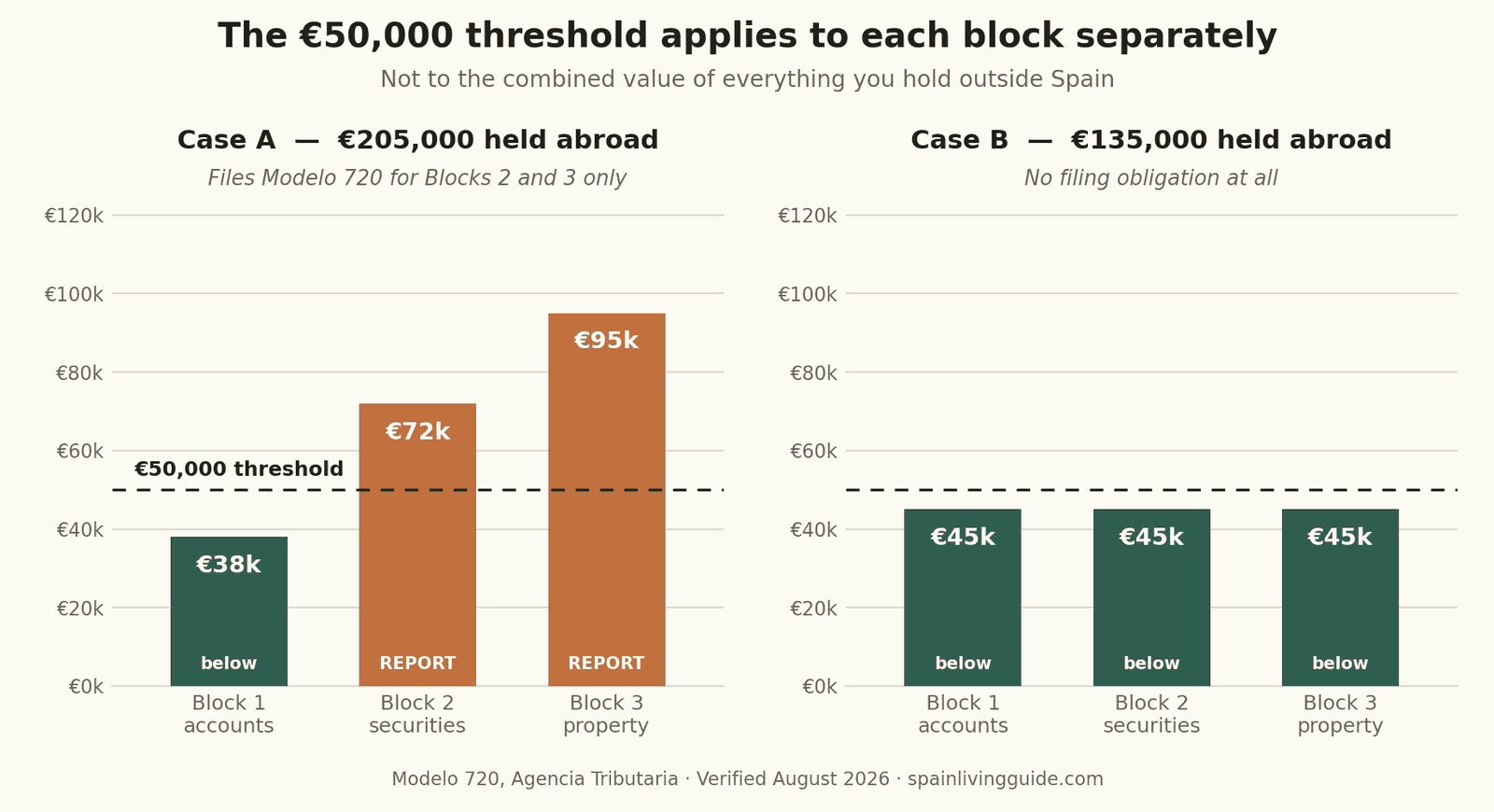
The €50,000 threshold applies to each block independently, not to the total. Someone holding €38,000 in a foreign bank account, €72,000 in an investment platform and a €95,000 flat abroad has €205,000 outside Spain, but files only in respect of Blocks 2 and 3. Someone with €45,000 in each of the three blocks has €135,000 abroad and no obligation at all.
This is not a reading of the form; it is how the obligation is built. The three blocks are three legally separate reporting duties, set out in articles 42 bis, 42 ter and 54 bis of the General Regulation approved by Royal Decree 1065/2007, and the Agencia Tributaria applies the threshold to each of them on its own, as its guidance on how the limit that obliges you to declare is calculated sets out. The separation runs all the way through: the tax authority’s guidance on penalties confirms that an infringement is assessed independently for each of the three obligations, so a person who ignores the form while all three apply has committed three failures rather than one.
Three refinements matter. Within a block you aggregate everything: three foreign accounts of €20,000 each put you over the line for Block 1 even though no single account approaches it. And for accounts the test looks both at the balance on 31 December and at the average balance in the final quarter, so draining an account in late December does not remove the obligation. And a jointly held asset is measured at its full value, not at your share of it: a €60,000 account you hold half and half with your spouse puts you both over the line, because the test is applied to the €60,000 and not to your €30,000.
That last point is worth dwelling on, because it is where couples arriving in Spain most often get the answer wrong. The Agencia Tributaria’s guidance on shared ownership is unambiguous: the obligation arises whenever the asset itself crosses the threshold, irrespective of how many people hold it, and each holder reports the total value while stating their own percentage. Its worked example is a foreign account of €150,000 held 70/30 between a company and an individual — the individual still files, still reports €150,000, and simply records a 30% share.
Modelo 721: cryptocurrency, and the distinction that decides everything
Crypto is not reported on Modelo 720. It has its own form, Modelo 721, created by Order HFP/886/2023 of 26 July, which sits on article 42 quater of the same 2007 Regulation and was filed for the first time in 2024 in respect of the 2023 year. The threshold is again €50,000, measured on the aggregate value of your holdings at 31 December, and it is assessed entirely separately from the three blocks above.
What counts as being “abroad” is the whole question, and the answer is not where the company was founded but who holds the private keys and whether they are registered in Spain.
- Held by a custodian outside Spain — a foreign exchange holding your keys on your behalf. Reportable, if you are over the threshold.
- Held by a provider registered in Spain. Not reportable by you. Those providers file Modelo 172 and 173 themselves, so the tax authority already has the data. This is the point most English-language guides get wrong: a well-known international exchange operating under Spanish registration does not go on your 721.
- Self-custodied. If you hold the private keys yourself, in a hardware or software wallet, the holdings are not considered situated abroad and there is no Modelo 721 obligation, however large the balance.
The legal test behind those three cases is narrower than it sounds. According to the Agencia Tributaria, virtual currencies count as situated abroad when whoever safeguards your private keys is not itself obliged to file the Spanish information return on virtual currency balances. That is the whole test. It has nothing to do with the exchange’s head office, its domain name, or where you were sitting when you opened the account.
The tax authority points readers at the Banco de España’s register of entities to check whether a provider is registered here. Use it, but treat it as a partial answer: that register was closed to new entrants when the EU’s markets in crypto-assets regulation began to apply, and authorisation in Spain now comes from the CNMV instead, so a provider licensed recently will not appear on the Banco de España list at all. There is also a trap in the other direction: a firm authorised in another EU country and passported into Spain is not necessarily obliged to file the Spanish return. If the answer matters to you, the reliable question to put to your provider in writing is simply whether it files Modelo 172 for your balances, because that — and not its licence, its logo or its “.es” address — is what decides the point.
One more thing that catches people who assume crypto and Modelo 720 never meet. Euros, dollars or pounds sitting in the cash balance of a foreign exchange are not virtual currency and do not go on Modelo 721. They are a foreign account, and the Agencia Tributaria says so directly in its guidance on what counts as a virtual currency: the fiat account you hold with a foreign exchange feeds into Block 1 of Modelo 720 under article 42 bis. Someone who sold a large position in December and left the proceeds in cash on the platform can therefore have no Modelo 721 obligation at all and a Modelo 720 obligation they never considered.
None of this affects whether you owe tax on crypto gains, which is a separate matter entirely and is covered in our guide to cryptocurrency and Web3 taxation in Spain. Reporting and taxation are different obligations, and satisfying one says nothing about the other.
Modelo 720 and 721 threshold checker
Enter the value of each category at 31 December. Each one is tested on its own.
How this works
Each block of Modelo 720 has its own €50,000 threshold, tested independently. Exceeding it in one block obliges you to report that block only. Modelo 721 covers virtual currencies held by custodians outside Spain and has its own separate €50,000 threshold; self-custodied crypto and holdings with providers registered in Spain do not count towards it.
This checker looks only at the first-time filing threshold. If you have filed before, you generally file again only when a category rises by more than €20,000 above the figure in your last declaration, or when you dispose of a reported asset. Both forms are filed between 1 January and 31 March for the previous year.
Verified August 2026 against Agencia Tributaria guidance on Modelo 720 and Modelo 721. Indicative only — not tax advice. Valuation rules differ by asset type; take professional advice before filing.
When to file, and when not to file again
Both forms are filed between 1 January and 31 March in respect of the previous calendar year. Filing is online only; paper is not accepted. Where a genuine technical problem prevents submission in time, the tax authority allows four further calendar days.
The obligation is not automatically annual, which is the part that saves most people work. Once you have filed for a given block, you file again only when the aggregate value of that block has risen by more than €20,000 above the figure that determined your last declaration, or when you have cancelled, sold or otherwise ceased to hold a reported asset.
Read that sentence carefully, because the word doing the work is last. The comparison is not against last year. It is against the figures in the most recent year in which you actually filed for that block, which means small annual increases accumulate until they cross the line. The Agencia Tributaria’s own worked example on the frequency of filing makes the point: a taxpayer whose accounts rise €18,000 in one year files nothing, but when they rise a further €10,000 the year after, the cumulative €28,000 against the last declared figure triggers a fresh declaration. A portfolio drifting up by €8,000 a year is therefore not permanently exempt; it is three years away from an obligation.
For accounts there are two figures to watch rather than one, and either of them crossing €20,000 is enough: the combined balance at 31 December and the combined average balance over the final quarter. And when a filing is triggered, you report the whole block again — every account in it — not merely the part that grew.
What actually happened to the penalties
This is where the fear comes from, and the position changed materially in 2022. The original regime attached a fine of 150% of the tax due, treated undeclared foreign assets as unjustified capital gains with no time limit at all, and imposed fixed penalties that could exceed the value of the asset.
On 27 January 2022 the Court of Justice of the European Union ruled in case C-788/19, Commission v Spain, that this amounted to a disproportionate restriction on the free movement of capital, singling out both the flat-rate fines and the absence of any limitation period. Spain responded with Law 5/2022 of 9 March, in force from 11 March 2022, whose final provisions stripped the specific penalty regime out of the eighteenth additional provision of the General Tax Law and deleted the paragraphs of the personal and corporate income tax acts that made undeclared foreign assets taxable without any time limit.
What replaced it is deliberately unremarkable. The Agencia Tributaria confirms that Modelo 720 now falls under the general regime of articles 198 and 199 of the General Tax Law, developed by articles 14 and 15 of the sanctions regulation approved by Royal Decree 2063/2004 — in other words, the same rules that apply to any other informative return filed late or filed wrong without loss to the Treasury.
What has not changed is the obligation itself, and two consequences remain real. Late or incomplete filing is penalised per omitted item of data, with fixed minimums, and a voluntary late filing before the tax authority contacts you attracts a materially lower minimum than one prompted by a demand. And undeclared foreign assets can still be treated as unjustified capital gains taxed at your marginal rate, with surcharges and interest — now within the ordinary four-year limitation period rather than forever.
The practical reading is straightforward. The catastrophic scenarios that circulated on expat forums between 2013 and 2022 no longer apply. The obligation is boring, and the sensible response to a boring obligation is to comply with it rather than to hope.
The mistakes that cause problems
- Adding the blocks together. The single most common error, in both directions: people file who need not, and people fail to file because no individual asset reaches €50,000 while the block total does.
- Forgetting accounts you do not own. Being an authorised signatory on a parent’s or a company’s foreign account can bring you into Block 1, even with no beneficial interest.
- Omitting pensions and life policies. Foreign pension pots and surrender-value life insurance frequently fall into Block 2 and are routinely overlooked, particularly by British and American arrivals. Our guide to transferring and protecting international wealth and pensions covers how these are treated.
- Valuing property at the purchase price when it should be another figure, or the reverse. Valuation rules differ by asset class and are the detail most worth taking advice on.
- Assuming a joint asset is halved. Each co-owner generally reports the full value of the asset and states their percentage, rather than reporting their share — and the €50,000 threshold is applied to that full value too.
- Forgetting the spouse who is not on the paperwork. Where a couple are married under the Spanish community-of-property regime and an asset is community property but registered in one spouse’s name alone, the tax authority’s position is that both must file: the formal holder as owner with a 100% share, and the other as beneficial owner with 50%. Couples who married abroad and later moved to Spain are the ones most likely to be caught by surprise here, and the answer depends on which matrimonial property regime actually governs the asset.
- Treating the form as a tax return. It is not. Figures reported here should nonetheless reconcile with your income tax return and your wealth tax position, and inconsistencies between them are exactly what the cross-check is designed to find.
Frequently asked questions
Do I pay any tax because of Modelo 720?
No. It is informative. It may, however, reveal income or wealth that should have been declared elsewhere, which is a different problem with a different solution.
I am not sure whether I am over the threshold. Should I file anyway?
Filing when you were not obliged to carries no penalty. Failing to file when you were does. Where the position is genuinely borderline, filing is the cheaper error.
I have lived here for years and never filed. What now?
Voluntary regularisation before any contact from the tax authority is treated considerably more leniently than a filing prompted by a demand. This is a situation for a Spanish tax adviser rather than a forum, but the outcome is very unlikely to resemble the horror stories from the pre-2022 regime.
Does selling my foreign property remove the obligation?
It creates one. Ceasing to hold a previously reported asset must itself be declared, and the sale may generate a taxable gain — the mirror image of the position we describe for non-residents selling property in Spain.
Does my home country find out?
Information already flows the other way. Spain receives data on foreign-held accounts through automatic exchange agreements, which is why the tax authority frequently knows about assets before the taxpayer reports them. Which country has the right to tax what is a separate question, governed by the applicable double taxation treaty.
This article is general information, not tax or legal advice. Verified in August 2026 against the Agencia Tributaria’s published guidance on Modelo 720, which sets out the three-block structure, the way the threshold is calculated, shared ownership, filing frequency and the current penalty regime; the filing deadlines; the Modelo 720 procedure page and the Modelo 721 procedure page for the governing regulations and the filing route; the Court of Justice judgment in case C-788/19 and Law 5/2022 for the change to the penalty regime; and Order HFP/886/2023 for the virtual currency return. Thresholds and filing windows have been stable for years, but valuation rules, the list of providers registered or authorised in Spain, and the crypto regime under the EU markets in crypto-assets rules are all moving, so check the position for the year you are actually filing. Consult a Spanish tax professional before filing, and before regularising a past year.